

An HMO for senior citizens is a type of Medicare Advantage plan that covers your care through a defined network of doctors and hospitals, usually at lower monthly costs than other plan types. If you are turning 65 in Greensboro, Winston-Salem, High Point, Kernersville or elsewhere in the Triad, an HMO can be a practical way to bundle hospital, medical and often prescription coverage into one plan, as long as your doctors participate in its network.
This guide explains how these plans work, what they cost in 2026, who tends to be a good fit, and how to compare them before you enroll.
What Is an HMO for Senior Citizens?
A Medicare HMO is a Health Maintenance Organization plan sold by private insurers that replaces Original Medicare for your Part A and Part B benefits. You still have Medicare, but the plan administers it, and you receive care through the plan's network.
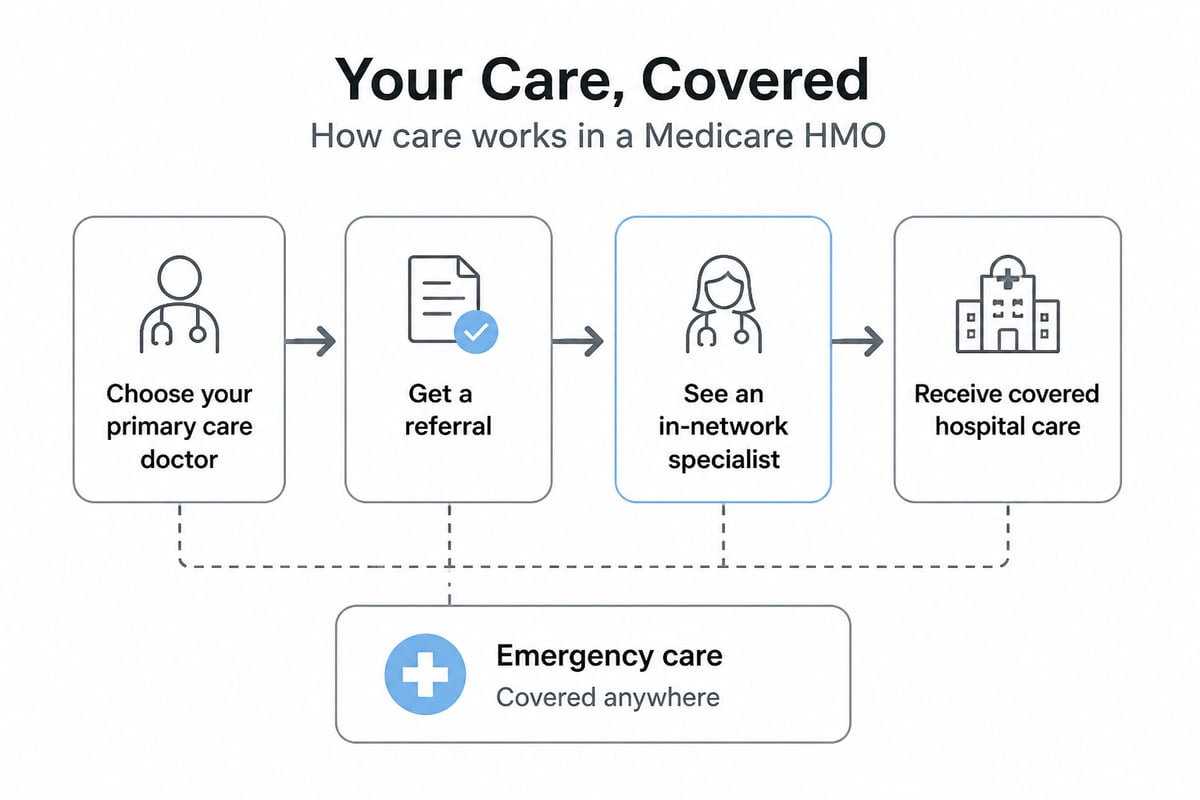
According to Medicare.gov, HMO members generally must use the plan's provider network, with exceptions for emergency care, urgent care when you are out of the service area, and temporary out-of-area dialysis. Most HMOs also require you to choose a primary care doctor and get a referral before you see a specialist.
Many HMO plans also include prescription drug coverage, and some add dental, vision and hearing benefits. Those extras vary by plan and by county, so the plan available in Guilford County may differ from one offered in Forsyth County. You can read more about how these plans are structured on our Medicare HMO plans page.
How Does a Medicare HMO Work Day to Day?
In practice, a Medicare HMO works by routing your care through a primary care physician who coordinates referrals, tests and specialist visits within the plan's network.
Here is what the process typically looks like:
- Choose a primary care doctor from the plan's directory when you enroll.
- Visit that doctor first for routine care, concerns and referrals.
- Obtain a referral when you need a specialist such as a cardiologist or orthopedist.
- Stay in network for non-emergency care, including labs, imaging and hospital stays.
- Seek emergency care anywhere, since emergencies are covered regardless of network.
Some plans also require prior authorization for certain services, such as specific procedures or imaging. Your doctor's office usually handles the request, but it can add time before treatment is approved.
HMO vs. PPO: Which Network Style Suits You?
The main difference is flexibility versus cost: an HMO limits you to its network and requires referrals, while a PPO lets you see out-of-network providers at a higher price and typically does not require referrals.
| Feature | HMO | PPO |
|---|---|---|
| Network | Must use plan network (emergencies excepted) | In-network preferred; out-of-network allowed at higher cost |
| Primary care doctor | Usually required | Usually not required |
| Specialist referrals | Usually required | Usually not required |
| Monthly premium | Often lower | Often higher |
| Out-of-network flexibility | Limited | Greater |
If you travel frequently or spend part of the year outside North Carolina, a PPO may offer more freedom. If you live in the Triad year-round and your doctors are in the network, an HMO often delivers comparable coverage for less. Our overview of HMO and PPO differences compares the two in more detail.
What Does an HMO for Senior Citizens Cost in 2026?
Costs for a Medicare HMO include a monthly premium (often low or even $0 on some plans, in addition to your Part B premium), copays or coinsurance for services, and a yearly cap on what you pay out of pocket.
The out-of-pocket cap is the most useful number to understand. KFF reports that for 2026, Medicare Advantage plans could set an in-network out-of-pocket limit no higher than $9,250, though plans may set a lower limit. The same analysis found that the average in-network limit for HMO enrollees was $4,636, compared with $5,421 across all Medicare Advantage plans.
For comparison, Original Medicare has no out-of-pocket maximum on its own. Medicare.gov lists the 2026 Part A inpatient hospital deductible at $1,736 per benefit period, and Medicare Advantage costs vary by plan. If you are weighing the two paths, our guide to supplemental insurance plans for Medicare explains how Original Medicare combined with a Medigap policy differs from an HMO.
Prescription Drug Costs
If your HMO includes Part D drug coverage, a separate annual limit applies. CMS set the 2026 Part D out-of-pocket threshold at $2,100. Your actual drug costs depend on the plan's formulary, so check that each medication you take is covered and note which pharmacy tier it falls into.
Is an HMO a Medicaid Plan?
No. A Medicare HMO is not Medicaid. Medicare is the federal health program for people 65 and older, while Medicaid is a joint federal and state program based on income and resources.
The two programs have different funding, different eligibility rules and different cards. Medicare eligibility is tied to age, disability status and work history, so a retiree with substantial savings still qualifies. Medicaid eligibility depends on income and asset limits set within each state, so qualification can change as your financial situation changes. Choosing a Medicare HMO neither enrolls you in Medicaid nor removes you from it.
Some people qualify for both and may be eligible for special plans designed for dual-eligible members, but that is a separate category with its own rules and enrollment options. Medicaid can help with costs Medicare does not, such as long-term custodial care, which is why the two programs are sometimes confused. For most people turning 65 in the Triad, Medicare eligibility is based on age and work history rather than income. You can review the basics on our pages about the age to qualify for Medicare and how to qualify for Medicare.

Who Is an HMO Best For?
An HMO tends to fit people who want predictable costs, prefer coordinated care through one primary doctor, and have providers that participate in the plan.
The cost structure is a large part of the appeal. With the 2026 average in-network out-of-pocket limit for HMO enrollees at $4,636, compared with $5,421 across all Medicare Advantage plans (KFF), an HMO often places a lower ceiling on yearly medical spending. Original Medicare, by contrast, has no out-of-pocket maximum on its own. Coordinated care also suits people who manage several conditions, since one primary doctor can track your medications, tests and specialist visits in a single place.
An HMO may be a strong match if you:
- Live in Greensboro, High Point, Winston-Salem, Kernersville or the surrounding Triad communities and plan to receive most of your care locally
- Want a lower monthly premium and a cap on yearly medical spending
- Are comfortable using a primary care doctor as the starting point for referrals
- Value extras such as dental, vision, hearing or fitness benefits bundled into the plan
It may be a weaker match if you keep a long-standing specialist outside the network, spend months each year out of state, or want to see any doctor without a referral. Snowbirds are a common example: an HMO covers emergencies anywhere and urgent care outside the service area, but routine visits in another state generally fall outside the network. If you are unsure which side of that line you fall on, we can review your doctors and travel habits with you at moserinsurancegroup.com.
What to Check Before You Enroll
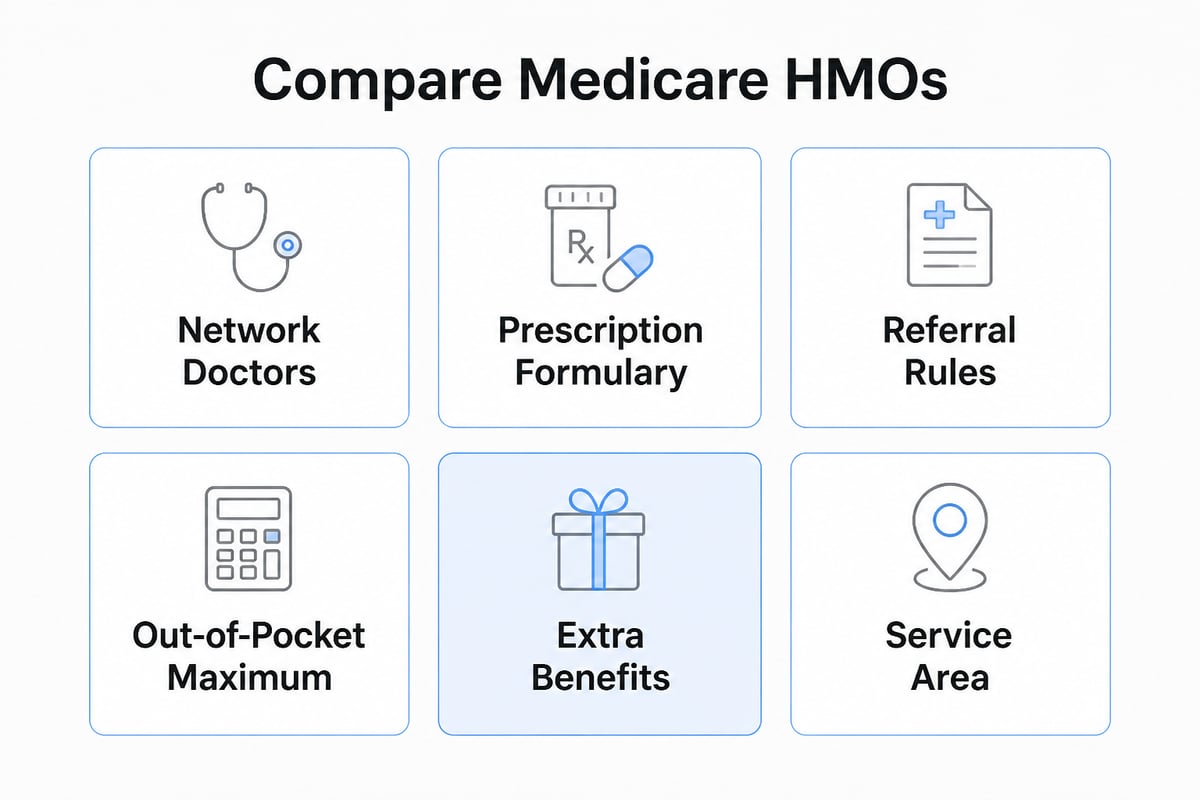
Before choosing a plan, confirm four things: your doctors and hospitals are in the network, your prescriptions are covered, the out-of-pocket maximum fits your budget, and the plan serves your county.
Use this checklist when you compare plans:
- Provider directory: Verify your primary care doctor, specialists and preferred hospital, such as those serving Guilford and Forsyth counties.
- Formulary: List every medication and confirm coverage and cost tier.
- Referral and authorization rules: Ask which services need approval first.
- Out-of-pocket maximum: Compare it against the 2026 averages above.
- Extra benefits: Dental, vision and hearing coverage differ widely.
- Plan ratings and service area: Make sure the plan covers where you live and travel.
How Plan Choices Can Change After You Enroll
One point that is easy to treat as permanent is that your plan is reviewed every year. Insurers can adjust provider networks, drug formularies, copays and benefits each January, so a plan that suited you in 2026 may look different in 2027. Reviewing your Annual Notice of Change each fall helps you catch a dropped doctor or a new prior authorization rule before the open enrollment window closes.
When Can You Enroll in a Medicare HMO?
You can first enroll during your Initial Enrollment Period, which surrounds your 65th birthday, and you can make changes during the fall open enrollment period each year.
The Initial Enrollment Period surrounds your 65th birthday and runs for several months before and after the birthday month. Enrolling early gives you the widest choice of plans and lets coverage begin the first day of your birthday month. If you wait until the final months of the window, your start date moves later, which can leave a gap if you have already stopped other coverage. Your Part A and Part B must be in place before a Medicare HMO can begin, so many people handle both steps together.
After that first window, the Medicare Advantage open enrollment period each fall is your regular opportunity to switch plans or move between an HMO and another plan type. Because networks and drug formularies change each January, a fall review is the practical moment to confirm your doctors are still included.
Timing matters because missed windows can limit your options or delay coverage. If you are approaching 65, our guides on applying for Medicare at 65 and signing up for Medicare walk through the steps and deadlines so you can plan ahead. For a timeline built around your own birthday, call us at (336) 862-1763 or email moserinsurancegroup@gmail.com.
Choosing the Right Plan With Local Guidance
Comparing HMO options across multiple carriers is difficult to do alone, because networks and benefits differ by county and change annually. Moser Insurance Group Inc works with multiple insurance carriers, so you can compare options in one place, and we stay neutral and educate you so you can make an informed decision. We tell you exactly which Medicare plan to choose, at no cost to you, and we check in during the year to review your plan and Medicare changes. We serve the Triad area, including Greensboro, Kernersville, High Point and Winston-Salem.
Our Medicare Advantage plans page outlines the coverage options we can help you review, and you can also reach us by email at moserinsurancegroup@gmail.com.
FAQ
What happens if an elderly person can't afford a nursing home?
Medicare does not cover long-term custodial nursing home care, so families sometimes turn to Medicaid, which has income and asset rules that vary by state. Planning ahead with the right coverage and a knowledgeable advisor can help you understand your options before a need arises.
What is the best health insurance for seniors over 70?
The best choice depends on your doctors, prescriptions, budget and how much flexibility you want. Many people over 70 choose between a Medicare Advantage plan such as an HMO and Original Medicare paired with a supplement, and a side-by-side comparison of your own providers and medications is the most reliable way to decide.
Is an OAP plan a PPO or HMO?
The term "OAP" is not a standard Medicare plan category, so it does not automatically indicate a PPO or an HMO. Check the plan's summary of benefits to confirm whether it uses a network with referrals (HMO) or allows out-of-network care at higher cost (PPO).
Start by writing down your doctors, your prescriptions and your preferred hospital, since those three lists decide which HMO fits you. Then let us handle the comparison across carriers: Moser Insurance Group Inc serves Greensboro, Winston-Salem, High Point, Kernersville and the wider Triad, and you can call or text (336) 862-1763 to talk through your options with no pressure, or visit moserinsurancegroup.com to get started.
Recent Comments