

An Aetna Advantage plan is a Medicare Advantage (Part C) plan sold by Aetna that replaces Original Medicare with a private plan bundling hospital, medical and usually prescription drug coverage. It is still Medicare, but a private insurer administers your benefits, so your costs, doctors and extras depend on the specific plan you choose. For people in Greensboro, Winston-Salem, High Point and Kernersville, understanding those differences before enrolling prevents expensive surprises later.
This guide explains how these plans work, which types are available, what they cover, what they cost in 2026 and how to decide whether one fits your situation.
How Does an Aetna Advantage Plan Differ From Original Medicare?
Aetna Advantage is not the same as Medicare, though it is delivered through the Medicare program. Original Medicare is run by the federal government and includes Part A (hospital) and Part B (medical). A Medicare Advantage plan is offered by a private company approved by Medicare, and it must cover everything Original Medicare covers, often with added benefits.
The main differences come down to a handful of points:
- Who administers coverage: Aetna handles claims and sets the provider network, rather than the federal government.
- Cost structure: You typically pay copayments or coinsurance and are protected by a yearly out-of-pocket maximum, which Original Medicare lacks.
- Extra benefits: Many plans add dental, vision, hearing and fitness benefits.
- Network rules: Original Medicare works with any provider that accepts Medicare nationwide. Advantage plans generally require you to use the plan's network for the lowest costs.
Enrollment trends show how common this choice has become. According to KFF, 55% of eligible Medicare beneficiaries, or 35.2 million of 64.2 million people with both Parts A and B, are enrolled in Medicare Advantage in 2026.
To remain in any Advantage plan, you must keep Part B and continue paying its premium, as Medicare.gov explains. That premium is separate from anything the plan charges.
What Types of Aetna Advantage Plans Are Available?
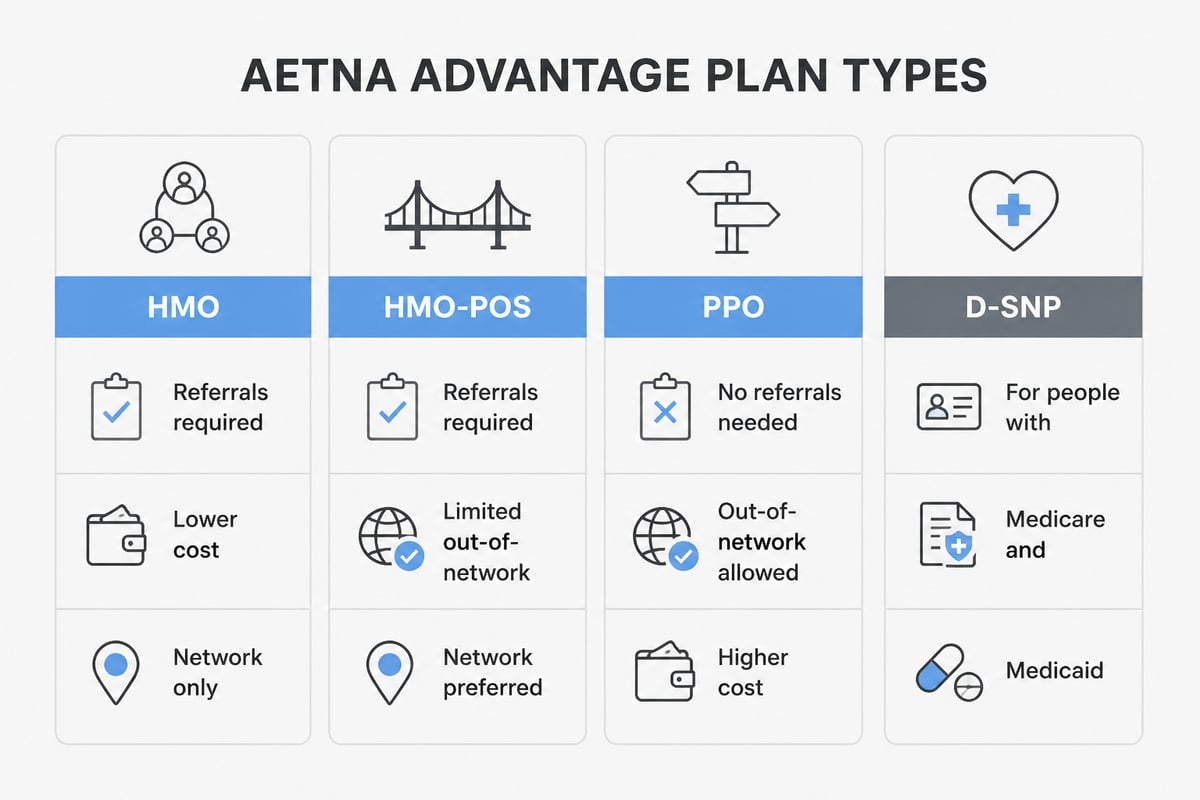
Aetna offers several plan structures, and the one you pick determines how much freedom you have in choosing doctors. Availability varies by county, so the options in Guilford County may differ from those in Forsyth or Davidson County.
HMO and HMO-POS Plans
An HMO plan generally requires you to use in-network providers and often to select a primary care physician who coordinates referrals. In return, premiums and copays tend to be lower. An HMO-POS (point of service) variant allows limited out-of-network use for certain services, usually at a higher cost.
PPO Plans
A PPO offers more flexibility. You can see in-network or out-of-network providers without referrals, though you pay less inside the network. If you want to keep a specialist who may not be in a narrow HMO network, a PPO is often the better fit. You can read more about how these work in our overview of Medicare Advantage PPO plans.
D-SNP Plans
Dual-eligible Special Needs Plans (D-SNPs) are designed for people who qualify for both Medicare and Medicaid. They coordinate benefits between the two programs and may reduce or eliminate cost sharing. Eligibility rules apply, so confirm whether you qualify before comparing these plans.
What Does an Aetna Advantage Plan Cover?
Every Aetna Advantage plan covers the hospital and medical services Original Medicare covers, and most add extras on top. Aetna's own overview of Medicare Advantage features notes that plans commonly include medical and prescription coverage, cost limits and possible dental, vision and fitness benefits, with specifics depending on the plan.
For 2026, Aetna states that its plans include dental, eyewear and hearing benefits, with $0 routine hearing and eye exams in network, though benefits and availability vary by plan, according to Aetna. Aetna also says its 2026 plans include an annual Healthy Home Visit from a licensed clinician at no additional cost.
Typical coverage categories include:
- Hospital care: inpatient stays, skilled nursing facility care and hospice.
- Medical services: doctor visits, specialists, outpatient care, lab work and preventive screenings.
- Prescription drugs: most plans bundle Part D coverage, which matters because standalone drug plans are an additional enrollment step.
- Supplemental benefits: dental, vision, hearing, fitness programs and sometimes over-the-counter allowances.
Benefit details change each plan year, so read the Evidence of Coverage document for the exact plan rather than relying on general descriptions.
How Much Does an Aetna Advantage Plan Cost in 2026?
Many Aetna Advantage plans carry a $0 monthly plan premium, but your total cost includes several other components. Aetna says many of its Medicare Advantage plans carry a $0 monthly plan premium in 2026, though members must still pay the Medicare Part B premium, per Aetna.
Medicare.gov cautions that premiums and other costs vary by plan and can change each year. A $0 premium does not mean $0 in care costs, so compare the full picture:
| Cost component | What to check |
|---|---|
| Monthly plan premium | Often $0, but varies by plan |
| Part B premium | Paid separately to Medicare in addition to any plan premium |
| Deductible | Medical and drug deductibles may differ |
| Copays and coinsurance | Primary care, specialists, emergency and hospital stays |
| Out-of-pocket maximum | The yearly limit on covered in-network medical costs |
| Drug costs | Tier placement, pharmacy choice and deductible |
For drug costs specifically, Aetna reports a $2,100 annual out-of-pocket maximum for covered prescription drugs in 2026. That cap can be especially meaningful for retirees on expensive medications.
Which Doctors and Hospitals Will You Be Able to See?
Network participation is the most important practical question, and it can change from year to year. Doctors and health systems periodically renegotiate contracts with insurers, and some choose to leave a network or stop accepting a particular plan. Confirming that your providers are in network before you enroll, and again each fall, protects you from losing access to a doctor you rely on.
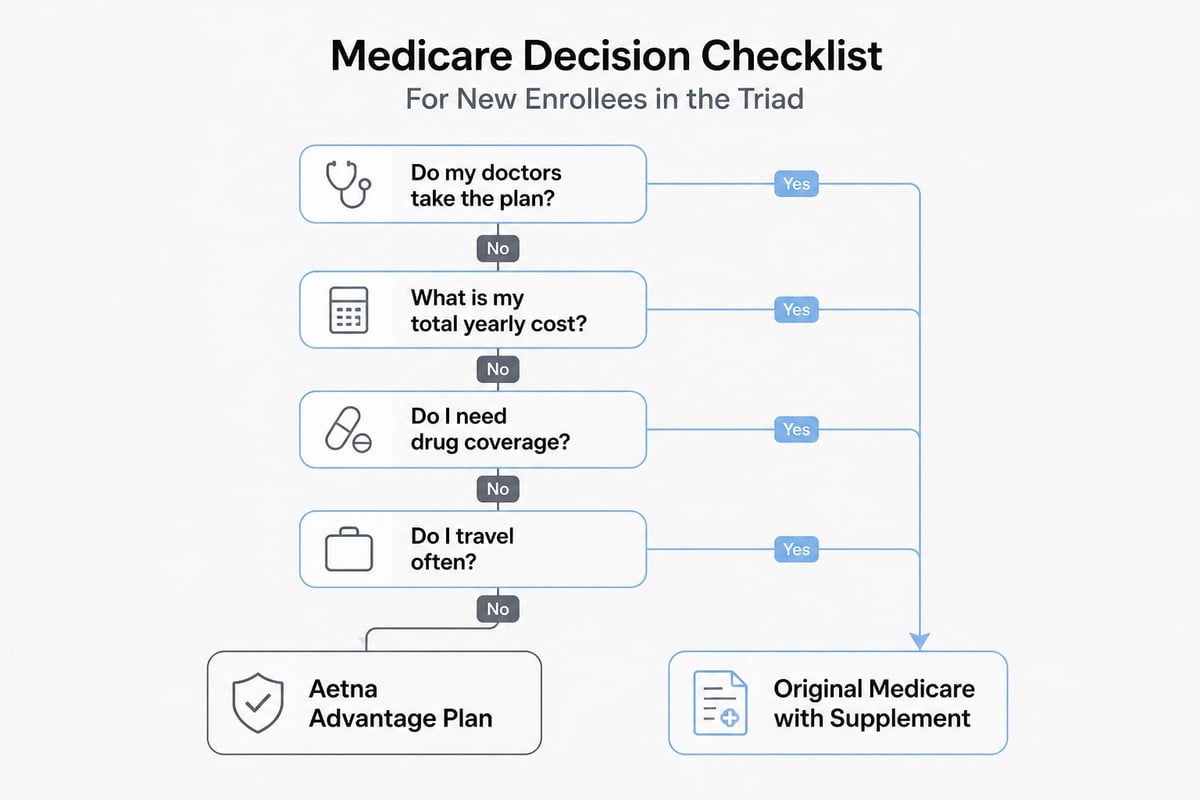
Before choosing a plan, run through this short checklist:
- Verify your primary care doctor and every specialist you see regularly.
- Confirm your preferred hospital in the Triad is in network for the exact plan, not just for Aetna generally.
- Check that your pharmacy is preferred and that each prescription appears on the plan's formulary.
- Ask whether referrals or prior authorizations are required for services you use often.
If you want to see how Aetna's HMO networks are structured, our page on Aetna HMO providers covers what to look for.
Who Is Eligible, and When Can You Enroll?
You qualify for an Aetna Advantage plan if you are enrolled in Medicare Parts A and B, live in the plan's service area and meet any special requirements for plans such as D-SNPs. Most people first enroll around age 65.
Key enrollment windows include:
- Initial Enrollment Period: a seven-month window around your 65th birthday.
- Annual Enrollment Period: October 15 through December 7 each year, when anyone can switch plans.
- Medicare Advantage Open Enrollment: January 1 through March 31, for people already in an Advantage plan to switch to another plan or return to Original Medicare.
- Special Enrollment Periods: triggered by events such as moving out of your plan's service area or losing other coverage.
For North Carolina residents, our guide to navigating Medicare Advantage open enrollment in North Carolina walks through timing and common mistakes.

Is an Aetna Advantage Plan Right for You?
An Aetna Advantage plan fits best when predictable costs, bundled benefits and a defined network matter more to you than unrestricted provider choice. It suits people who want drug coverage, dental and vision in one plan, who are comfortable with network rules and who value an annual out-of-pocket limit.
It may be a weaker fit if you travel extensively, see out-of-network specialists regularly or prefer to pair Original Medicare with a Medigap policy for broader access. Comparing the two paths is worthwhile, and our explanation of Medicare Supplement versus Advantage plans lays out the tradeoffs.
Choice also varies by market. KFF reports that the average beneficiary can choose from 32 Medicare Advantage prescription-drug plans in 2026, two fewer than in 2025, per its plan offerings analysis. Fewer choices make it more important to evaluate the ones available in your county carefully.
How Can You Compare Plans Across the Triad?
Comparing plans is easiest when you look at the same set of factors for every option in your county. Costs, networks and drug formularies differ between Greensboro, High Point, Winston-Salem and Kernersville, so a plan that works well in one area may not be the best choice in another.
A practical comparison process looks like this:
- List your doctors, hospitals and medications.
- Gather each plan's premium, deductible, copays and out-of-pocket maximum.
- Check that every provider and prescription is covered.
- Estimate your likely yearly use of care, then total the costs.
- Review supplemental benefits only after confirming the essentials.
Local resources can narrow the field quickly. We have area-specific pages for Medicare Advantage in Greensboro, Winston-Salem and High Point, plus a general guide to comparing Medicare Advantage plans.
Moser Insurance Group Inc works with multiple insurance carriers, so you can compare Aetna against other options in one place. We stay neutral, educate you and tell you exactly which Medicare plan to choose, at no cost to you. Our Medicare Advantage plans page outlines the options we can review with you across the Triad.
Where Is Aetna Advantage Available?
Aetna says it will offer Medicare Advantage Prescription Drug plans in 43 states plus Washington, D.C., in 2026, per Aetna. Within a state, availability is set county by county, and specific plans may not be offered in every ZIP code.
If you live in the Triad area, including Greensboro, Kernersville, High Point and Winston-Salem, confirm which Aetna plans are offered in your county before comparing benefits. Plan details and service areas are updated for each plan year.
What Should You Do After You Enroll?
Enrolling is the beginning of the process, not the end. Plans change their networks, formularies and costs each year, and your health needs change too. Reviewing your coverage annually helps you stay in a plan that still fits.
A few habits help:
- Read the Annual Notice of Change your plan sends each fall.
- Re-check that your doctors and prescriptions remain covered.
- Use included benefits such as the annual home visit and preventive screenings.
- Know your appeal rights if a service is denied.
Moser Insurance Group Inc can check in during the year to review your plan and Medicare changes, which helps catch problems before the next enrollment window.
FAQ
How can you talk to a real person at Aetna?
Call the member services number printed on your plan ID card, which connects you to a representative who can answer questions about benefits, claims and providers. If you are not yet a member, Aetna's sales line is listed on its website. A local independent agent can also answer plan questions and help you reach the right department.
Why are doctors dropping Aetna?
Providers sometimes leave a network because of contract disagreements, reimbursement rates or administrative requirements such as prior authorization. These decisions vary by practice and health system, and they can change between plan years. Always verify that your doctors are in network before you enroll and again during open enrollment.
Which state has the best Medicare Advantage plans?
There is no single best state, because plan quality, premiums and benefits vary widely by county and by carrier. The better question is which plans in your own county fit your doctors, drugs and budget. For North Carolina residents, comparing the plans available in your specific area is the most reliable approach.
Start by writing down your doctors, hospitals and prescriptions, then confirm which Aetna Advantage plans are offered in your county before the next enrollment window. Moser Insurance Group Inc serves the Triad, including Greensboro, Kernersville, High Point and Winston-Salem, and can walk you through your options without pressure. You can email moserinsurancegroup@gmail.com, visit moserinsurancegroup.com, or call or text (336) 862-1763 now to talk with a Medicare specialist about the plan that fits you.
Recent Comments