

A million dollar life insurance policy pays your beneficiaries a $1,000,000 death benefit, generally income-tax-free, if you pass away while the policy is active. For a healthy adult, a 20-year term version often costs far less than most people expect, while permanent versions that build cash value cost considerably more. This guide explains how the coverage works, what drives the price, and how to decide whether $1 million is the right amount for your family or business in Greensboro, Winston-Salem, High Point, Kernersville and the wider Triad area.
How Does a Million Dollar Life Insurance Policy Work?
A $1 million policy is a contract in which you pay premiums and the insurer agrees to pay a $1,000,000 death benefit to the people you name as beneficiaries. The face amount is what matters: whether you buy term, whole life or universal life, the payout is the same number. What changes is how long the coverage lasts, how premiums behave, and whether the policy builds cash value.
Beneficiaries typically file a claim with a certified death certificate, and the insurer pays the benefit in a lump sum or through another settlement option. Because the benefit is designed to replace lost income and cover obligations, most families use it for:
- Mortgage payoff and other debts
- Replacing the paycheck of a primary earner for many years
- College costs for children
- Final expenses and estate settlement costs
The size of the benefit is not what makes it complicated. The underwriting, the policy type and the term length are where decisions are made.
What Are the Types of Life Insurance for a $1 Million Benefit?
You can buy $1 million of coverage as term life, whole life, universal life or variable life. The National Association of Insurance Commissioners (NAIC) explains that term life covers a specified period and generally offers lower-cost protection for that period, but it typically does not build cash value. The NAIC also notes that whole life, universal life and variable life are cash-value policies, which can include savings or investment features.
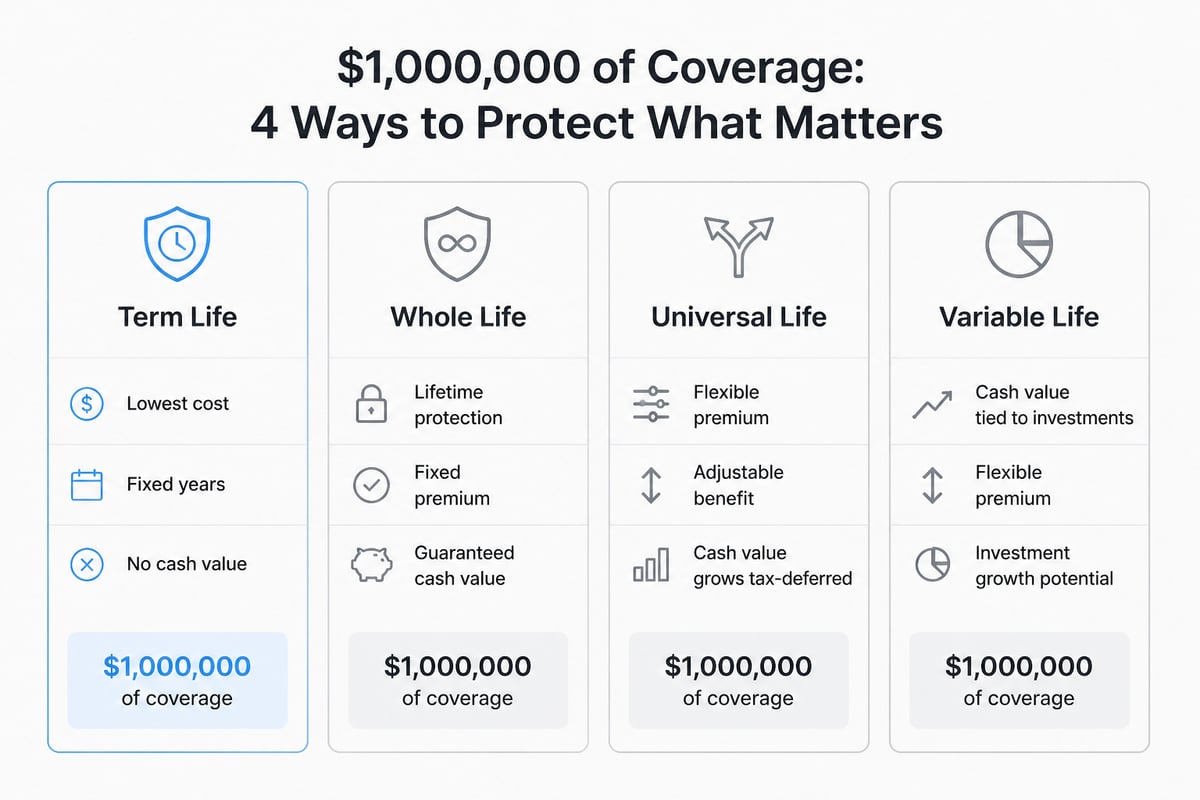
| Policy type | Coverage length | Cash value | Relative cost for $1M |
|---|---|---|---|
| Term life | 10, 20 or 30 years | None | Lowest |
| Whole life | Lifetime | Guaranteed growth | Highest |
| Universal life | Lifetime (if funded) | Flexible, interest-based | Moderate to high |
| Variable life | Lifetime (if funded) | Invested, can fluctuate | High, with market risk |
For most working families, term coverage delivers the largest benefit per premium dollar during the years when financial responsibilities peak. Permanent policies make more sense for estate planning, business succession or lifelong dependents. If you want a deeper walkthrough, Moser Insurance Group's overview of the types of life insurance and how to choose the right policy covers each option in plain language.
How Much Does a Million Dollar Life Insurance Policy Cost?
A 1 million dollar life insurance policy can cost far less per month than many people expect for a healthy younger adult on a 20-year term, while whole life for the same benefit costs considerably more. Exact premiums depend on your age, health, tobacco use, term length and the carrier, so any figure below is a general range rather than a quote.
The cost gap between term and permanent coverage is large. A person in their 30s in good health may see a term premium that is modest for the coverage, while a $1 million whole life policy for the same person typically costs considerably more per month. Moser Insurance Group publishes a closer look at what a $1 million whole life policy costs if you are weighing the permanent route.
Many people assume the price is out of reach. According to LIMRA’s 2024 Insurance Barometer Study, most Americans overestimated the cost of a basic term life insurance policy. That misperception keeps many households underinsured.
What Drives Your Premium
Insurers price a million dollar life insurance policy by estimating how likely a claim is during the term. The main factors are:
- Age at purchase. Each year you wait raises the rate, and the increase accelerates after 50.
- Health and medical history. Blood pressure, cholesterol, weight, diabetes and family history all matter at this coverage level.
- Tobacco and nicotine use. Smokers often pay two to four times the non-smoker rate.
- Term length. A 30-year term costs more than a 10-year term because the insurer carries the risk longer.
- Occupation and lifestyle. Hazardous work, aviation or high-risk hobbies can raise rates.
- Gender. Women typically pay less than men of the same age and health class.
Locking in a term while you are young and healthy fixes the premium for the entire term, which is why timing has such a direct effect on lifetime cost.
How Much Life Insurance Do I Need?
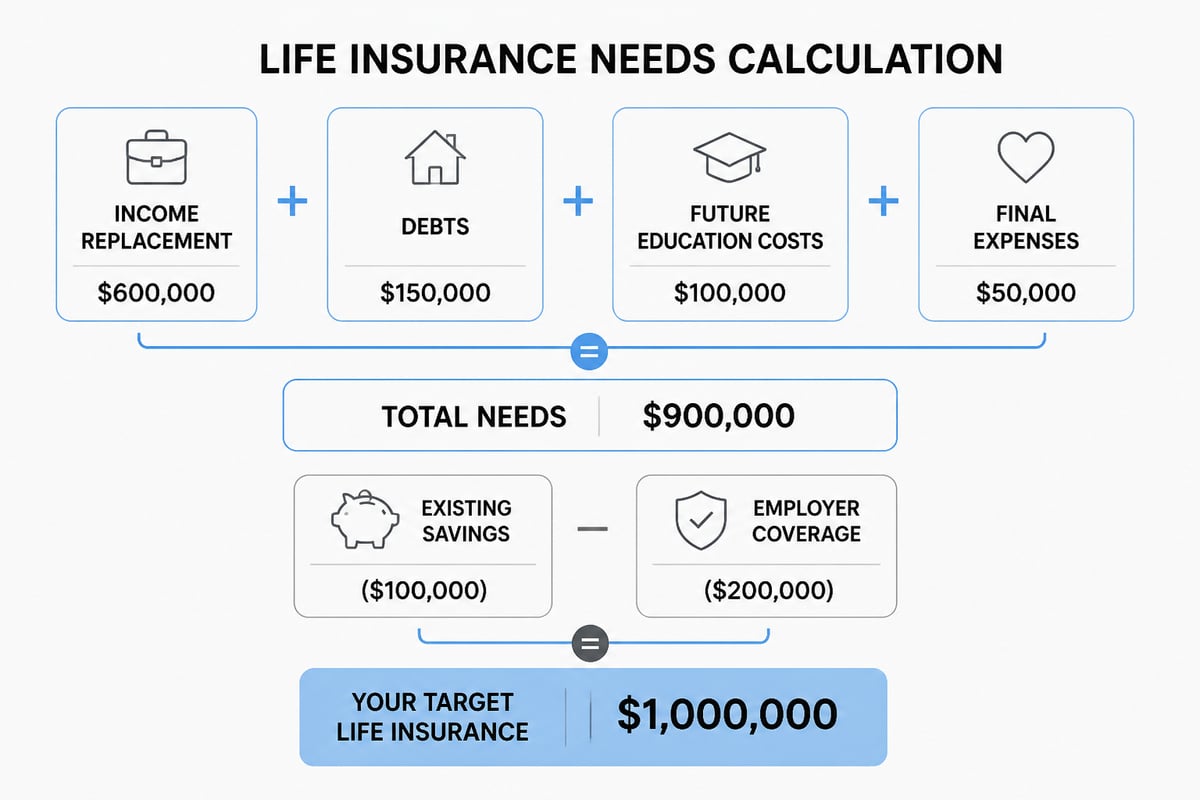
The right amount is the sum that would let your family keep its standard of living and meet its obligations if your income stopped, and for many households that lands between five and ten times annual income. A common method is to add up what your family would need and subtract what they already have.
A simple needs worksheet looks like this:
- Income replacement: Annual income multiplied by the number of years your dependents would need support
- Debts: Mortgage balance, auto loans, credit cards, business loans
- Future costs: College tuition, a spouse's retirement shortfall, care for a dependent
- Final expenses: Funeral, medical bills, estate settlement
- Minus existing resources: Savings, retirement accounts and any employer-provided life insurance
Employer group coverage is often just one or two times salary and usually ends when you leave the job, so it rarely covers the full gap. In 2024, LIMRA reported that roughly 102 million U.S. adults said they needed life insurance or needed more coverage. The need is widespread, and a $1 million face amount is a reasonable benchmark for families with a mortgage, children and one or two earners.
Who Should Consider a $1 Million Policy?
A $1 million policy fits people whose death would create a financial gap that savings and Social Security survivor benefits could not fill. In the Triad, that often describes several groups.
Families with young children and a mortgage. A primary earner in Greensboro or High Point with a 30-year mortgage and two kids can easily exceed $1 million in total obligations once income replacement and college are included.
Business owners. Owners in Kernersville, Winston-Salem and across North Carolina often use a million dollar policy to fund a buy-sell agreement, cover business debt, or protect a partner or key employee. Without it, a death can force a sale of the business at a loss.
Pre-retirees protecting a spouse. Someone in their 50s or early 60s may want to protect a spouse's income or leave a legacy. If you are in this stage, the life insurance over 60 options are worth reviewing, since pricing and underwriting change with age.
Anyone with a dependent who will need lifelong support. A permanent policy can provide for a family member with special needs long after a term policy would have expired.
Moser Insurance Group Inc helps individuals, families and business owners across the Triad compare life insurance options from multiple carriers in one place, so you can match a $1 million benefit to the situation you actually have.
Can You Have More Than One Life Insurance Policy?
Yes, you can own more than one life insurance policy, and many people layer coverage to match changing needs. Insurers look at your total coverage across all policies during underwriting, and they require that the combined amount be justified by your income and financial obligations.
Layering, sometimes called a ladder strategy, is a practical way to control cost. Instead of one 30-year, $1 million policy, you might buy:
- A $500,000 30-year term to cover the mortgage and long-term needs
- A $250,000 20-year term to cover the years children are at home
- A $250,000 10-year term to cover a business loan or short-term debt
As each policy expires, your coverage steps down with your declining obligations, and your premiums fall with it. Policies can be held with different carriers, and you must disclose existing coverage on each new application.

What Does the Application and Underwriting Process Look Like?
Applying for a $1 million policy usually takes a few weeks and involves a health questionnaire, a review of your medical records and, in many cases, a paramedical exam. At this coverage level, insurers want more documentation than they do for a small policy.
The typical sequence is:
- Quote and needs review. You confirm the amount, term and budget.
- Application. You answer questions about health, family history, finances, driving record and lifestyle.
- Medical exam. A nurse collects height, weight, blood pressure, and blood and urine samples, often at your home or office.
- Underwriting review. The insurer checks medical records, prescription history and the MIB database.
- Offer and rate class. You receive an approval at a rate class such as preferred, standard or substandard.
- Policy delivery and first premium. Coverage begins once you accept and pay.
Some carriers offer accelerated underwriting that skips the exam for healthy applicants, but large face amounts and older ages more often require full underwriting. Review the no-exam term life insurance options if you want to see how that route compares.
Are Life Insurance Benefits Taxable?
Life insurance death benefits paid to a named beneficiary are generally not subject to federal income tax. That tax treatment is a large part of what makes a $1 million policy efficient: your family receives the full amount rather than a reduced after-tax sum.
There are exceptions worth discussing with a tax or estate professional. If the estate is named as beneficiary, or if the policy is owned by the insured and the estate is large, the proceeds can count toward estate value. Cash-value growth in permanent policies is generally tax-deferred, but withdrawals and loans can have consequences if handled incorrectly. For a broader view, the NAIC’s consumer life insurance guide explains how term and cash-value policies differ in premiums, duration and cash value.
Tips for Getting the Best Rate on a $1 Million Policy
You can lower the price of a million dollar life insurance policy by controlling the factors you can influence before you apply. A few steps tend to make the biggest difference:
- Apply sooner rather than later. Premiums are based on your age at purchase, and they rise every year.
- Improve your health numbers first. Lowering blood pressure, cholesterol or weight before the exam can move you into a better rate class.
- Stop using nicotine. Many insurers reclassify you as a non-smoker after 12 months of being tobacco-free.
- Match the term to the need. Buying 30 years when 20 would do adds cost without adding value.
- Compare several carriers. Underwriting standards differ, and one insurer may rate a health condition more favorably than another.
- Pay annually if possible. Many carriers charge a fee for monthly billing.
Because carriers weigh health conditions differently, working with an independent agent who can shop multiple companies matters more than it does for a simple consumer product. Moser Insurance Group Inc works with multiple insurance carriers, stays neutral and educates you so you can make an informed decision, at no cost to you. The firm is based on 119 Google reviews and is one of the fastest growing independent insurance groups in Central North Carolina.
FAQ
How much is a 1 million dollar life insurance policy?
For a healthy non-smoker, a 20-year term policy with a $1,000,000 benefit can cost a modest monthly amount that rises with age, while whole life for the same benefit costs considerably more. Your actual rate depends on your health class, tobacco use and the carrier. A personalized quote is the only way to see your exact number.
Does a $1 million life insurance policy require a medical exam?
Often yes, because larger face amounts receive closer underwriting. Some carriers offer accelerated or no-exam options for healthy applicants, but those may come with higher premiums or lower coverage limits. Your age and medical history determine which route is available to you.
What happens to my policy if I change jobs or move?
An individually owned policy stays with you regardless of employer or address. That is a key difference from group coverage through work, which typically ends when employment does. Moving within or out of North Carolina does not cancel an in-force policy.
Your next step is to gather your mortgage balance, debts, annual income and any existing coverage, then request quotes so you can compare a $1 million term policy against permanent options with real numbers. If you want help sorting through it, Moser Insurance Group Inc serves families, retirees and business owners in Greensboro, Winston-Salem, High Point, Kernersville and across the Triad, and you can review its life insurance offerings before you talk. You can also email moserinsurancegroup@gmail.com or visit moserinsurancegroup.com, and when you are ready, Call/Text Now (336) 862-1763 to review your coverage options with a licensed agent.
Recent Comments