

The Highmark Community Blue Medicare PPO is a Medicare Advantage plan from Highmark that bundles Medicare Part A and Part B benefits, usually adds prescription drug coverage, and lets members see both in-network and out-of-network providers. Plan names, prices and service areas change each year, and Highmark's Community Blue Medicare PPO plans have been marketed mainly in Pennsylvania and nearby states, so anyone in Greensboro, Winston-Salem, High Point or Kernersville should confirm availability in their county before getting attached to any plan details.
That point matters for people turning 65 in the Triad. A plan can look ideal on paper and still be unavailable at your ZIP code. This guide explains how the PPO structure works, what the plan's benefits typically look like, what to check before enrolling, and how to compare it with the Medicare Advantage options that are offered where you live.
What Is the Highmark Community Blue Medicare PPO?
It is a Medicare Advantage (Part C) plan offered by Highmark, a Blues-affiliated insurer, built around a Preferred Provider Organization network. Medicare Advantage plans are sold by private insurers and approved by Medicare. They replace Original Medicare for your day-to-day coverage while still covering everything Parts A and B cover.
Highmark's Community Blue Medicare PPO plans appear in several tiers in some markets, often labeled with names such as Signature or Premier. Each tier carries its own premium, deductible and copay schedule. A listing for a Lancaster County, Pennsylvania version of the plan, for example, can be viewed on medicareplans.com, which shows how one county-level plan is laid out. Plans for one county do not transfer to another.
Key characteristics of this plan type:
- You must keep paying your Medicare Part B premium
- The plan covers the same services as Original Medicare, with its own cost-sharing rules
- Many versions include Part D prescription coverage, along with extras such as vision or fitness benefits
- Each plan has an annual out-of-pocket maximum for in-network care
How a Medicare PPO Works
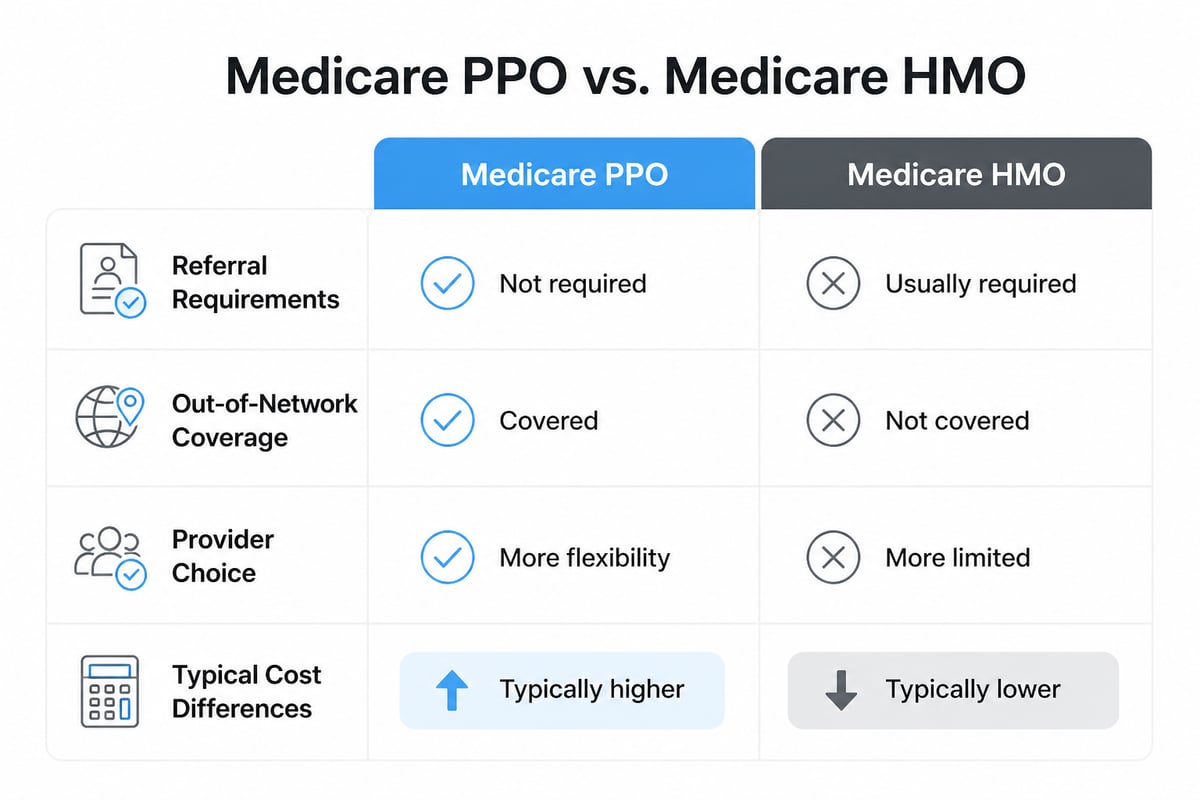
A Medicare PPO lets you see any provider who accepts the plan and Medicare, but you pay less when you stay inside the plan's network. This is the main difference from an HMO, which generally limits coverage to its network except in emergencies.
With a PPO, you typically do not need a referral to see a specialist. You can choose a cardiologist or dermatologist directly. Going out of network usually raises your copay or coinsurance, and some services may require prior authorization either way. In practice, that means a visit with an in-network specialist might carry a flat copay, while the same visit out of network could be billed as a percentage of the allowed amount. Costs for out-of-network care generally count toward a separate or combined out-of-pocket limit, so check which one your plan uses before relying on it.
For Triad residents, this flexibility has a practical side. Many people in Greensboro, High Point and Winston-Salem split their care among health systems and travel for specialists. A PPO can fit that pattern better than a plan that restricts you to a narrow network. Before a planned procedure, call the plan to confirm whether the surgeon and facility are in network and whether authorization is needed. That one call can prevent a surprise bill. If you want a deeper comparison of the two structures, Moser Insurance Group Inc. explains the differences in its article on Blue Shield HMO vs PPO.
Typical Costs and Benefits to Review
The costs on a Highmark Community Blue Medicare PPO vary by plan tier and county, so every number below is a category to check rather than a promise. Look these up in the plan's Summary of Benefits and Evidence of Coverage for the current year, 2026.
| Cost area | What to look for |
|---|---|
| Monthly premium | Many Medicare Advantage plans charge a low or $0 premium, but you still pay Part B |
| Medical deductible | Some tiers have none; others apply one to certain services |
| Primary care and specialist copays | Flat dollar amounts in network, higher out of network |
| Inpatient hospital stay | Per-day copay for an initial number of days, or coinsurance |
| Out-of-pocket maximum | Separate limits for in-network and combined in- and out-of-network care |
| Prescription drug deductible | May apply to certain drug tiers, with others exempt |
| Drug tier copays | Generic, preferred brand, non-preferred and specialty tiers differ sharply |
Beyond these, many Medicare Advantage plans add benefits that Original Medicare lacks, such as routine vision, hearing, dental and fitness memberships. Whether this plan includes each one depends on the tier. Dental, in particular, ranges from cleanings only to broader coverage with annual dollar caps. If dental matters to you, review Medicare dental plan options alongside the plan's own benefits.
Prescription Drug Coverage in the Plan
Most Community Blue Medicare PPO versions include Part D coverage, which makes them MAPD plans, but you should verify that your specific plan does. Drug coverage is where costs differ most from one person to another, so it deserves its own check.
Start with the plan's formulary, which is the list of covered drugs. Confirm that each of your medications appears, note which tier it sits in, and check for restrictions such as prior authorization or step therapy. Prior authorization means the plan must approve the drug before it pays. Step therapy means you may have to try a lower-cost drug first. Either rule can delay a fill, so ask your prescriber whether your current drugs trigger them. Then confirm that your pharmacy is in the plan's preferred network, since preferred pharmacies often carry lower copays. A drug that costs one amount at a preferred pharmacy can cost noticeably more at a standard in-network pharmacy down the street.
Part D also has an annual out-of-pocket cap under current federal rules, which limits what you can spend on covered drugs in a year. If you take expensive medications, the cap and the plan's tier structure together determine your real exposure. A person on only generics may never approach the cap, while someone on a specialty drug may reach it early in the year. For more background, see this overview of Medicare Part D plans.
Is the Plan Available in the Triad Area?
Availability is set by county, and a plan marketed in Pennsylvania is generally not sold in Guilford, Forsyth or Davidson counties. Medicare Advantage plans each have a defined service area, and you can only enroll if you live in it.
The Triad's main population centers include:
- Greensboro and the rest of Guilford County
- High Point, which spans Guilford and Davidson counties
- Winston-Salem and Kernersville in Forsyth County
To see which Medicare Advantage plans operate in your county, the CMS Medicare Advantage and Part D contract and enrollment data hub lists contracts, service areas and enrollment figures. You can also review overall participation patterns in the CMS Medicare monthly enrollment reports. These sources show which carriers are active in a region.
If the Highmark plan is not offered where you live, that is not a setback. Several Blue-branded and other PPO plans serve Central North Carolina, and the structure you liked in a Highmark plan often has a local equivalent. Moser Insurance Group Inc. covers one example on its page about Blue Cross Medicare.

Who Tends to Fit a PPO Plan
A Medicare Advantage PPO tends to suit people who value choice and are comfortable with a defined cost structure. Consider whether these statements describe you:
- You want to see specialists without referrals
- Your doctors are spread across more than one health system
- You travel part of the year and want coverage outside your home area
- You prefer predictable copays and an annual spending limit over open-ended costs
- You are comfortable with plan rules such as prior authorization
A few situations make the fit easier to judge. Someone in Kernersville who sees a primary care doctor in Forsyth County, a cardiologist in Greensboro and a dermatologist in High Point is a natural PPO candidate, because no single narrow network is likely to include all three. A retiree who spends winters in another state benefits from a plan that pays for out-of-network care, even at a higher cost share, instead of limiting coverage to emergencies. People who take several brand-name drugs may also value a plan with a stated out-of-pocket maximum for medical care, since it caps a major part of their yearly exposure.
On the other side, Original Medicare paired with a Medigap policy offers broader provider access nationwide and more predictable costs for those willing to pay a higher monthly premium. Neither route is correct for everyone. You can read about the supplement route on the page about Medicare Medigap plans.
Questions to Settle Before Enrolling
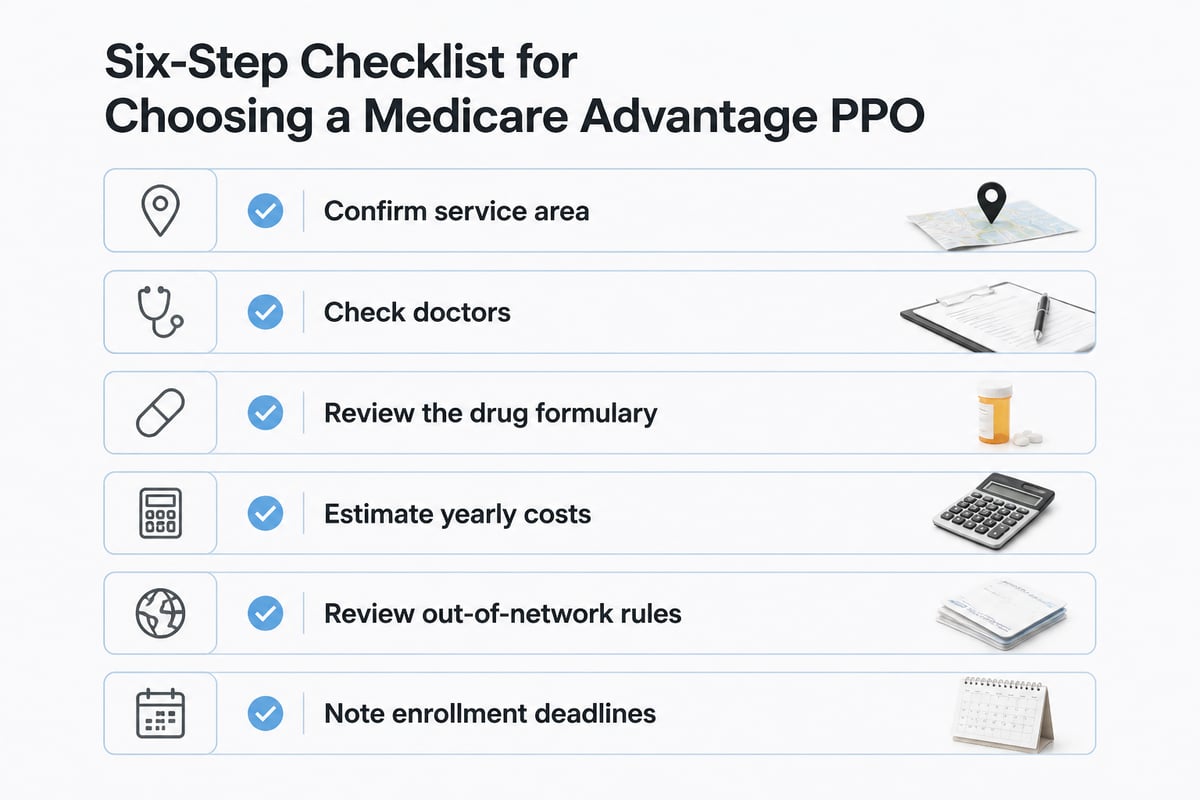
Before choosing any Medicare Advantage PPO, work through a short checklist so the decision rests on your own situation rather than a premium figure.
- Confirm your county and ZIP code against the plan's service area.
- Check each doctor and hospital you use in the plan's provider directory, and ask whether they accept it as in-network.
- Review the drug formulary for every medication, including tier and restrictions.
- Estimate a realistic year of care, adding premium, copays and the out-of-pocket maximum.
- Look at out-of-network rules if you travel or use providers outside the Triad.
- Note your enrollment window, since your Initial Enrollment Period around age 65 and the Annual Enrollment Period each fall have different rules.
That last step carries real weight. Missing an enrollment window can leave you waiting for months or facing a penalty, particularly for Part B and Part D. If you are still sorting out timing, the guide on applying for Medicare at 65 walks through the sequence.
Getting Help Comparing PPO Plans in the Triad
Comparing Medicare Advantage plans carrier by carrier is slow, and the paperwork for each one runs long. Moser Insurance Group Inc. works with multiple insurance carriers, so you can compare options in one place rather than visiting separate company sites. The agency is one of the fastest growing independent insurance groups in Central North Carolina and has Google reviews from its clients.
The guidance does not cost you anything. Moser Insurance Group Inc. helps you understand your Medicare options, stays neutral, and educates you so the final decision is yours. Clients can also reach out during the year to review their plan and any Medicare changes. If a PPO is the right structure for you, the Medicare Advantage Plans page is a good place to see the range of options the agency can review with you.
You can reach the team at 336-862-1763, by email at moserinsurancegroup@gmail.com, or through moserinsurancegroup.com. Serving Greensboro, Winston-Salem, High Point and Kernersville, Moser Insurance Group Inc. can help you weigh plans like the Highmark Community Blue Medicare PPO against what is actually available in the Triad.
Your next step is to write down your doctors, hospitals and medications, since those three lists decide whether any PPO will work for you. With them in hand, you can have a plan comparison done in one conversation rather than piecing it together alone. Moser Insurance Group Inc. serves the Triad area, including Greensboro, Kernersville, High Point and Winston-Salem, and can review your options at no cost to you, so call or text (336) 862-1763 now to get started. You can also email moserinsurancegroup@gmail.com or visit moserinsurancegroup.com whenever it suits you.
Recent Comments