

Medicare medical coverage is the federal health insurance program for people 65 and older, and for some younger people with disabilities, and it works best when you match its four parts to your doctors, prescriptions and budget. If you are turning 65 in Greensboro, Winston-Salem, High Point or Kernersville, the main decision is whether to keep Original Medicare and add a supplement, or to choose a Medicare Advantage plan that bundles your benefits. This guide explains each path, what it costs, and how to choose with confidence.
What Does Medicare Medical Coverage Include?
Medicare medical coverage is divided into parts, and each part pays for a different category of care. Understanding the split makes every later decision easier. The official Medicare.gov overview of how Medicare works explains how these pieces fit together, and our own breakdown of the 4 parts of Medicare covers the same ground in plain language.
- Part A (hospital insurance): inpatient hospital stays, skilled nursing facility care after a qualifying stay, hospice and some home health care.
- Part B (medical insurance): doctor visits, outpatient care, lab tests, durable medical equipment and preventive services.
- Part C (Medicare Advantage): a private-plan alternative that includes Parts A and B and often adds drug, dental, vision and hearing benefits.
- Part D (prescription drug coverage): outpatient prescriptions, offered through stand-alone plans or built into many Medicare Advantage plans.
Together, Parts A and B are called Original Medicare. Many people stop there and assume they are fully covered, but Original Medicare leaves gaps in cost sharing that you will want to address before you need care.
Original Medicare vs. Medicare Advantage
The core choice is between Original Medicare plus optional add-ons and a Medicare Advantage plan that replaces Original Medicare with a private plan. Both are legitimate paths, and the right one depends on how you use care and how much cost predictability you want.
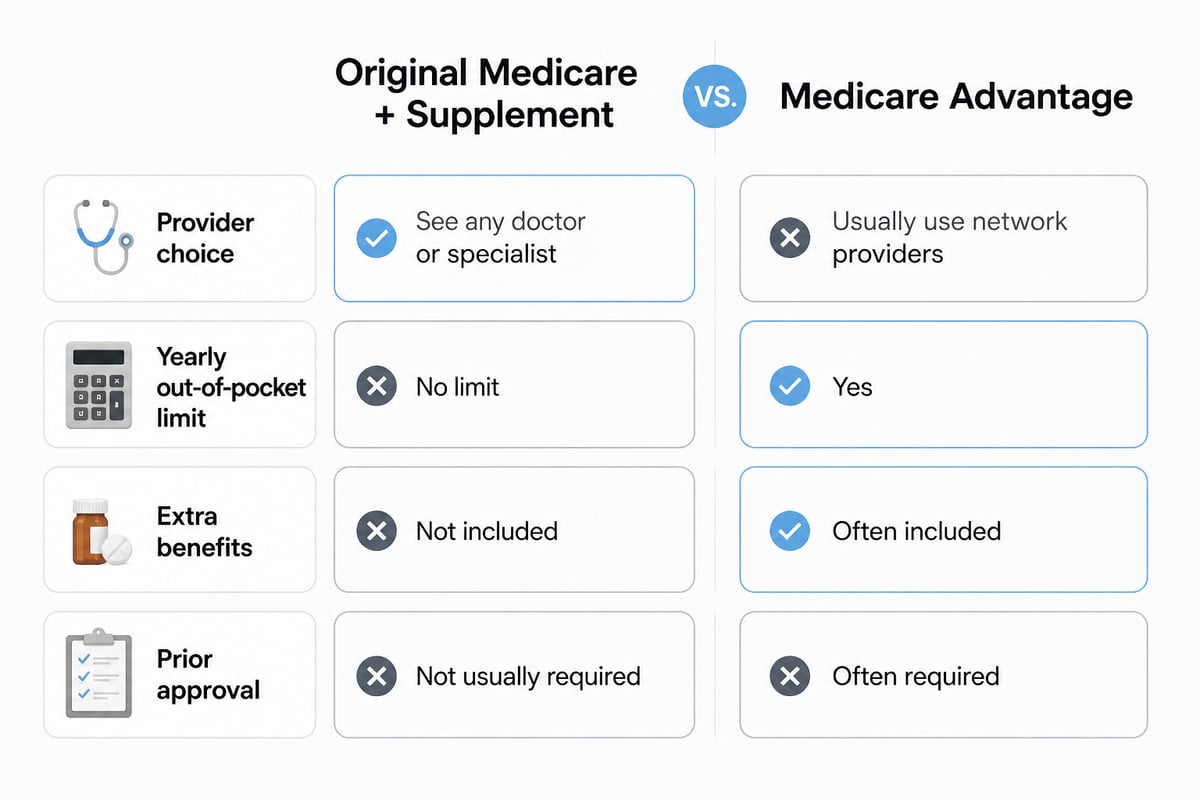
Under Original Medicare, you can use any doctor or hospital that takes Medicare. Medicare Advantage plans may require you to use a provider network and obtain prior approval for some services or drugs. That difference matters if your specialists are in Winston-Salem and your primary care physician is in High Point, because network boundaries can affect which of them you can see.
| Feature | Original Medicare | Medicare Advantage |
|---|---|---|
| Provider choice | Any provider that accepts Medicare | May require a network |
| Yearly out-of-pocket limit | None, unless you add supplemental coverage | Yes, for covered Medicare services |
| Extra benefits | Not included | Often includes drug, dental, vision, hearing |
| Prior approval | Rarely required | Required for some services |
To join a Medicare Advantage plan, you must have both Medicare Part A and Part B. Medicare Advantage plans must also cover all medically necessary services that Original Medicare covers, so you do not lose core protections by choosing one. For a deeper side-by-side look, read our comparison of Medicare supplements vs. Advantage plans.
What You Pay Under Original Medicare
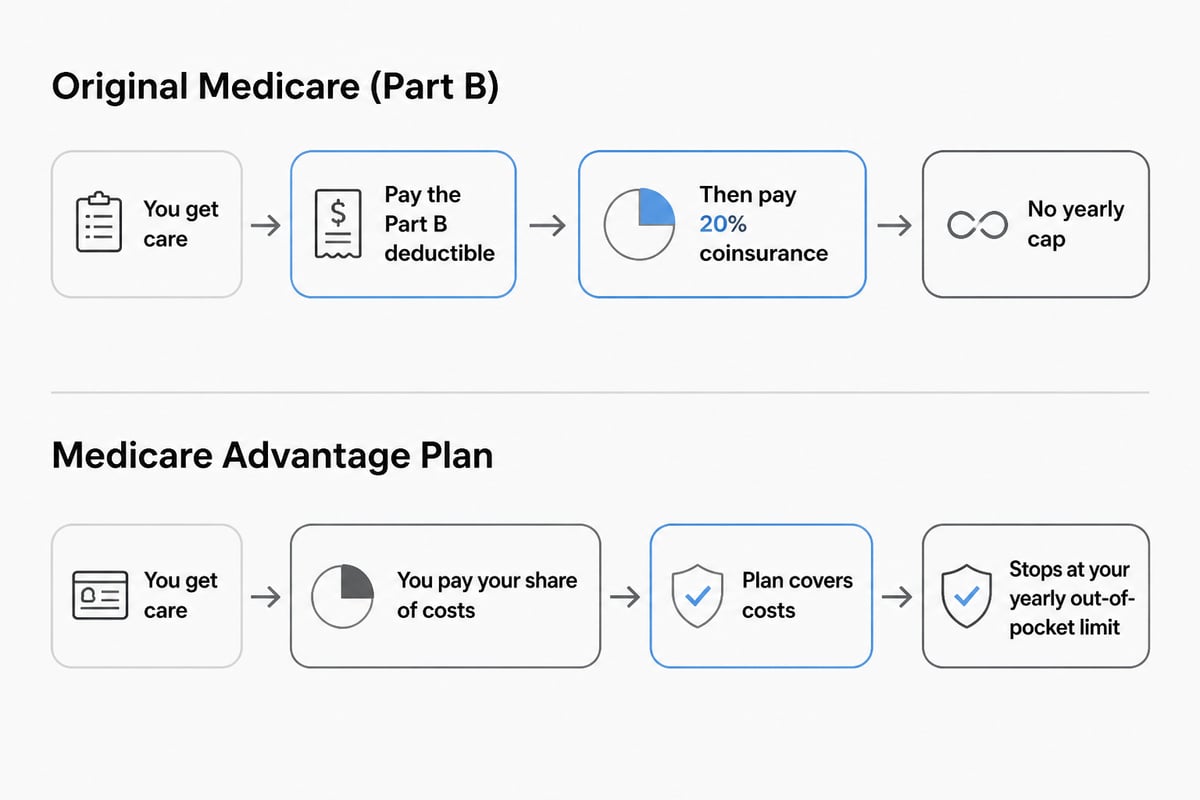
Original Medicare has real cost sharing, and understanding it is the best way to see why many people add supplemental coverage. For Part B services, beneficiaries usually pay 20% of the Medicare-approved amount after meeting the deductible. That percentage has no ceiling, because Original Medicare has no yearly out-of-pocket spending limit unless you have supplemental coverage or other insurance.
Consider what that means in practice. A single outpatient procedure, a course of cancer treatment or repeated specialist visits can generate 20% coinsurance charges that accumulate over the year. Without a cap, a serious health event creates open-ended exposure.
You also face premiums, deductibles and copays that vary by part. Higher-income beneficiaries may owe an additional amount, which our page on the Medicare surcharge explains. If your income is limited, programs may reduce your costs, and you can learn about them through our guides on Extra Help with Medicare and getting help with Medicare costs.
How Medicare Advantage Limits Your Costs
A Medicare Advantage plan changes the cost structure by adding a protective ceiling. These plans have a yearly limit on out-of-pocket costs for covered Medicare services, and after you reach it, you pay nothing for covered services for the rest of the year.
That cap is attractive for people who want predictability. The tradeoff is that you work within a plan's structure: networks, referrals for some specialists and prior authorization for certain procedures or drugs. Copays for individual services still apply until you reach the limit.
Many Medicare Advantage plans also bundle extras that Original Medicare does not offer. Depending on the plan, these can include vision, hearing, dental and fitness programs such as SilverSneakers. Because benefits and provider networks differ by plan and by county, comparing plans available in Guilford and Forsyth counties side by side is more reliable than relying on general assumptions. Our guide on comparing Medicare Advantage plans shows which features deserve the most attention.
Medicare Supplement Insurance: Filling the Gaps
Medicare Supplement insurance, often called Medigap, pays some of the costs Original Medicare leaves behind, such as the 20% coinsurance and deductibles. It works only alongside Original Medicare, and it keeps your freedom to see any provider that accepts Medicare.
Plan G and Plan N are among the most discussed options because they cover most of the cost sharing that otherwise falls to you. Our Plan G overview and our page answering the top 10 questions about Medicare supplement plans in Greensboro walk through how they differ.
For a clear view of the combined structure, see our explanation of Medicare and supplemental insurance.
Preventive Care and Prescription Costs
Preventive care is one of the most valuable parts of Medicare medical coverage. Part B covers preventive and screening services, including exams, vaccines, lab tests and screenings. You pay nothing for most covered preventive services when your provider accepts assignment.
There is one caution. Additional tests or services performed during the same visit may lead to costs, so it helps to ask your provider in advance which parts of a visit are considered preventive and which are diagnostic.
Prescription costs deserve their own planning. Part D plans each have formularies, tiers and pharmacies, so the drug list you take today should drive your plan choice. The federal Medicare Prescription Payment Plan lets Part D enrollees spread out-of-pocket drug costs into capped monthly payments, which can help if you take expensive medications. Our page on the donut hole in Medicare gives additional background on how drug coverage phases have worked.
When to Enroll and What Mistakes to Avoid
The most common Medicare mistakes involve timing, and most of them are avoidable with a little planning. Your Initial Enrollment Period surrounds your 65th birthday, and missing it can lead to late enrollment penalties on some parts and delayed coverage. If you are still working, whether and when to enroll depends on your employer coverage, so confirm the details before you decide.
The mistakes that cost people the most include:
- Missing the Initial Enrollment Period and facing penalties or gaps in coverage.
- Choosing a plan based on premium alone without checking doctors, hospitals, pharmacies and drug lists.
- Skipping Part D and later paying a permanent late penalty.
- Assuming Original Medicare has a spending cap, when it does not.
- Never reviewing the plan again after enrollment, even as benefits and networks change each year.
Each year, you also have a chance to adjust your coverage during the fall. Your Social Security timing can also interact with Medicare enrollment, which is covered in our guide to Social Security and Medicare.
How to Choose Your Medicare Medical Plan
Choosing well comes down to a repeatable process that starts with your own care patterns rather than with plan brochures. Work through these steps in order.
- List your doctors, specialists and hospitals. Confirm whether they take Medicare and which networks include them.
- List your prescriptions. Check each drug against any plan's formulary and note the tier.
- Decide how you value predictability. A yearly cap and bundled extras suit some people, while unrestricted provider choice suits others.
- Estimate your total yearly cost. Add premiums, deductibles, copays and likely out-of-pocket spending, not just the monthly premium.
- Check availability. Plans and premiums vary by county, so confirm what is offered where you live.
- Plan to review each year. Your health, medications and plan benefits can change.
Our Medicare Made Easy resource and Find the Right Medicare page support this process with additional detail. If you prefer to learn in person, our Making Sense of Medicare event is designed for first-time enrollees.
Getting Local Guidance in the Triad
Working with a local, independent guide can make Medicare medical decisions simpler, because plan availability and provider networks differ across the Triad. Moser Insurance Group Inc works with multiple insurance carriers, so you can compare options in one place rather than visiting separate carrier sites. The team stays neutral and educates you so you can make an informed decision. It also checks in during the year to review your plan and any Medicare changes.
Moser Insurance Group Inc is one of the fastest growing independent insurance groups in Central North Carolina and is rated by clients on Google reviews. It serves the Triad Area, including Greensboro, Kernersville, High Point and Winston-Salem. If you are exploring options, the team's Medicare Advantage Plans offering is a practical place to start, and you can see local details on our Medicare in Greensboro, NC page or our Medicare help in Kernersville page.
You can reach the team directly at (336) 862-1763, by email at moserinsurancegroup@gmail.com, or through moserinsurancegroup.com.

FAQ
How many Americans are on Medicare?
Medicare is one of the largest health insurance programs in the country, and enrollment grows each year as more people reach age 65. For current figures, rely on the most recent federal enrollment data.
How do I contact Medicare?
You can reach Medicare through its official website, Medicare.gov. For local, plan-specific questions in the Triad, you can also call or text Moser Insurance Group Inc at (336) 862-1763 or email moserinsurancegroup@gmail.com.
What is the government's role in healthcare?
The federal government runs Medicare for older adults and some people with disabilities, and it funds Medicaid jointly with states for people with limited income. It also sets rules for private plans that participate in Medicare, such as Medicare Advantage. Private insurers then administer many of those plans within the government's standards.
Your next step is to write down your doctors, hospitals and prescriptions, then call or text Moser Insurance Group Inc at (336) 862-1763 so someone can match them against the plans available in the Triad. You can start by exploring Medicare Advantage Plans and the full range of options on offer. Moser Insurance Group Inc helps individuals and families in Greensboro, Kernersville, High Point and Winston-Salem understand their choices with clear, no-pressure guidance, so Call/Text Now (336) 862-1763 or email moserinsurancegroup@gmail.com to get started.
Recent Comments