

Mortgage unemployment insurance is a policy that makes some or all of your monthly home loan payments if you lose your job involuntarily, usually for a limited period such as 6 to 24 months. It does not replace your income entirely, and it often comes with a waiting period, a benefit cap, and exclusions, so it fits some households far better than others. Homeowners across the Triad, including Greensboro, Kernersville, High Point and Winston Salem, can use this guide to decide whether the coverage is worth the cost or whether another safeguard makes more sense.
How Mortgage Unemployment Insurance Works
Mortgage unemployment insurance pays a defined monthly benefit toward your mortgage after a covered involuntary job loss, once a waiting period ends and your claim is approved.
The structure is simple. You pay a monthly or annual premium. If you are laid off through no fault of your own, you file a claim with documentation such as a termination letter and proof that you are collecting state unemployment benefits. After the waiting period, the policy pays either your full mortgage payment or a set percentage of it, up to a maximum number of months.
Most policies share these features:
- Waiting period: often 30 to 90 days after the job loss before benefits begin
- Benefit period: a fixed window, commonly 6 to 24 months, per claim
- Monthly cap: a dollar limit or a percentage of your payment
- Covered events: involuntary layoff, not resignation, firing for cause, or end of a contract you knew would expire
- Employment history: many policies require you to have worked full time for a minimum period before the claim
Self-employed people and business owners are frequently excluded or restricted, because there is no layoff to document. Read the definition of "involuntary unemployment" in the policy before you buy.
Why a Job Loss Puts Your Mortgage at Risk
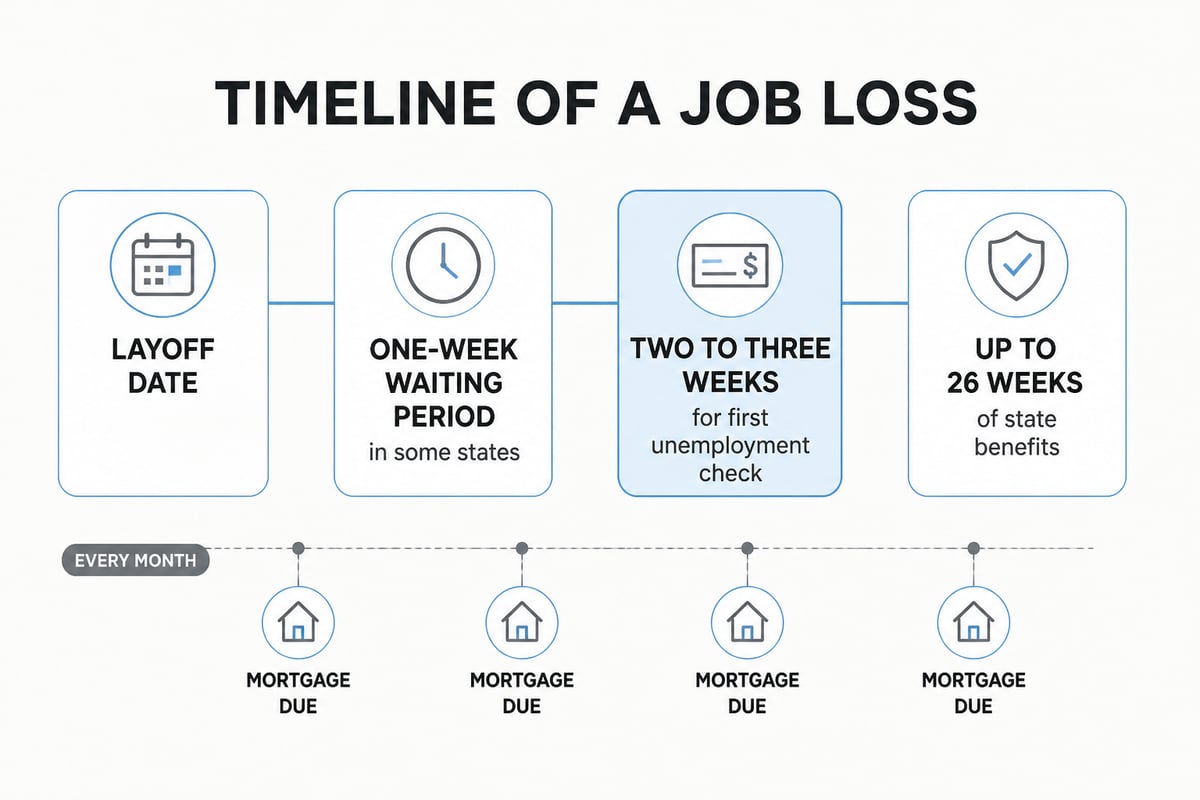
A job loss puts your mortgage at risk because state unemployment benefits typically replace only a portion of your pay, and they arrive after a delay.
The U.S. Department of Labor explains that unemployment benefits are generally based on a percentage of recent earnings, up to a state maximum, and can be paid for up to 26 weeks in most states. The same source notes that it generally takes a few weeks after filing a claim to receive the first benefit check, and some states require a waiting period. For a household whose mortgage, property taxes, and homeowners insurance consume a large share of take-home pay, that gap and that reduction matter.
The broader mortgage market is stable, but distress still happens. In the OCC’s second-quarter 2025 mortgage metrics report, 97.5% of covered mortgages were current and performing at quarter-end, while servicers initiated 7,163 new foreclosures during the quarter. Most borrowers stay current, yet some do not each quarter, and income interruption is a common reason.
What Mortgage Unemployment Insurance Costs and Excludes
Mortgage unemployment insurance typically costs a small monthly premium tied to your loan balance or payment, and the exclusions determine whether that premium buys real protection.
Prices vary by lender, state, benefit amount, and benefit length, so confirm any figure in writing before you commit. Compare these terms line by line:
- Definition of covered job loss. Confirm that layoffs, plant closures, and position eliminations qualify.
- Pre-existing notice. If you knew of a pending layoff when you enrolled, the claim may be denied.
- Waiting and elimination periods. A longer wait means more out-of-pocket months.
- Maximum benefit. A policy that pays 50% of your payment leaves a real shortfall.
- Claim limits. Some policies cap lifetime payouts or require months of re-employment before a second claim.
- Cancellation terms. Know whether the premium is level or can rise.
Unlike lender-sold debt protection add-ons, which are often bundled into the loan, a stand-alone policy gives you the freedom to review terms without pressure at closing.
Mortgage Insurance vs. Mortgage Unemployment Insurance
Mortgage insurance and mortgage unemployment insurance are different products: mortgage insurance protects the lender, while unemployment coverage protects your ability to keep making payments.
This distinction answers a common search question: what is mortgage insurance, and do you need it? There are several related products, and they are easy to confuse.
| Product | Who it protects | What triggers it | Who typically pays the premium |
|---|---|---|---|
| Private mortgage insurance (PMI) | The lender | Borrower default on a loan with under 20% down | Borrower |
| Mortgage unemployment insurance | The borrower | Involuntary job loss | Borrower |
| Mortgage protection life insurance | The borrower's family | Death of the borrower | Borrower |
| Mortgage disability insurance | The borrower | Injury or illness preventing work | Borrower |
PMI does nothing for you if you lose your income. It only reimburses the lender. If you are weighing 20% down against paying PMI, the tradeoff is liquidity versus cost: a larger down payment avoids PMI and lowers your payment, but it also drains savings that could serve as your emergency cushion. Many households keep several months of expenses in cash and accept PMI for a few years rather than empty reserves for the sake of avoiding it.
Is There Insurance to Cover Your Mortgage if You Lose Your Job?
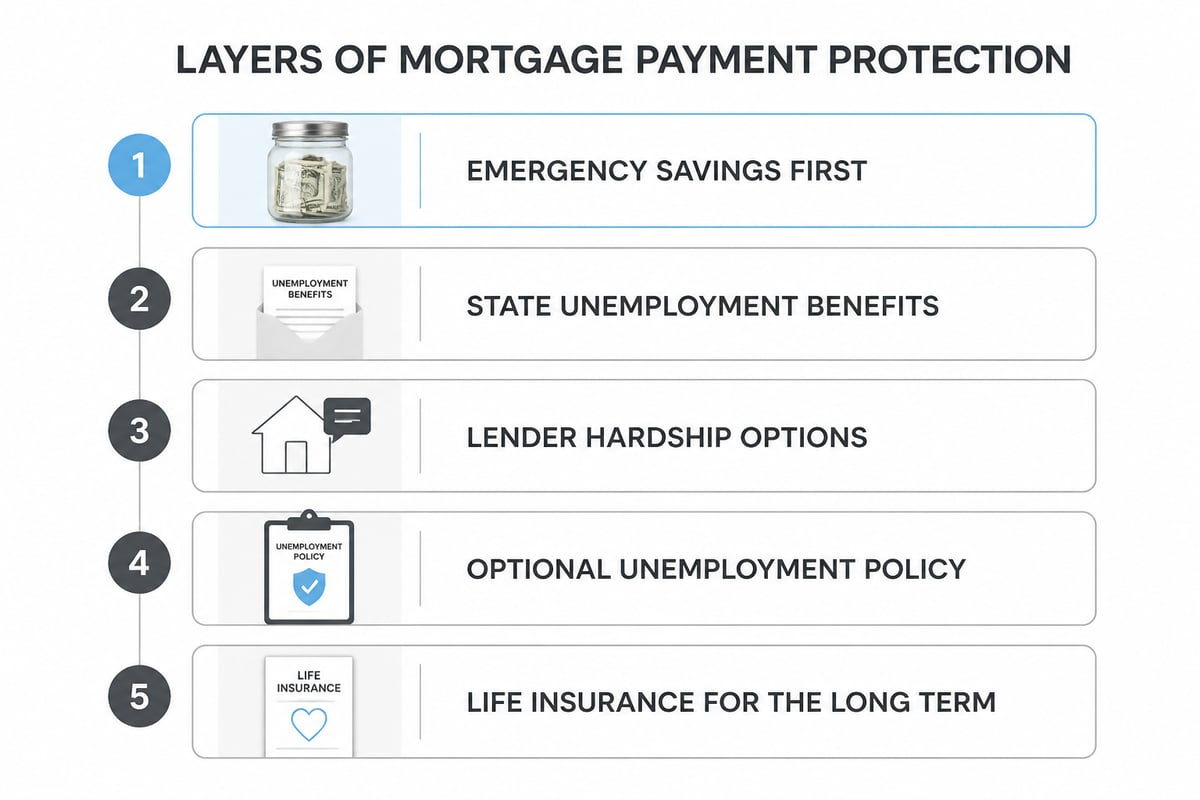
Yes, a few products do, but they are narrow, and the strongest protection for most families comes from combining a cash reserve with the right life and disability coverage.
Dedicated unemployment coverage exists through some lenders and stand-alone policies. Outside of it, here is how the other layers work:
- State unemployment benefits replace part of your pay for a limited time, as described above.
- Lender hardship programs can pause or reduce payments. The OCC reported mortgage modifications in the second quarter of 2025, and most were combination modifications involving multiple changes to loan terms, such as a rate reduction paired with an extended term. Contacting your servicer early, before you miss a payment, gives you the most options.
- Emergency savings remain the most flexible tool, since they cover any expense and carry no exclusions.
- Disability and life insurance protect against two risks that unemployment coverage ignores.
Because unemployment policies rarely cover resignation, termination for cause, or self-employment, they work best for salaried employees in industries with layoff risk who lack large savings.
Who Needs Mortgage Unemployment Insurance and Who Can Skip It
You are most likely to benefit if you depend on one salary, carry a high payment relative to income, and hold fewer than three to six months of expenses in savings.
Coverage deserves a closer look if:
- Your household relies on a single wage earner in a cyclical industry
- Your mortgage payment takes a large share of take-home pay
- You bought recently with a small down payment and little equity
- You have no other source of income, such as a pension, a working spouse, or rental income
You can probably skip it if you hold a sizable emergency fund, have multiple income streams, or are close to retirement. Pre-65 households in North Carolina often face a more pressing question: what happens to health coverage if a layoff ends employer insurance? That cost can exceed the mortgage risk, and it belongs in the same plan. If you are approaching 65, understanding your Medicare options before an unplanned retirement can prevent coverage gaps and late-enrollment penalties.
Retirees generally no longer face layoff risk, so unemployment coverage stops being relevant. Their concern shifts to paying the mortgage if a spouse dies, which is where life insurance fits.

Alternatives That Often Protect a Mortgage Better
For many Triad homeowners, mortgage protection life insurance, term life insurance, and a funded emergency account offer broader and more reliable protection than unemployment coverage alone.
Moser Insurance Group Inc, an independent agency serving the Triad, works with multiple carriers, so you can compare options in one place. Your choices include:
- North Carolina mortgage protection insurance, which is designed to help your family keep the home if you die, become seriously ill, or suffer a qualifying event, depending on the plan
- Term life insurance, which pays your beneficiary directly instead of the lender, so your family decides how to use the money
- Universal life insurance for those who want permanent coverage with flexibility
A key difference between typical lender-sold mortgage life products and term life is control. With lender-sold mortgage life insurance, the lender is the beneficiary, and the payout shrinks as the balance falls. With term life, the benefit stays level and your family chooses how to spend it, whether on the mortgage, living costs, or tuition.
How to Choose the Right Protection for Your Home
Choose by listing your risks, pricing each fix, and picking the combination that closes the biggest gaps at a premium you can sustain.
- Calculate your cushion. Add up essential monthly costs and divide your liquid savings by that figure. Fewer than three months suggests a gap.
- Check what you already have. Review employer disability and life benefits, since many are modest and end when employment does.
- Price the exposures. Get written quotes for term life, mortgage protection, and any unemployment rider.
- Read exclusions first. The definition of a covered claim matters more than the headline price.
- Confirm the beneficiary. Make sure the money goes to your family and not only to the lender.
- Review annually. A new job, a refinance, or a growing family changes the answer.
A licensed agent can walk through these steps without a sales push. Moser Insurance Group Inc stays neutral and focuses on educating you so you can make an informed decision, and its team checks in during the year to review your coverage as your life changes. You can start with an insurance consultation or browse the local life insurance options in Greensboro.
FAQ
How does PMI work?
Private mortgage insurance is required by most lenders when your down payment is under 20%. You pay a monthly premium, and it reimburses the lender, not you, if you default. It can usually be removed once your equity reaches the threshold your lender sets.
Does mortgage unemployment insurance cover resignation or self-employment?
Generally no. Most policies pay only for involuntary job loss, such as a layoff, and exclude quitting, firing for cause, and self-employment income loss. Always confirm the exact wording of the claim definition before you buy.
Can I get help with my mortgage without insurance if I lose my job?
Yes. Contact your loan servicer immediately to ask about forbearance, payment deferral, or a loan modification, and file for state unemployment benefits right away. Acting before a payment is missed generally gives you more options.
Start by writing down your monthly essentials and how many months your savings would cover, then bring that number to a conversation about protecting your home. Moser Insurance Group Inc serves homeowners across the Triad, including Greensboro, Kernersville, High Point and Winston Salem, and you can call or text (336) 862-1763 now to talk through your options, or email moserinsurancegroup@gmail.com. The team will explain how each type of coverage fits your situation at no cost to you, so you can decide with confidence. You can also learn more at moserinsurancegroup.com.
Recent Comments