

Navigating prescription drug coverage can feel overwhelming, especially when you're approaching Medicare eligibility or already enrolled. Medicare Part D plans provide essential prescription medication coverage that helps millions of Americans afford the drugs they need to maintain their health. Whether you live in Greensboro, Winston Salem, High Point, Kernersville, or anywhere in the Triad Area, understanding how these plans work and which option suits your specific medication needs can save you thousands of dollars annually while ensuring you have access to necessary treatments.
Understanding Medicare Part D Plans and How They Work
Medicare Part D plans are standalone prescription drug coverage plans offered through private insurance companies approved by Medicare. These plans work alongside Original Medicare (Parts A and B) to provide comprehensive coverage for medications. The structure of Medicare Part D coverage involves formularies, coverage tiers, and specific cost-sharing arrangements that vary by plan.
Each plan maintains a formulary, which is essentially a list of covered medications organized into different tiers. These tiers determine your out-of-pocket costs, with generic drugs typically costing less than brand-name medications. Plans must cover at least two drugs in each therapeutic category, but they have flexibility in determining which specific medications make their formulary.
Key Components of Part D Coverage
The basic structure of medicare part d plans includes several distinct phases that affect what you pay throughout the year:
- Annual deductible – The amount you pay before coverage begins (varies by plan, with a maximum of $590 in 2026)
- Initial coverage period – You and your plan share costs after meeting the deductible
- Coverage gap – Previously called the "donut hole," now largely eliminated for most beneficiaries
- Catastrophic coverage – Protection after reaching the out-of-pocket threshold ($2,000 in 2026)
Thanks to the Inflation Reduction Act, significant improvements have been made to Medicare Part D plans. The most notable change is the $2,000 annual cap on out-of-pocket prescription drug costs, which provides substantial financial protection for beneficiaries with high medication expenses.

Comparing Medicare Part D Plans in Your Area
When evaluating medicare part d plans available in the Triad Area, you'll need to compare multiple factors beyond just the monthly premium. The best Medicare Part D plans for your situation depend on your specific medications, preferred pharmacies, and overall health needs.
Essential Comparison Criteria
| Factor | What to Consider | Why It Matters |
|---|---|---|
| Monthly Premium | $0-$100+ depending on plan | Lower premiums may have higher copays |
| Annual Deductible | $0-$590 in 2026 | Plans with $0 deductible offer immediate coverage |
| Formulary Coverage | Check your specific medications | Ensures your drugs are covered |
| Pharmacy Network | Preferred and standard pharmacies | Network pharmacies offer lower costs |
| Mail-Order Options | 90-day supply availability | Convenience and potential savings |
The Medicare Plan Finder tool at Medicare.gov allows you to enter your specific medications and compare plans based on total estimated annual costs. This comprehensive approach is far more accurate than simply comparing monthly premiums, as a plan with a higher premium might actually cost less overall if it offers better coverage for your specific drugs.
Formulary Tiers and Your Costs
Most Medicare Part D formularies organize medications into five or six tiers, each with different cost-sharing requirements:
- Tier 1 – Preferred generic drugs (lowest cost)
- Tier 2 – Generic drugs
- Tier 3 – Preferred brand-name drugs
- Tier 4 – Non-preferred brand-name drugs
- Tier 5 – Specialty tier drugs (highest cost)
- Tier 6 – Select care drugs (some plans only)
If your medication is on a higher tier, you'll pay more out-of-pocket. However, you can work with your doctor to request an exception if a lower-tier alternative isn't medically appropriate for your condition.
Enrollment Periods and When to Sign Up
Understanding when you can enroll in medicare part d plans is crucial to avoid gaps in coverage and potential late enrollment penalties. The timing of your enrollment depends on your Medicare eligibility and current coverage status.
Initial Enrollment Period
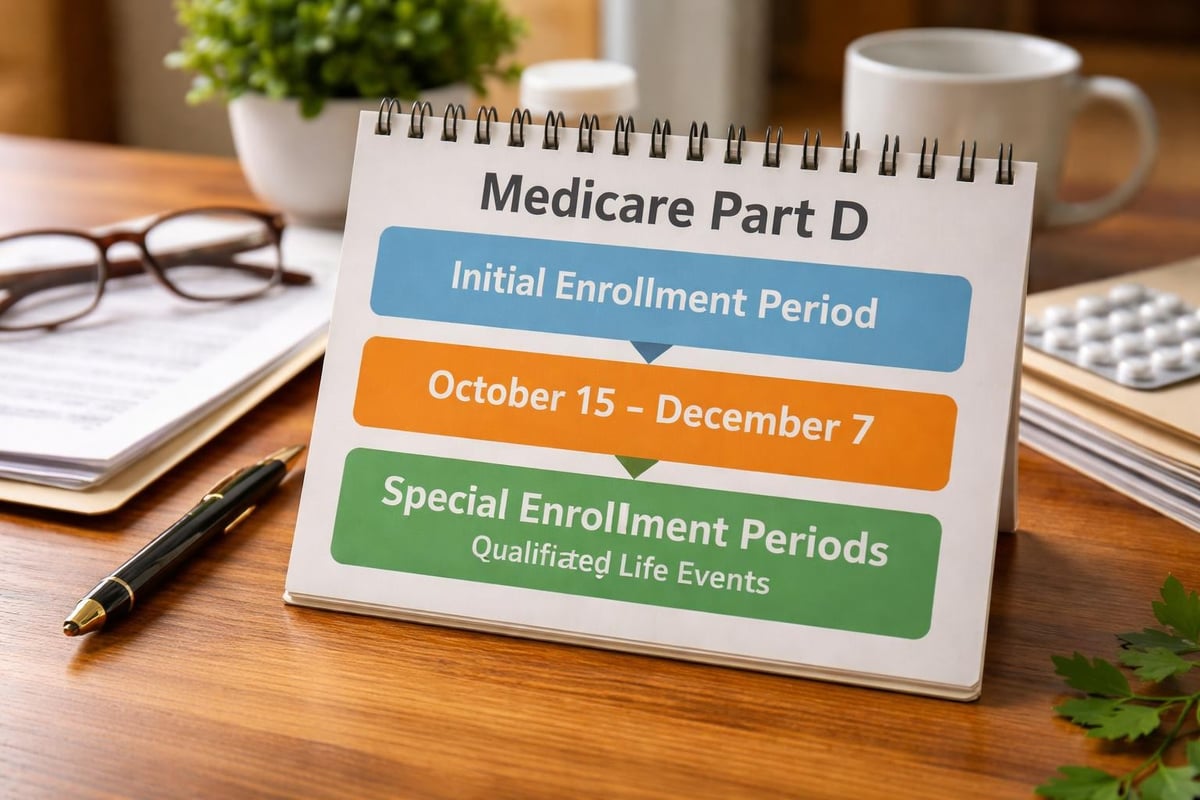
Your Initial Enrollment Period (IEP) for Part D aligns with your Medicare eligibility, which typically begins three months before the month you turn 65, includes your birthday month, and extends three months after. If you're already receiving Social Security benefits, you'll be automatically enrolled in Medicare Parts A and B, but you must actively choose a Part D plan.
Missing this window without creditable prescription drug coverage can result in a late enrollment penalty that lasts as long as you have Medicare coverage. For residents in Winston Salem, Greensboro, and throughout the Triad Area, planning ahead ensures you don't face unnecessary penalties or coverage gaps.
Annual Enrollment Period
The Medicare Annual Enrollment Period runs from October 15 through December 7 each year, with coverage changes taking effect January 1. Reviewing your Medicare plan during open enrollment is critical because plans can change their formularies, premiums, and cost-sharing from year to year.
During this period, you can:
- Switch from Original Medicare to Medicare Advantage (which includes drug coverage)
- Change from one Part D plan to another
- Drop your Part D coverage (though this may trigger penalties later)
- Add Part D coverage if you previously went without
Special Enrollment Periods
Certain qualifying events allow you to change medicare part d plans outside the Annual Enrollment Period:
- Moving to a new address outside your current plan's service area
- Losing other creditable prescription drug coverage
- Moving into or out of a nursing home
- Qualifying for Extra Help (Low-Income Subsidy)
- Affected by a federal disaster declaration
The Medicare Advantage Open Enrollment Period (January 1 – March 31) provides an additional opportunity to make changes, though options are more limited than during the fall enrollment period.
Cost-Saving Strategies for Part D Coverage
Managing prescription drug costs requires strategic planning beyond simply choosing a plan. Several programs and approaches can significantly reduce your out-of-pocket expenses for medications.
Extra Help Program
The Extra Help program (also called the Low-Income Subsidy) assists Medicare beneficiaries with limited income and resources. If you qualify, you could pay:
- $0 monthly premium
- No annual deductible
- $0-$4.50 copays for generic drugs
- $0-$11.20 copays for brand-name drugs
To qualify in 2026, your annual income must be below $23,760 (individual) or $32,130 (married couple), with resources limited to $17,220 (individual) or $34,360 (married couple). Resources exclude your home, vehicle, and certain personal belongings.
Manufacturer Assistance Programs
Many pharmaceutical companies offer patient assistance programs that provide free or reduced-cost medications to eligible individuals. These programs work independently of Medicare Part D and can fill gaps when your plan doesn't cover a needed medication or when costs remain too high even with coverage.
Generic Substitution Benefits
Generic medications contain the same active ingredients as brand-name drugs but cost significantly less. Working with your doctor to identify appropriate generic alternatives can dramatically reduce your annual drug costs. Most medicare part d plans incentivize generic use through lower tier placement and reduced copayments.
| Strategy | Potential Savings | Best For |
|---|---|---|
| Extra Help Program | Up to $5,000+ annually | Low-income beneficiaries |
| Generic substitution | 50-80% per prescription | Those taking brand-name drugs |
| Mail-order pharmacy | 15-30% on maintenance meds | Chronic condition management |
| Preferred pharmacy use | $10-$50 per prescription | All plan members |
Understanding Coverage Changes and Plan Management
Medicare Part D plans evolve annually, requiring active management to ensure continued optimal coverage. Policy updates and regulatory changes regularly affect plan operations, beneficiary protections, and coverage requirements.
Annual Notice of Change
Every September, you'll receive an Annual Notice of Change (ANOC) from your current Part D plan. This document details any modifications for the upcoming year, including:
- Premium adjustments
- Deductible changes
- Formulary updates (drugs added or removed)
- Cost-sharing modifications
- Pharmacy network changes
Reviewing this notice carefully allows you to determine whether your current plan still meets your needs or if switching to a different option would be more beneficial. Many beneficiaries in High Point and Kernersville find that their medication needs change over time, making annual review essential.
Mid-Year Formulary Changes
While plans primarily update formularies annually, they can make certain changes during the year. Plans must provide 60 days' notice before removing a drug from their formulary or moving it to a higher cost tier. If your medication is affected, you have options:
- Request a formulary exception from your plan
- Ask your doctor to prescribe an alternative covered medication
- File an appeal if the plan denies your exception request
- Use a Special Enrollment Period to switch plans if you qualify
Star Ratings and Plan Quality
Medicare assigns star ratings (1-5 stars) to Part D plans based on quality and performance measures. Five-star Medicare plans can be joined at any time during the year through a Special Enrollment Period, providing flexibility if you discover a highly-rated option.
Higher-rated plans typically demonstrate:
- Better customer service
- Fewer member complaints
- More transparent pricing
- Effective medication therapy management programs
- Higher member satisfaction scores

Coordination with Other Medicare Coverage
Understanding how medicare part d plans interact with other Medicare coverage options helps you build comprehensive health protection. The relationship between Part D and other coverage types affects your choices and potential benefits.
Part D with Original Medicare
If you have Original Medicare (Parts A and B), adding a standalone Part D plan completes your prescription coverage. Many beneficiaries also add a Medicare Supplement plan to cover out-of-pocket costs that Original Medicare doesn't pay, such as deductibles, coinsurance, and copayments for medical services.
This three-part approach (Original Medicare + Medigap + Part D) provides comprehensive coverage with flexibility to see any doctor who accepts Medicare. For residents throughout the Triad Area, this combination offers broad provider access across North Carolina and nationwide.
Medicare Advantage Plans with Drug Coverage
Medicare Advantage plans (Part C) often include prescription drug coverage, eliminating the need for a separate Part D plan. These all-in-one plans combine hospital insurance, medical insurance, and usually drug coverage into a single plan with one premium.
You cannot have both a Medicare Advantage plan and a standalone Part D plan simultaneously. If you join a Medicare Advantage plan without drug coverage and want prescription coverage, you must add a standalone Part D plan. However, most Medicare Advantage plans in Greensboro and surrounding areas include integrated drug coverage.
Employer and Union Coverage Considerations
If you have prescription drug coverage through current or former employment, you need to determine whether it's "creditable coverage" that meets Medicare standards. Creditable coverage allows you to delay Part D enrollment without penalty.
Your employer or union must notify you annually whether their coverage is creditable. Keep these notices, as you'll need proof if you later enroll in Part D to avoid late enrollment penalties. Contact Moser Insurance Group Inc at 336-862-1763 or moserinsurancegroup@gmail.com if you need help evaluating whether your employer coverage is creditable.
Medication Management and Utilization
Effective use of medicare part d plans goes beyond simply having coverage. Active medication management ensures you receive maximum value from your plan while maintaining optimal health outcomes.
Medication Therapy Management Programs
Part D plans must offer Medication Therapy Management (MTM) programs to beneficiaries who have multiple chronic conditions, take multiple medications, and are likely to incur high drug costs. MTM services include:
- Comprehensive medication reviews with a pharmacist
- Medication action plans
- Intervention and referral services
- Personal medication lists
These programs identify potential drug interactions, duplicate therapies, and opportunities for generic substitution or therapeutic alternatives. Participation is typically free and can reveal significant cost-saving opportunities while improving health outcomes.
Prior Authorization and Step Therapy
Some medications require prior authorization, meaning your doctor must demonstrate medical necessity before the plan covers the drug. Step therapy (also called "fail first") requires trying less expensive medications before the plan approves coverage for more costly alternatives.
While these requirements can feel frustrating, they're designed to control costs and encourage use of clinically appropriate, cost-effective treatments. Your doctor can request exceptions if they document why the standard approach isn't medically appropriate for your situation.
Specialty Medications
Specialty drugs typically appear on Tier 5 and treat complex conditions like cancer, multiple sclerosis, or rheumatoid arthritis. These medications often require special handling, administration, or monitoring. Most Part D plans cap specialty drug cost-sharing at 25% of the drug's cost during the initial coverage period.
Many beneficiaries with specialty drug needs benefit from working with specialty pharmacies that provide additional support services, including:
- Coordination with healthcare providers
- Insurance benefits verification
- Financial assistance identification
- Adherence monitoring and support
- Clinical consultation services
Regional Considerations for Triad Area Residents
Residents of Greensboro, Winston Salem, High Point, Kernersville, and the broader Triad Area have access to numerous medicare part d plans, but local factors can influence plan selection and use.
Preferred Pharmacy Networks
Major pharmacy chains throughout the Triad Area participate in most Part D plan networks, including CVS, Walgreens, Walmart, Food Lion, and Harris Teeter pharmacies. However, plans designate some pharmacies as "preferred," offering lower copays when you use these locations.
Check whether your regular pharmacy is in-network and whether it's designated as preferred for plans you're considering. Using a preferred pharmacy can save $10-$30 per prescription, adding up to significant annual savings for beneficiaries taking multiple medications.
Local Independent Pharmacies
Many Triad Area residents prefer supporting local independent pharmacies that offer personalized service. Most Part D plans include local pharmacies in their networks, though they may not always be designated as preferred. The personal relationships and specialized services offered by community pharmacies often provide value beyond cost considerations.
Mail-Order and Home Delivery Options
All Part D plans must offer mail-order options for maintenance medications, typically providing 90-day supplies. This option offers convenience for beneficiaries with mobility limitations or those taking stable, long-term medications. During North Carolina winters or hot summers, home delivery eliminates trips to the pharmacy in challenging weather.
Making Your Part D Plan Selection
Choosing among medicare part d plans requires balancing multiple factors specific to your health needs, medication requirements, and financial situation. An overview of Medicare Part D benefits provides valuable context for making informed decisions.
Step-by-Step Selection Process
- List your current medications including dosage and frequency
- Identify your preferred pharmacies in the Greensboro, Winston Salem, or High Point area
- Use the Medicare Plan Finder at Medicare.gov to compare plans
- Review total estimated annual costs not just monthly premiums
- Check formularies to ensure your medications are covered
- Verify pharmacy networks include your preferred locations
- Consider plan star ratings for quality indicators
- Review plan restrictions like prior authorization or step therapy requirements
Common Selection Mistakes to Avoid
Many beneficiaries make predictable errors when choosing Part D coverage. Avoiding these mistakes can save money and frustration:
- Focusing only on premium costs instead of total annual expenses
- Not checking whether current medications are covered before enrolling
- Ignoring plan changes from year to year
- Delaying enrollment without creditable coverage
- Not exploring Extra Help if income-eligible
- Failing to request exceptions when needed medications aren't covered
Getting Professional Guidance
Medicare decisions can feel overwhelming, especially when comparing dozens of medicare part d plans available in North Carolina. Working with experienced local professionals who understand both Medicare regulations and regional considerations provides peace of mind.
Moser Insurance Group Inc serves the Triad Area with personalized Medicare guidance. Call 336-862-1763, email moserinsurancegroup@gmail.com, or visit moserinsurancegroup.com to discuss your specific needs. Our approach focuses on education and clarity, helping you understand your options without pressure so you can make confident decisions about your prescription drug coverage.
Handling Denials and Appeals
Even with comprehensive coverage, you may encounter situations where your Part D plan denies coverage for a medication your doctor prescribes. Understanding the appeals process protects your rights and ensures access to medically necessary treatments.
Coverage Determination Requests
If your medication isn't on your plan's formulary or requires prior authorization, you or your doctor can request a coverage determination. Plans must respond within 72 hours for standard requests or 24 hours for expedited requests when your health could be seriously harmed by waiting.
The Five-Level Appeals Process
If your plan denies coverage, you have the right to appeal through five levels:
- Redetermination – Your plan reconsiders (7 days standard, 72 hours expedited)
- Reconsideration – Independent review entity evaluates (14 days standard, 72 hours expedited)
- Administrative Law Judge hearing – If amount in controversy exceeds threshold
- Medicare Appeals Council review – Council evaluates ALJ decision
- Federal court review – Judicial review in federal district court
Most appeals resolve at the first or second level, but knowing your rights through all levels ensures you can advocate effectively for necessary medications.
Exception Requests
If your medication isn't covered or is on a high-cost tier, you can request a formulary exception or tiering exception. Your doctor must provide supporting documentation explaining why:
- The covered alternatives aren't medically appropriate
- The requested medication is medically necessary
- The requested tier placement is appropriate
Plans must make exception decisions within 72 hours for standard requests or 24 hours for expedited requests when delays would seriously jeopardize your health.
Understanding medicare part d plans and selecting the right coverage requires careful evaluation of your medications, costs, and personal preferences, but the effort pays dividends through better health outcomes and manageable expenses. At Moser Insurance Group Inc, we help individuals and families throughout Greensboro, Winston Salem, High Point, Kernersville, and the Triad Area navigate Medicare decisions with clear guidance and personalized support. Whether you're new to Medicare or reviewing your current coverage, we're here to help you understand your options and make confident choices. Contact Moser Insurance Group Inc at 336-862-1763 or moserinsurancegroup@gmail.com to discuss your prescription drug coverage needs.
Recent Comments