

Index universal life insurance (IUL) has become increasingly popular among families in Greensboro, Winston Salem, High Point, Kernersville, and throughout the Triad Area who want permanent life insurance with growth potential tied to market indexes. Understanding index universal life insurance cost is essential before purchasing this type of coverage. Unlike traditional policies with fixed premiums, IUL products involve multiple cost layers that can fluctuate throughout the life of the policy. This comprehensive guide breaks down every component that influences what you'll pay, helping you make informed decisions about whether this coverage aligns with your financial goals and budget.
What Determines Index Universal Life Insurance Cost
The index universal life insurance cost structure differs significantly from simpler products like term life insurance. While term policies charge a fixed premium for a specific period, IUL policies incorporate flexible premiums, various fees, and charges that can adjust over time.
Core Cost Components
Every IUL policy includes several distinct charges that collectively determine your out-of-pocket expense:
- Cost of Insurance (COI): The mortality charge that covers the death benefit protection
- Administrative fees: Policy maintenance and record-keeping expenses
- Premium expense charges: Percentage-based fees on each premium payment
- Surrender charges: Early withdrawal penalties during the initial policy years
- Rider costs: Additional charges for supplemental benefits like disability waivers
The National Association of Insurance Commissioners provides regulatory oversight for these products, ensuring carriers disclose all fees and charges in policy illustrations.

How Age and Health Affect Index Universal Life Insurance Cost
Your personal risk profile plays the most significant role in determining index universal life insurance cost. Insurance carriers assess mortality risk through medical underwriting, and this evaluation directly impacts your COI charges.
| Age Range | Typical Monthly COI Impact | Health Rating Effect |
|---|---|---|
| 25-35 | Lowest base rates | Preferred: -20% to -30% |
| 36-50 | Moderate rates | Standard: Baseline |
| 51-65 | Higher rates | Substandard: +25% to +100% |
| 66+ | Highest rates | Table ratings apply |
Younger applicants in the Triad Area consistently receive lower COI charges because they present less mortality risk. A healthy 30-year-old might pay $150 monthly for $500,000 in coverage, while a 55-year-old with similar coverage could pay $450 or more.
Medical Underwriting Impact
The underwriting process examines multiple health factors that influence your index universal life insurance cost:
- Current health conditions: Diabetes, heart disease, and cancer history increase costs
- Family medical history: Hereditary conditions may trigger higher ratings
- Lifestyle factors: Tobacco use, occupation hazards, and risky hobbies affect pricing
- Weight and BMI: Obesity can result in table ratings that double base premiums
- Prescription history: Medications indicate underlying conditions that impact risk assessment
According to LIMRA’s 2024 industry analysis, individual life insurance sales reached record levels, with IUL products capturing growing market share due to their flexibility and growth potential. This demand has led carriers to refine their underwriting criteria and pricing models.
Premium Flexibility and Its Cost Implications
One distinguishing feature of universal life insurance products is premium flexibility. Unlike whole life policies with fixed payments, IUL allows you to adjust contributions within certain parameters. This flexibility affects long-term index universal life insurance cost in ways many policyholders don't initially anticipate.
Minimum vs. Target Premiums
Insurance carriers establish multiple premium benchmarks:
- Minimum premium: The lowest payment that keeps the policy in force
- Target premium: The amount designed to maintain coverage throughout your lifetime
- Maximum premium: The highest contribution allowed under IRS tax qualification rules
Paying only the minimum consistently can lead to policy lapse when cash value depletes. The target premium incorporates projected costs and builds adequate cash reserves. NerdWallet’s IUL analysis emphasizes understanding these distinctions before purchase.
Strategic premium planning requires balancing current affordability with long-term sustainability. Many families in Greensboro and Winston Salem initially pay above the target amount to accelerate cash value growth, then reduce premiums in later years when other financial priorities emerge.
Administrative Fees and Policy Charges
Beyond the mortality cost, index universal life insurance cost includes various administrative charges that carriers assess monthly or annually. These fees fund policy operations, compliance, and carrier profit margins.
Monthly Deductions From Cash Value
Your policy's cash value account faces regular deductions:
- Per-policy charge: Flat monthly fee (typically $10-$25)
- Cost of insurance: Variable charge based on current age and risk class
- Rider charges: Additional fees for death benefit increases, chronic illness riders, etc.
- Expense charges: Percentage of premium (often 5-10% of each payment)
These charges compound over time. A policy with $15 monthly administrative fees costs $180 annually, or $9,000 over 50 years. When combined with other expenses, these seemingly small charges significantly impact net cash value accumulation.

Index Crediting and Cap Rates
The growth component of IUL policies ties cash value increases to market index performance, subject to caps, participation rates, and floors. While not technically a "cost," these limitations directly affect net policy performance and the relationship between premiums paid and benefits received.
Understanding Crediting Limitations
| Crediting Method | How It Works | Typical Range |
|---|---|---|
| Cap Rate | Maximum credit percentage regardless of index gains | 8%-12% annually |
| Participation Rate | Percentage of index gains credited to cash value | 40%-100% |
| Spread/Margin | Percentage subtracted from index gains | 2%-4% |
| Floor | Minimum credit in negative market years | 0%-1% |
Current cap rates in 2026 reflect both the interest rate environment and carrier hedging costs. When treasury yields rise, insurance companies can afford higher caps. Conversely, low interest environments compress crediting potential.
The Society of Actuaries’ research on IUL product risks demonstrates how carriers balance policyholder crediting with financial stability requirements. This actuarial balancing act influences the sustainable index universal life insurance cost structure.
Illustration Assumptions and Cost Projections
When evaluating index universal life insurance cost, you'll receive an illustration projecting premiums, charges, and cash value over decades. Recent regulatory changes mandate more conservative assumptions to prevent misleading projections.
AG 49-A Illustration Requirements
The NAIC’s updated guidance on life insurance illustrations established stricter standards for IUL projections. Carriers must now limit illustrated rates based on the policy's actual charge structure and market realities.
Key illustration components include:
- Guaranteed columns: Show worst-case scenarios with minimum crediting and maximum charges
- Current assumption columns: Use today's caps, COI rates, and administrative fees
- Non-guaranteed elements: Clearly identify which values can change at carrier discretion
Families in High Point and Kernersville should request multiple illustrations showing various premium amounts and crediting scenarios. This comparison reveals how sensitive the policy is to market performance and helps establish realistic expectations about index universal life insurance cost over time.
Surrender Charges and Early Access Costs
Accessing cash value through withdrawals or policy surrender triggers additional costs during the early policy years. These surrender charges recoup carrier acquisition expenses and ensure the product remains profitable despite early terminations.
Surrender Charge Schedules
Most IUL policies impose declining surrender penalties:
- Years 1-5: Highest charges (often 10%-15% of cash value)
- Years 6-10: Gradually declining penalties
- Years 11-15: Minimal or eliminated charges
- Year 16+: No surrender penalties
A policy with $50,000 cash value surrendered in year three might incur a $7,500 penalty (15%), leaving you with only $42,500. Understanding these costs is crucial for families considering IUL as part of their broader financial strategy alongside life insurance planning.
Partial Withdrawal Options
Many policies allow limited withdrawals without surrender charges after the initial years. These penalty-free withdrawal provisions typically permit access to:
- Amounts up to your cumulative premium payments
- A percentage of cash value annually (often 10%)
- Accumulated interest or gains above cost basis
However, withdrawals reduce the death benefit and remaining cash value available for future growth, effectively increasing the relative index universal life insurance cost by diminishing long-term benefits.
Optional Riders That Increase Index Universal Life Insurance Cost
Supplemental benefits called riders enhance IUL policies but add monthly or annual charges. Evaluating these costs against the benefits provides clarity about whether each rider justifies its expense.
Common IUL Riders and Their Costs
- Chronic illness rider: Accelerates death benefit for qualifying conditions (0.25%-0.50% of death benefit annually)
- Disability waiver of premium: Covers premiums during total disability ($10-$50 monthly depending on coverage amount)
- Accidental death benefit: Doubles payout for accidental death ($5-$15 per $100,000 coverage)
- Children's term insurance: Adds coverage for dependent children ($50-$100 annually)
- Long-term care rider: Provides LTC benefits using death benefit (varies widely based on age and benefits)
Residents of the Triad Area should carefully assess which riders address genuine risks versus those adding unnecessary expense. A 40-year-old with adequate disability insurance through their employer might skip the premium waiver rider, reducing annual index universal life insurance cost by $300-$600.
Tax Considerations That Affect Net Cost
The IRS establishes guidelines governing life insurance tax treatment, and these rules significantly impact the effective index universal life insurance cost. Properly structured policies offer tax advantages that reduce net expense compared to taxable investment alternatives.
Tax-Advantaged Features
IUL policies receive favorable tax treatment when maintained within IRS limits:
- Tax-deferred growth: Cash value accumulates without annual income tax
- Tax-free death benefit: Beneficiaries receive proceeds income-tax-free
- Tax-free loans: Policy loans don't trigger income tax if structured properly
- No 1099 reporting: Unlike brokerage accounts, no annual tax forms for growth
Modified Endowment Contract (MEC) rules limit how much you can contribute in early years. Exceeding these limits converts the policy to MEC status, subjecting withdrawals to income tax and potential penalties. This limitation effectively caps how aggressively you can overfund the policy to minimize long-term index universal life insurance cost per dollar of death benefit.
Comparing Index Universal Life Insurance Cost Across Carriers
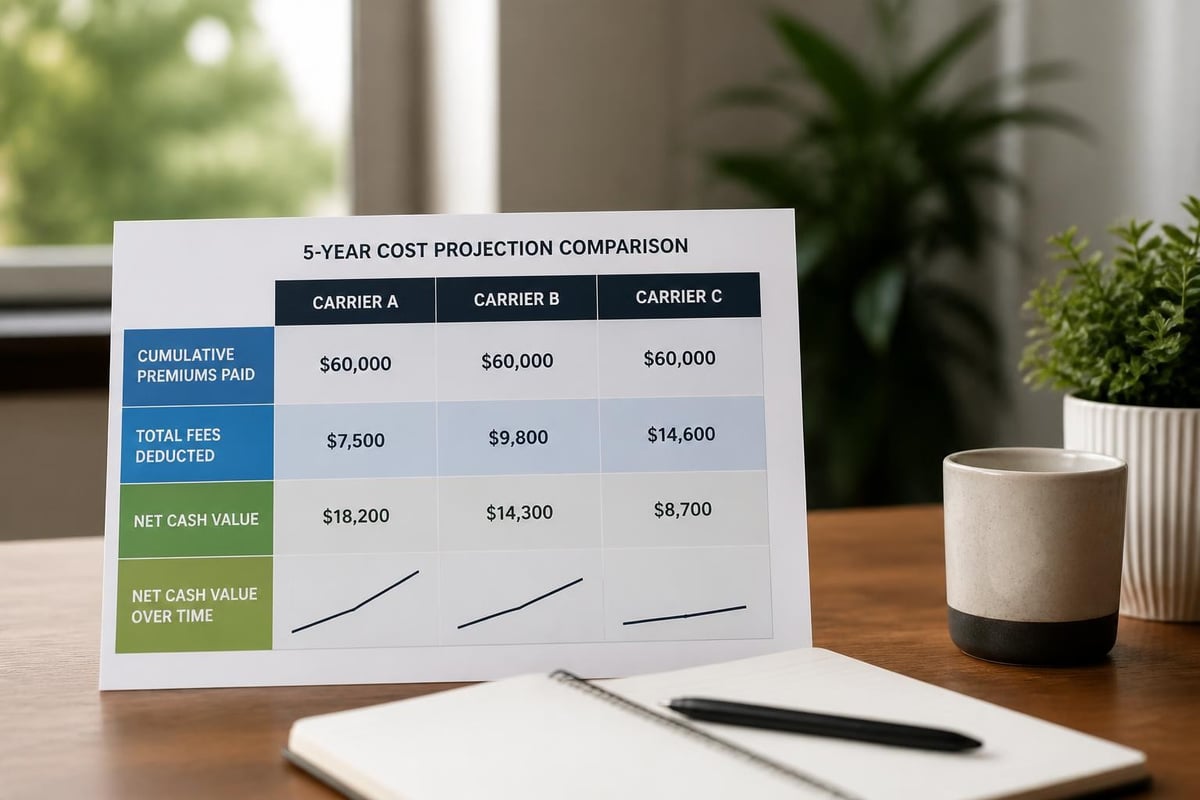
Not all IUL policies cost the same, even for identical applicants. Carriers vary significantly in their COI charges, administrative fees, cap rates, and surrender schedules. Shopping multiple insurers can reveal substantial cost differences.
Carrier Comparison Factors
| Cost Component | Carrier A | Carrier B | Carrier C |
|---|---|---|---|
| Monthly admin fee | $15 | $20 | $12 |
| First-year expense load | 8% | 10% | 6% |
| Current cap rate | 10.5% | 11.0% | 9.5% |
| Year 1 surrender charge | 10% | 12% | 8% |
| COI rate trend | Moderate | Lower | Higher |
Working with an independent agent serving Greensboro, Winston Salem, and surrounding communities provides access to multiple carriers without bias toward any single company. This competitive shopping can reduce index universal life insurance cost by 15%-30% compared to working with captive agents representing only one insurer.
Long-Term Cost Management Strategies
Successfully managing index universal life insurance cost over decades requires active monitoring and periodic adjustments. Unlike set-it-and-forget-it term policies, IUL demands ongoing attention to ensure premiums remain adequate and the policy performs as expected.
Annual Policy Review Checklist
Conduct comprehensive reviews each year covering:
- Current cash value: Compare actual performance to original illustrations
- COI charges: Verify current mortality costs haven't increased unexpectedly
- Cap and participation rates: Confirm crediting terms remain competitive
- Premium adequacy: Ensure current contributions support long-term viability
- Rider necessity: Reevaluate whether supplemental benefits still justify their cost
Many policies that seemed affordable at purchase become expensive burdens when carriers raise COI charges or reduce crediting rates. Early detection of these changes allows policyholders to increase premiums, adjust death benefits, or explore replacement options before problems become irreversible.
Premium Optimization Techniques
Strategic overfunding in early years creates larger cash value cushions that absorb future charge increases. This approach frontloads index universal life insurance cost but provides greater long-term stability.
Conversely, minimum premium strategies preserve cash flow today but require absolute confidence in future income availability. One job loss or medical emergency could jeopardize the entire policy if inadequate cash reserves exist to cover ongoing charges.
Families in Kernersville and High Point should align premium strategies with their broader financial plans, coordinating IUL funding with retirement savings, education expenses, and other priorities.
How Economic Conditions Influence Index Universal Life Insurance Cost
Broader economic factors-interest rates, market volatility, and insurance company investment returns-all affect what carriers charge for IUL coverage and how generously they credit cash value.
Interest Rate Impact
When the Federal Reserve raises benchmark rates, insurance companies earn higher yields on their general account investments. These improved returns allow carriers to:
- Lower cost of insurance charges
- Increase cap rates and participation rates
- Reduce administrative fees to remain competitive
- Offer better crediting terms overall
Conversely, low-rate environments compress carrier margins, often resulting in higher index universal life insurance cost through increased fees or reduced crediting potential. The interest rate cycle significantly impacts policy economics over multi-decade holding periods.
Market Volatility Effects
While IUL cash value isn't directly invested in stocks, extreme market volatility affects carrier hedging costs. Insurance companies purchase options and derivatives to support index crediting guarantees. When market volatility spikes, these hedging instruments become more expensive, potentially leading carriers to reduce caps or increase policy charges to maintain profitability.
Common Mistakes That Increase Index Universal Life Insurance Cost
Many policyholders inadvertently drive up their long-term costs through avoidable errors. Recognizing these pitfalls helps you implement strategies that minimize total index universal life insurance cost over your lifetime.
Underfunding in Early Years
Paying only minimum premiums during the first decade creates a weak foundation. Cash value grows slowly, leaving insufficient cushion when COI charges increase with age. This often forces dramatic premium increases later when budgets are less flexible.
Ignoring Annual Statements
Policy statements reveal current charges, crediting rates, and cash value performance. Ignoring these documents means missing early warning signs that the policy is underperforming or becoming unsustainable. Annual reviews with a knowledgeable agent can identify problems before they become crises.
Excessive Borrowing Against Cash Value
While policy loans offer tax-free access to cash value, excessive borrowing increases the effective index universal life insurance cost. Outstanding loans accrue interest charges, reduce death benefits, and decrease remaining cash value available to cover future COI charges. Large loan balances can cause policies to lapse unexpectedly.
Replacing Policies Unnecessarily
The insurance industry sometimes promotes replacing older policies with "better" new products. However, replacements restart surrender charge periods, require new underwriting (potentially at worse health ratings), and involve new acquisition costs. Carefully analyze whether replacement truly benefits you versus generating new commissions for agents.
Index Universal Life Insurance Cost for Different Life Stages
The appropriate premium amount and policy structure varies significantly based on your current life stage, financial obligations, and long-term objectives.
Young Professionals (25-40)
Individuals early in their careers often balance IUL costs against competing priorities like student loans, home purchases, and retirement savings. Lower COI charges at younger ages make IUL relatively affordable, but premium commitments must fit within tight budgets.
Recommended approach: Start with target premiums that build adequate cash value without straining monthly cash flow. Consider policies with flexible premium options that allow increases as income grows.
Mid-Career Families (40-55)
Parents in Greensboro and Winston Salem typically face peak expenses-mortgages, college funding, and aging parent care. Index universal life insurance cost must compete with these immediate needs while still providing adequate protection.
Recommended approach: Balance adequate death benefit coverage with reasonable premiums. Avoid overfunding at the expense of emergency savings or retirement contributions. Consider coordinating IUL with term coverage to maximize protection during high-need years.
Pre-Retirees (55-65)
Individuals approaching retirement often have greater income and fewer dependents. This life stage offers opportunity to maximize IUL funding, building substantial cash value for tax-free retirement income supplementation.
Recommended approach: Increase premiums to maximum allowable levels without triggering MEC status. This strategy minimizes the effective index universal life insurance cost per dollar of accessible cash value in retirement.
Professional Guidance on Index Universal Life Insurance Cost
The complexity of IUL products makes professional guidance particularly valuable. Working with an experienced advisor who understands these policies helps you avoid costly mistakes and optimize your coverage for your specific situation.
What to Look for in an Advisor
Quality IUL guidance requires advisors who:
- Represent multiple carriers to ensure competitive pricing
- Thoroughly explain all fees, charges, and limitations
- Provide annual policy reviews without additional fees
- Demonstrate expertise in tax-efficient policy design
- Prioritize education over high-pressure sales tactics
At Moser Insurance Group Inc, we help families throughout the Triad Area understand complex insurance products without pressure or confusion. Whether you're exploring IUL alongside other life insurance options or need guidance on policy management, our team provides clear explanations and personalized recommendations.
Questions to Ask Before Purchase
Before committing to an IUL policy, obtain clear answers to these questions:
- What are the current and maximum guaranteed COI charges?
- How have this carrier's cap rates changed over the past 10 years?
- What happens to my policy if I can only pay minimum premiums?
- Under what scenarios could this policy lapse?
- What are the total fees and charges in years 1, 10, and 20?
Reputable advisors welcome these questions and provide detailed, documented answers. Evasive responses or pressure to "trust the illustration" should raise red flags about the advisor's priorities.
Regional Considerations for Triad Area Residents
Families in Greensboro, Winston Salem, High Point, and Kernersville benefit from understanding how local economic conditions and demographics affect index universal life insurance cost and availability.
Cost of Living Impact
The Triad Area's moderate cost of living compared to major metropolitan regions means local families often allocate smaller percentages of income to insurance premiums. However, adequate coverage remains essential for protecting dependents and building long-term financial security.
Local Insurance Market
North Carolina's competitive insurance market provides residents access to numerous carriers offering IUL products. This competition benefits consumers through better pricing and more innovative product features. Independent agents can leverage this market depth to find optimal coverage at the best available index universal life insurance cost.
Estate Planning Coordination
Many Triad Area families use IUL as part of comprehensive estate plans, coordinating coverage with wills, trusts, and business succession strategies. The tax-free death benefit provides liquidity to pay estate taxes or equalize inheritances among heirs. These planning objectives often justify higher premiums than pure protection needs alone would require.
Understanding every component of index universal life insurance cost empowers you to make confident decisions about whether this coverage fits your financial strategy. The interplay of mortality charges, administrative fees, crediting limitations, and premium flexibility creates complexity that demands careful analysis and ongoing management. At Moser Insurance Group Inc, we specialize in helping individuals and families in Greensboro, Winston Salem, High Point, Kernersville, and throughout the Triad Area navigate insurance decisions with clear guidance and personalized support. Contact us at 336-862-1763, email moserinsurancegroup@gmail.com, or visit Moser Insurance Group Inc to discuss how IUL or other life insurance solutions can protect your family's future.
Recent Comments