

Affordable life cover usually means term life insurance: a policy that pays your beneficiaries a tax-free benefit if you pass away during a set period, at a fixed monthly premium that costs far less than permanent coverage. For most families and pre-retirees in the Triad, a well-sized term policy delivers the protection they need without straining the monthly budget.
This guide explains which policy types cost least, what moves your rate up or down, and how to choose coverage that holds up over time. It is written for readers in Greensboro, Winston-Salem, High Point, Kernersville and the wider Triad Area.
What Makes Life Insurance Affordable?
Life insurance is affordable when the premium is low enough to keep paying for the full length of the policy while still replacing the income or debts your family would need covered. A cheap policy that lapses after five years protects no one.
Price alone is a poor measure. A better test has three parts:
- Premium fit: the monthly cost sits comfortably inside your budget, even in a tight year.
- Coverage fit: the death benefit matches real obligations such as a mortgage, final expenses, or income replacement.
- Duration fit: the term runs long enough to cover the years your family depends on you.
Many people assume coverage costs more than it does. LIMRA research found that healthy adults ages 18 to 30 overestimated the median cost of a $250,000, 20-year level-term policy by roughly ten times or more. That finding comes from younger adults, but the lesson carries over: the real price of term coverage is often well below what people expect, so getting an actual quote beats guessing.
Which Type of Policy Costs the Least?
Term life insurance costs the least of any major policy type because it covers a fixed period and builds no cash value. You pick a death benefit, such as $250,000 or $500,000, choose a term of 10, 20 or 30 years, and pay a level premium. If you pass away during the term, your beneficiaries receive a tax-free payout. If you outlive the term, the policy simply expires.
The California Department of Insurance describes term policies as coverage for a specified period, such as 5, 10 or 20 years, and lists term premiums as low but rising with age. The Texas Department of Insurance notes that permanent-life premiums run higher than term-life premiums.
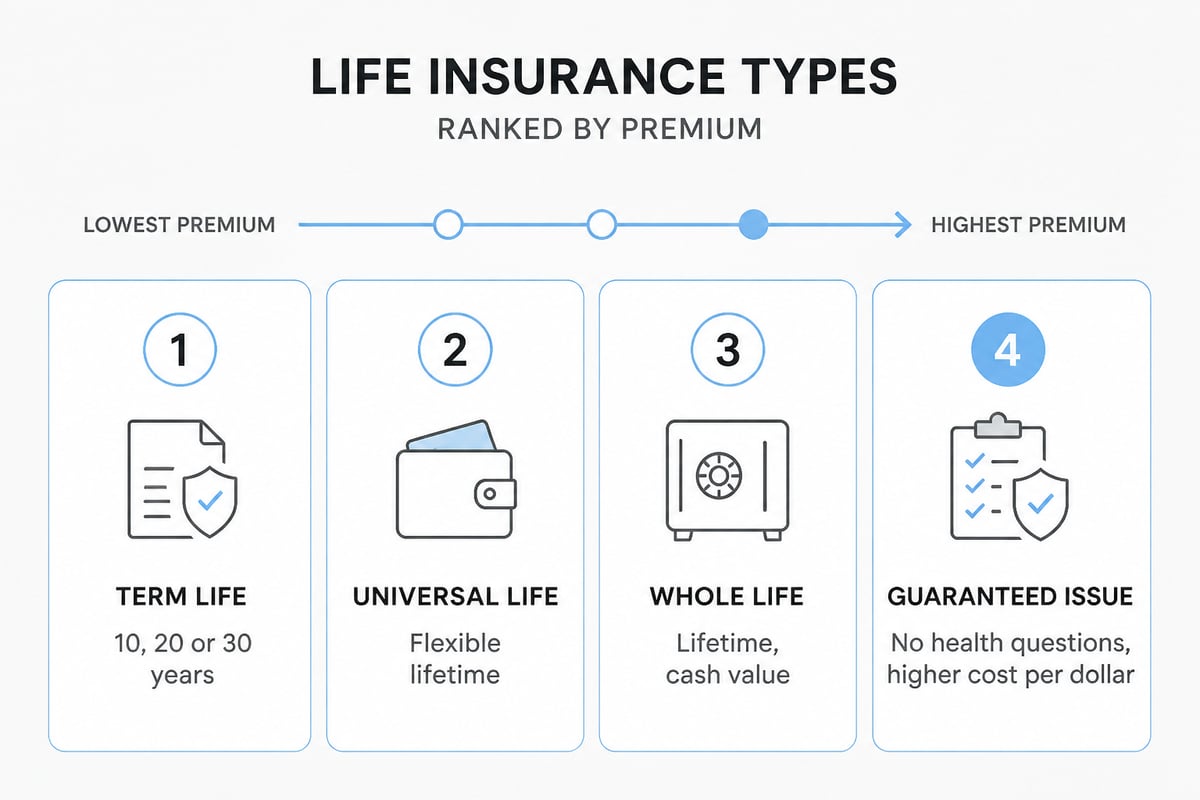
Here is how the common types compare on cost and purpose:
| Policy type | Relative cost | How long it lasts | Best used for |
|---|---|---|---|
| Term life | Lowest | 10, 20 or 30 years | Income replacement, mortgage, raising children |
| Whole life | Highest | Lifetime | Final expenses, estate planning, lifelong need |
| Universal life | Middle to high | Lifetime, flexible | Permanent coverage with adjustable premiums |
| Guaranteed issue | High per dollar of coverage | Lifetime | Applicants who cannot pass health questions |
Moser Insurance Group Inc offers term life insurance with a choice of coverage amount and term length, and because the agency works with multiple carriers, you can compare options in one place rather than visiting one company at a time. For a deeper look at pricing, see this overview of term life insurance prices.
What Factors Set Your Premium?
Your premium is set by the insurer's estimate of risk, and seven factors do most of the work. Knowing them shows you where you have control and where you do not.
- Age at purchase. Every year you wait raises the price. Locking in a rate earlier keeps it level for the whole term.
- Health. Blood pressure, cholesterol, tobacco use and medical history all influence the rate class you receive.
- Coverage amount. A $500,000 benefit costs more than a $250,000 benefit, though not twice as much in many cases.
- Term length. A 30-year term costs more per month than a 10-year term because the insurer carries the risk longer.
- Policy type. Term costs less than permanent coverage.
- Hobbies and occupation. Aviation, scuba diving and similar activities can raise rates.
- Gender. Rates often differ by gender because of life expectancy statistics.
Tobacco use and age are the two largest levers. If you have quit smoking within the past year or two, ask about rates again, because you may qualify for a better class than you did before.
How Much Coverage Do You Actually Need?
You need enough coverage to replace the income and pay the obligations your family would face without you, and a simple calculation gets you close. Many households buy too much because they pick a round number, or too little because they only think about the mortgage.
Add these items together:
- Outstanding mortgage and other debts
- Final expense costs such as funeral and burial
- Several years of income your family would need to adjust
- Future costs you have committed to, such as a child's education
Then subtract existing coverage and savings you would want your family to keep.
Do not rely on a workplace policy alone. LIMRA reports that a majority of working adults said they had life insurance through their employer in 2025, but group coverage is often a small multiple of salary and usually ends when you leave the job. Business owners and people approaching retirement in the Triad should check whether any employer coverage will follow them. If you are weighing a group benefit against an individual policy, this explanation of group term life insurance covers the tradeoffs.
Affordable Life Cover for Your Stage of Life
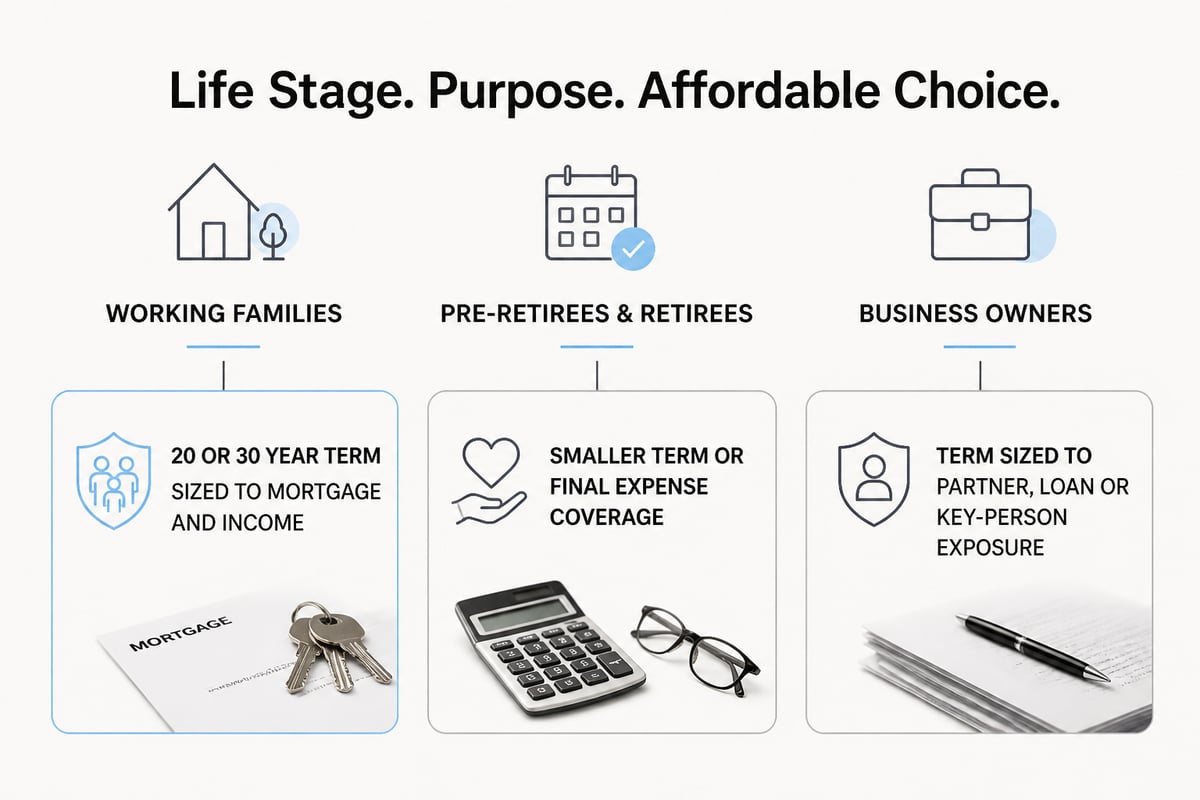
The most affordable life cover depends on your age, health and goals, and the right policy at 40 looks different from the right policy at 68. Matching the product to the stage of life is how you avoid overpaying.
Families and Working Adults
If you are raising children or carrying a mortgage, a 20- or 30-year term policy usually delivers the most protection per dollar. Choose a term that runs until your youngest child is independent and your home is paid down. Families in Greensboro and Kernersville often pair a term policy with a smaller amount sized to cover a spouse's income needs.
Pre-Retirees and Retirees
Needs shift after 50. The mortgage may be nearly paid off, but final expenses, a surviving spouse's income, and estate goals remain. Term options still exist for many people in their 50s and early 60s, and some carriers offer coverage into later ages. For readers in this group, these pages on life insurance over 60 and affordable life insurance for seniors over 65 explain how options and pricing change with age.
Business Owners
Owners often need coverage that protects a partner, a loan or key-person income. Term is usually the starting point because it keeps cost predictable while the business grows. A review in Winston-Salem or High Point can help you size the benefit to the actual exposure.
No-Exam and Simplified Policies: When They Make Sense
No-exam policies make sense when health history or timing makes a fully underwritten policy impractical, but they usually cost more per dollar of coverage. Understanding the three underwriting paths helps you choose without overspending.
- Fully underwritten: includes a health questionnaire and often an exam. This path usually gives the lowest rates for people in good health.
- Simplified issue: asks a short set of health questions and skips the exam. Approval is faster, and the premium is typically higher.
- Guaranteed issue: asks no health questions at all, which makes approval certain but limits the benefit amount and raises the cost per dollar of coverage.
If you are in good health, start with a fully underwritten quote, because that is where the lowest premiums are. If you have a health condition that complicates approval, no-medical-exam life insurance may be a practical route, and a guaranteed issue option can work as a last resort.

Ways to Lower Your Life Insurance Premium
You can lower your premium through a handful of practical steps, most of which cost nothing but a little preparation.
- Apply while you are younger and healthier. Rates rise with age and with new diagnoses.
- Right-size the benefit. Buy what your calculation supports, not a round number.
- Shop several carriers. The Texas Department of Insurance advises comparing quotes from several companies because rates vary.
- Improve your health profile. Quitting tobacco and lowering blood pressure can move you into a better class.
- Pay annually if you can. Many carriers charge a modest fee for monthly billing.
- Choose the shortest term that does the job. Do not buy 30 years if 20 covers your obligations.
- Review after major changes. A paid-off mortgage or a smaller family may mean you can reduce coverage.
Mistakes That Make Cheap Coverage Cost More
A low premium becomes expensive when the policy fails to pay or runs out before you need it. Four mistakes cause most of the trouble:
- Letting the policy lapse. Missed payments can cancel coverage, so set up automatic payments from the start.
- Choosing a term that is too short. If the policy ends while your family still depends on you, renewing at an older age costs far more.
- Leaving beneficiaries out of date. Review them after marriage, divorce, births and deaths.
- Answering health questions loosely. Inaccurate answers can create problems at claim time, so be complete and honest.
Choosing the Right Option With Local Guidance
Working with a local independent agency lets you compare multiple carriers and get plain explanations before you commit. Moser Insurance Group Inc is one of the fastest growing independent insurance groups in Central North Carolina, and it helps individuals, families and business owners across the Triad Area understand life, health and Medicare options without pressure. The team stays neutral and educates you so you can make an informed decision, and it checks in during the year to review your plan.
You can reach the office at 336-862-1763 or moserinsurancegroup@gmail.com, and the website is moserinsurancegroup.com.
Scale matters in the market as well. LIMRA reports that insurers sold millions of life insurance policies in 2024, which shows how many households make this decision each year and why a clear comparison is worth the effort.
FAQ
What is the most reasonable life insurance?
Term life insurance is generally the most reasonable choice because it charges the lowest premium for a given death benefit. It covers a fixed period such as 10, 20 or 30 years and pays a tax-free benefit if you pass away during that time. It fits best when your main goal is protecting income and debts rather than building cash value.
Can I get affordable coverage if I have health issues?
Yes, though your options and price depend on the condition. Simplified issue and guaranteed issue policies skip or limit health questions, but they cost more per dollar of coverage. Comparing carriers matters here, because underwriting standards vary and one company may rate your condition more favorably than another.
Is whole life insurance ever the affordable choice?
Whole life can make sense when you need coverage that lasts for life, such as for final expenses or estate goals. It costs substantially more than term, so it is rarely the cheapest way to protect a young family. Reviewing a whole life policy alongside a term quote shows the price difference clearly.
Your next step is to write down your mortgage balance, debts and the number of years your family would need income replaced, since those numbers decide the coverage you should price. From there, Moser Insurance Group Inc can compare carriers for you, starting with term life insurance sized to your budget and your goals in Greensboro, Winston-Salem, High Point, Kernersville and across the Triad. Call/Text Now (336) 862-1763 to talk through your options with no pressure and a clear explanation of every choice.
Recent Comments