

Medicare Part C plans represent a fundamental shift in how millions of Americans receive their Medicare benefits. Rather than managing separate coverage for hospital care, doctor visits, and prescriptions through Original Medicare, these plans bundle everything into a single, coordinated package offered by private insurance companies. Understanding how medicare part c plans work, what they cover, and whether they align with your healthcare needs is essential for making an informed decision during your Medicare enrollment period.
Understanding Medicare Part C Plans
Medicare Part C, commonly known as Medicare Advantage, provides an alternative way to receive your Medicare benefits. Instead of Original Medicare (Parts A and B) administered directly by the federal government, you receive all your Medicare-covered benefits through a private insurance company that has a contract with Medicare.
These plans must cover everything Original Medicare covers, but they often include additional benefits that go beyond the basic coverage. The structure allows insurance companies to design plans that meet regional healthcare needs while offering competitive benefits to attract enrollees.
The Legal Foundation and Structure
Medicare Part C plans exist under federal law that authorizes private insurers to offer Medicare benefits. Congress created this option to introduce managed care principles into Medicare, with the goal of improving care coordination and potentially reducing costs through network management and integrated services.
Insurance companies receive a fixed payment from Medicare for each person enrolled in their plan. This capitated payment structure incentivizes plans to manage care efficiently while keeping members healthy. The payment amount varies based on geography, health status, and other risk factors.
Key structural elements include:
- Federal oversight by the Centers for Medicare & Medicaid Services (CMS)
- Annual contracts between CMS and insurance companies
- Required coverage of all Medicare Part A and Part B services
- Network-based care delivery in most plan types
- Quality measurement through the Star Rating system
Types of Medicare Part C Plans Available
Not all medicare part c plans operate the same way. Several distinct plan types exist, each with different rules about how you access care and what you pay out-of-pocket.
Health Maintenance Organization (HMO) Plans
HMO plans are the most common type of Medicare Advantage plan. These plans require you to use doctors and hospitals within the plan's network, except in emergencies. You typically need to select a primary care physician who coordinates your care and provides referrals to specialists.
The structured approach of HMO plans often results in lower monthly premiums compared to other plan types. However, the trade-off is less flexibility in choosing providers. If you see a doctor outside the network without proper authorization, you'll likely pay the full cost yourself.

Preferred Provider Organization (PPO) Plans
PPO plans offer more flexibility than HMOs. You can see any doctor who accepts Medicare, though you'll pay less if you use providers in the plan's preferred network. Referrals to specialists are not required, giving you more control over your healthcare decisions.
This flexibility comes at a cost. PPO plans typically charge higher monthly premiums than HMO plans. You'll also face different cost-sharing amounts depending on whether you use in-network or out-of-network providers.
Private Fee-for-Service (PFFS) Plans
PFFS plans determine how much they'll pay doctors and hospitals and how much you'll pay when you receive care. Any provider who accepts the plan's payment terms can treat you. These plans are less common than HMO and PPO options but may be available in areas with limited provider networks.
Special Needs Plans (SNPs)
Special Needs Plans target specific groups of people with particular diseases, healthcare needs, or circumstances. Three main types exist:
- Chronic Condition SNPs for people with specific diseases like diabetes or heart failure
- Institutional SNPs for individuals in nursing homes or requiring nursing-level care at home
- Dual Eligible SNPs for people who qualify for both Medicare and Medicaid
SNPs tailor their benefits, provider networks, and drug formularies to the unique needs of their target population.
Coverage and Benefits in Medicare Part C Plans
All medicare part c plans must cover medically necessary services that Original Medicare covers. However, the real distinction lies in the additional benefits and how costs are structured.
Standard Medicare Coverage
Every Medicare Advantage plan provides:
- Hospital care (Part A services)
- Medical services (Part B services)
- Skilled nursing facility care (when medically necessary)
- Home health care
- Hospice care
- Preventive services like screenings and vaccines
Additional Benefits Beyond Original Medicare
Most medicare part c plans include prescription drug coverage (Part D), eliminating the need to purchase a separate drug plan. According to recent enrollment analysis, nearly all Medicare Advantage enrollees have integrated prescription coverage.
Common extra benefits include:
- Routine dental care (cleanings, fillings, extractions)
- Vision services (eye exams, glasses, contact lenses)
- Hearing benefits (exams, hearing aids)
- Fitness programs (gym memberships, home fitness kits)
- Transportation to medical appointments
- Over-the-counter drug allowances
- Telehealth services beyond what Original Medicare covers
Some plans in the Triad Area, Greensboro, Kernersville, High Point, and Winston Salem offer innovative benefits like meal delivery after hospital discharge, home safety modifications, or caregiver support services.
| Benefit Category | Original Medicare | Typical Medicare Part C Plan |
|---|---|---|
| Hospital Coverage | Yes (with deductibles) | Yes (often lower costs) |
| Doctor Visits | Yes (20% coinsurance) | Yes (often copays) |
| Prescription Drugs | No (need Part D) | Usually included |
| Dental | No | Often included |
| Vision | Limited | Usually included |
| Hearing | No | Often included |
| Out-of-Pocket Maximum | No limit | Annual cap (protects you) |
The Out-of-Pocket Maximum Protection
One of the most valuable features of medicare part c plans is the annual out-of-pocket maximum. This cap limits what you'll pay for covered services each year. Once you reach this limit, the plan pays 100% of covered services for the rest of the year.
Original Medicare has no such protection, leaving beneficiaries potentially exposed to unlimited costs in a catastrophic health year.
Costs Associated with Medicare Part C Plans
Understanding the full cost picture requires looking at several components that work together to determine your total healthcare spending.
Monthly Premiums
Most medicare part c plans charge a monthly premium in addition to your Part B premium (which you continue paying). Some plans, particularly HMOs, offer $0 additional premiums, though you still pay your Part B premium to Medicare.
Premium amounts vary significantly based on:
- Your county of residence
- The plan type and benefits offered
- The insurance company's pricing strategy
- The plan's Star Rating and quality measures
Cost-Sharing for Services
When you receive healthcare services, you'll typically pay one of these amounts:
Copayments: Fixed dollar amounts for specific services (like $15 for a primary care visit or $50 for a specialist)
Coinsurance: A percentage of the Medicare-approved amount for a service (like 20% of the cost)
Deductibles: Amounts you pay before the plan starts sharing costs (some plans have $0 deductibles for medical services)
Network Considerations and Access
Your choice of plan type significantly impacts your costs. HMO plans generally cost less if you're comfortable with network restrictions. PPO plans offer flexibility but charge more both in premiums and when you use out-of-network providers.
Research from the Urban Institute shows that beneficiaries increasingly value plan features beyond just premium costs, including network breadth and supplemental benefits.
Eligibility and Enrollment for Medicare Part C Plans
Qualifying for medicare part c plans requires meeting specific criteria and enrolling during designated time periods.
Basic Eligibility Requirements
To enroll in a Medicare Part C plan, you must:
- Have Medicare Part A and Part B
- Live in the plan's service area
- Not have End-Stage Renal Disease (ESRD), with limited exceptions
- Pay your Part B premium
You cannot have both a Medicare Advantage plan and a Medicare Supplement plan (Medigap) simultaneously. If you enroll in Medicare Advantage, any Medigap coverage you have will be suspended.
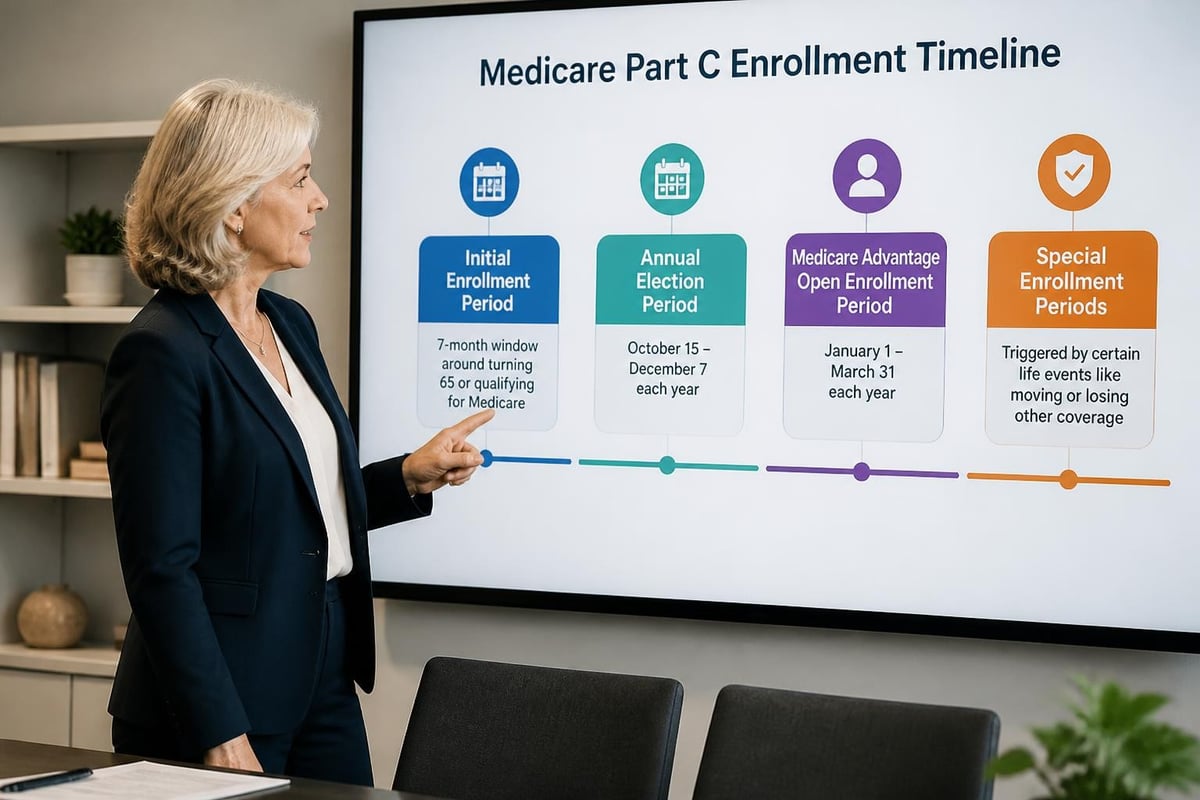
Enrollment Periods Explained
Initial Enrollment Period (IEP): When you first become eligible for Medicare, you have a seven-month window (three months before your 65th birthday month, your birthday month, and three months after) to enroll in a Medicare Advantage plan.
Annual Election Period (AEP): Each year from October 15 to December 7, all Medicare beneficiaries can change their coverage. You can switch from Original Medicare to Medicare Advantage, change from one Medicare Advantage plan to another, or return to Original Medicare.
Medicare Advantage Open Enrollment Period: From January 1 to March 31, people already enrolled in Medicare Advantage can switch to a different Medicare Advantage plan or return to Original Medicare (and join a Part D plan).
Special Enrollment Periods (SEPs): Certain qualifying events allow you to change plans outside the standard periods. These include moving to a new address, losing other coverage, or qualifying for Extra Help with prescription costs.
Comparing Medicare Part C Plans to Other Options
The decision between Medicare Advantage and other Medicare coverage options depends on your personal circumstances, healthcare needs, and preferences.
Medicare Part C vs. Original Medicare Plus Supplement
Original Medicare with a Medicare Supplement plan offers a fundamentally different approach. You maintain Parts A and B through the government, then purchase a Medigap policy to cover copays, coinsurance, and deductibles.
| Feature | Medicare Part C | Original Medicare + Supplement |
|---|---|---|
| Network restrictions | Usually yes (except PPO out-of-network) | No – any provider accepting Medicare |
| Prescription coverage | Typically included | Must purchase separate Part D |
| Extra benefits (dental, vision) | Often included | Not included |
| Out-of-pocket maximum | Yes – provides protection | Only if you buy separate coverage |
| Monthly costs | Variable, sometimes $0 premium | Supplement premiums typically higher |
| Predictability | Copays vary by service | More predictable with comprehensive supplements |
Provider Access and Network Concerns
One of the most significant differences involves provider access. Original Medicare allows you to see any doctor or hospital that accepts Medicare assignment nationwide. Medicare Part C plans restrict access to network providers in most cases.
This becomes particularly important if you:
- Travel frequently or split time between different states
- Have established relationships with specific specialists
- Need access to major medical centers that may not be in all networks
- Want guaranteed access without prior authorization requirements
Recent oversight by the Office of Inspector General has examined denial rates for certain services in Medicare Advantage plans, highlighting the importance of understanding how plan authorization processes may affect access to care.
Evaluating Plan Quality and Performance
Not all medicare part c plans deliver the same quality of care or customer service. Medicare provides tools to help you compare plan performance objectively.
The Star Rating System
Medicare rates plans on a scale of one to five stars based on dozens of quality and performance measures. These ratings cover:
- Management of chronic conditions
- Member experience and satisfaction
- Customer service quality
- Prescription drug safety and accuracy
- Preventive service delivery
Plans with higher Star Ratings may offer additional benefits or lower costs. Some plans with 5-star ratings allow beneficiaries to enroll at any time during the year, not just during standard enrollment periods. The 2025 Star Ratings methodology continues to evolve to better measure plan quality.
Performance Data to Review
When comparing plans, examine:
- Appeals and grievances rates (how often members dispute plan decisions)
- Disenrollment rates (what percentage of members leave the plan)
- Health outcomes for specific conditions
- Medication adherence support
- Care coordination effectiveness
CMS publishes detailed performance data that allows for plan-level comparisons, though interpreting this data requires some technical knowledge.
Reading Plan Documents Carefully
Every medicare part c plan must provide standardized documents that explain coverage:
Evidence of Coverage (EOC): Comprehensive document detailing all plan rules, covered services, costs, and rights
Annual Notice of Change (ANOC): Yearly summary of changes to benefits, costs, or coverage for the upcoming year
Summary of Benefits: Condensed overview of the most important plan features and costs
Don't rely solely on marketing materials. Review the actual EOC to understand exactly what's covered, how much you'll pay, and what restrictions apply.
Special Considerations for North Carolina Residents
If you live in the Triad Area, Greensboro, Kernersville, High Point, and Winston Salem, regional factors influence your medicare part c plans options.
Provider Networks in the Triad Area
The Triad has several major health systems, including hospitals and medical groups. When comparing plans, verify that your preferred providers participate in the plan's network. Some plans may have broader networks that include multiple health systems, while others may have exclusive arrangements with specific providers.
Network adequacy matters particularly for specialists. If you have ongoing relationships with cardiologists, oncologists, or other specialists, confirm they accept your prospective plan before enrolling.
Plan Availability and Competition
North Carolina markets generally offer multiple Medicare Advantage options, giving beneficiaries choice among carriers and plan types. This competition can result in competitive pricing and innovative benefits as plans compete for enrollment.
However, rural areas may have fewer options than urban centers. Residents in less populated areas should pay particular attention to network adequacy and whether their local providers participate.
State-Specific Benefits and Programs
North Carolina participates in Medicare-Medicaid coordination programs for dual-eligible beneficiaries. If you qualify for both Medicare and Medicaid, Special Needs Plans designed for dual-eligibles may offer comprehensive coverage with minimal out-of-pocket costs.
Common Questions About Medicare Part C Plans
Can I Return to Original Medicare After Choosing Medicare Advantage?
Yes, you can switch back to Original Medicare during the Annual Election Period (October 15 – December 7) or the Medicare Advantage Open Enrollment Period (January 1 – March 31). However, getting a Medicare Supplement plan may be difficult depending on your state's rules and your health status. In most states, you don't have guaranteed issue rights to purchase Medigap after your initial enrollment period unless you qualify for specific exceptions.
What Happens If I Move to a Different Area?
Moving outside your plan's service area triggers a Special Enrollment Period. You'll need to choose a new plan available in your new location. Contact your current plan as soon as you know you're moving to understand your options and avoid a coverage gap.
How Do Prior Authorization Requirements Work?
Many medicare part c plans require prior authorization for certain services, meaning the plan must approve the service before it's provided. This typically applies to expensive services, specialized care, or inpatient hospital stays. Your doctor's office usually handles prior authorization requests, but you should understand which services require this approval to avoid unexpected denials.
What If My Doctor Leaves the Plan Network?
If your provider leaves the network mid-year, the plan typically allows you to continue seeing that provider for a transition period (often 90 days) at in-network rates. You'll need to find a new in-network provider or potentially switch plans during the next enrollment period. Some circumstances may qualify you for a Special Enrollment Period to change plans immediately.
Making Your Decision About Medicare Part C Plans
Choosing the right Medicare coverage requires careful analysis of your individual situation. Consider these factors systematically.
Assess Your Healthcare Needs
Current health status: Do you have chronic conditions requiring regular specialist care? Are you generally healthy with minimal doctor visits?
Prescription medications: Make a complete list of your drugs and check that plans cover them on appropriate formulary tiers.
Preferred providers: Identify doctors, hospitals, and specialists you want to continue seeing.
Geographic flexibility: Do you travel frequently or have homes in different states?
Calculate Total Expected Costs
Don't focus solely on monthly premiums. Calculate your total anticipated annual costs including:
- Monthly premiums (both Part B and any plan premium)
- Expected copays based on typical doctor visit frequency
- Prescription drug costs under each plan
- Any planned procedures or surgeries
Medicare’s Plan Finder tool allows you to enter your doctors and drugs to compare personalized cost estimates.
Consider Your Risk Tolerance
Some people prefer predictable costs with higher monthly premiums (like comprehensive Medigap plans). Others accept variability in exchange for lower monthly costs (like many Medicare Advantage plans). Neither approach is inherently better; it depends on your financial situation and preferences.

Get Personalized Help
Medicare coverage is complex, and individual circumstances vary dramatically. Speaking with a knowledgeable insurance professional can clarify your options and help you avoid costly mistakes.
For personalized guidance on medicare part c plans in the Triad Area, Greensboro, Kernersville, High Point, and Winston Salem, contact Moser Insurance Group Inc at 336-862-1763 or email moserinsurancegroup@gmail.com. Their expertise helps you understand how different coverage options align with your specific healthcare needs and budget.
Staying Current with Plan Changes
Medicare Advantage plans can and do change their benefits, costs, and provider networks annually. Active management of your coverage ensures you maintain optimal benefits.
Annual Review Process
Every fall, review your plan's Annual Notice of Change carefully. Look for:
- Premium increases or decreases
- Changes to copays or coinsurance amounts
- Modifications to the drug formulary
- Providers entering or leaving the network
- New benefits being added or existing benefits being reduced
Even if you were satisfied with your plan previously, changes might make a different option more suitable for the upcoming year.
Monitoring Throughout the Year
Stay alert to mid-year changes that might affect your coverage:
- New medications prescribed that might not be covered optimally
- Developing health conditions that change your care needs
- Provider network changes that affect your doctors
- Life changes like moving or losing other insurance coverage
Some changes may qualify you for a Special Enrollment Period, allowing you to adjust your coverage outside the standard enrollment windows.
Resources for Staying Informed
Utilize these resources to stay current:
- Medicare's official communications about program changes
- Your plan's member newsletters and portal
- State Health Insurance Assistance Programs (SHIIP in North Carolina) offering free counseling
- Trusted insurance professionals who monitor market changes
Visit moserinsurancegroup.com for updates on Medicare changes affecting North Carolina beneficiaries.
Choosing among medicare part c plans requires understanding how benefits, costs, networks, and quality measures align with your healthcare needs and preferences. Whether Medicare Advantage's integrated approach suits you better than Original Medicare with supplemental coverage depends entirely on your individual circumstances. Moser Insurance Group Inc provides the personalized guidance you need to navigate these options confidently in the Triad Area, Greensboro, Kernersville, High Point, and Winston Salem. Contact them at 336-862-1763, email moserinsurancegroup@gmail.com, or visit Moser Insurance Group Inc to discuss your Medicare options with experienced professionals who prioritize education over pressure.
Recent Comments