

Navigating retirement planning requires understanding two critical federal programs that form the foundation of most Americans' retirement security. Social security and medicare represent the cornerstone benefits that millions of retirees across the Triad Area, including Greensboro, Kernersville, High Point, and Winston Salem, depend on for income and healthcare coverage. While these programs operate separately, they intersect at important points throughout your retirement journey. Understanding how they work together, when to enroll, and what coverage gaps exist can help you make informed decisions about your financial and healthcare future.
Understanding the Social Security System in 2026
Social Security provides monthly income benefits to retired workers, disabled individuals, and survivors of deceased workers. The program operates through payroll taxes collected from current workers, which fund benefits for current beneficiaries.
Eligibility and Benefit Calculations
To qualify for Social Security retirement benefits, you must earn 40 credits throughout your working life, equivalent to approximately 10 years of work. Your benefit amount depends on your 35 highest-earning years, adjusted for inflation.
Key factors affecting your benefit:
- Your average indexed monthly earnings (AIME)
- The age you claim benefits
- Your full retirement age (FRA) based on birth year
- Cost-of-living adjustments (COLA)
Your full retirement age ranges from 66 to 67, depending on your birth year. Claiming before your FRA reduces your monthly benefit permanently, while delaying beyond your FRA increases it up to age 70.
The Congressional Research Service provides comprehensive analysis of how these programs are structured and financed, offering valuable background for understanding your benefits.

Medicare: America's Health Insurance for Seniors
Medicare serves as the primary health insurance program for Americans aged 65 and older, plus certain younger individuals with disabilities. Unlike Social Security, which provides income, Medicare addresses healthcare costs through several distinct parts.
The Four Parts of Medicare Coverage
Medicare divides into four separate components, each covering different healthcare services:
| Medicare Part | Coverage | 2026 Premium |
|---|---|---|
| Part A | Hospital insurance, inpatient care | Most pay $0 (if 40+ work credits) |
| Part B | Medical insurance, doctor visits | Standard: $185/month |
| Part C | Medicare Advantage (alternative to A+B) | Varies by plan |
| Part D | Prescription drug coverage | Varies by plan |
Part A covers hospital stays, skilled nursing facilities, hospice care, and some home healthcare. Most people qualify for premium-free Part A through their work history or their spouse's work history.
Part B covers doctor visits, outpatient care, preventive services, and durable medical equipment. The 2025 Medicare Parts B premiums and deductibles established baseline costs that continue into 2026 with adjustments.
Part C, or Medicare Advantage, offers an alternative way to receive Medicare benefits through private insurance companies. These plans combine Parts A, B, and often D into one package.
Part D provides prescription drug coverage through private insurers. Understanding how Medicare Part D drug plans work helps you evaluate whether your medications will be covered affordably.
Income-Related Monthly Adjustment Amounts (IRMAA)
Higher-income beneficiaries pay additional premiums for Parts B and D. These surcharges apply based on your modified adjusted gross income (MAGI) from two years prior.
2026 IRMAA brackets for Part B (per person):
- Income up to $106,000 (single) / $212,000 (joint): Standard premium
- Income $106,001-$133,000 / $212,001-$266,000: Add $74/month
- Income $133,001-$167,000 / $266,001-$334,000: Add $185/month
- Income $167,001-$200,000 / $334,001-$400,000: Add $295.80/month
- Income above $200,000 / $400,000: Add $332.20/month
How Social Security and Medicare Connect
Social security and medicare intersect at several critical junctures that affect your enrollment timing and coverage options.
Automatic Medicare Enrollment
If you're already receiving Social Security benefits when you turn 65, Medicare enrollment happens automatically. You'll receive your Medicare card approximately three months before your 65th birthday, with coverage beginning the first day of your birthday month.
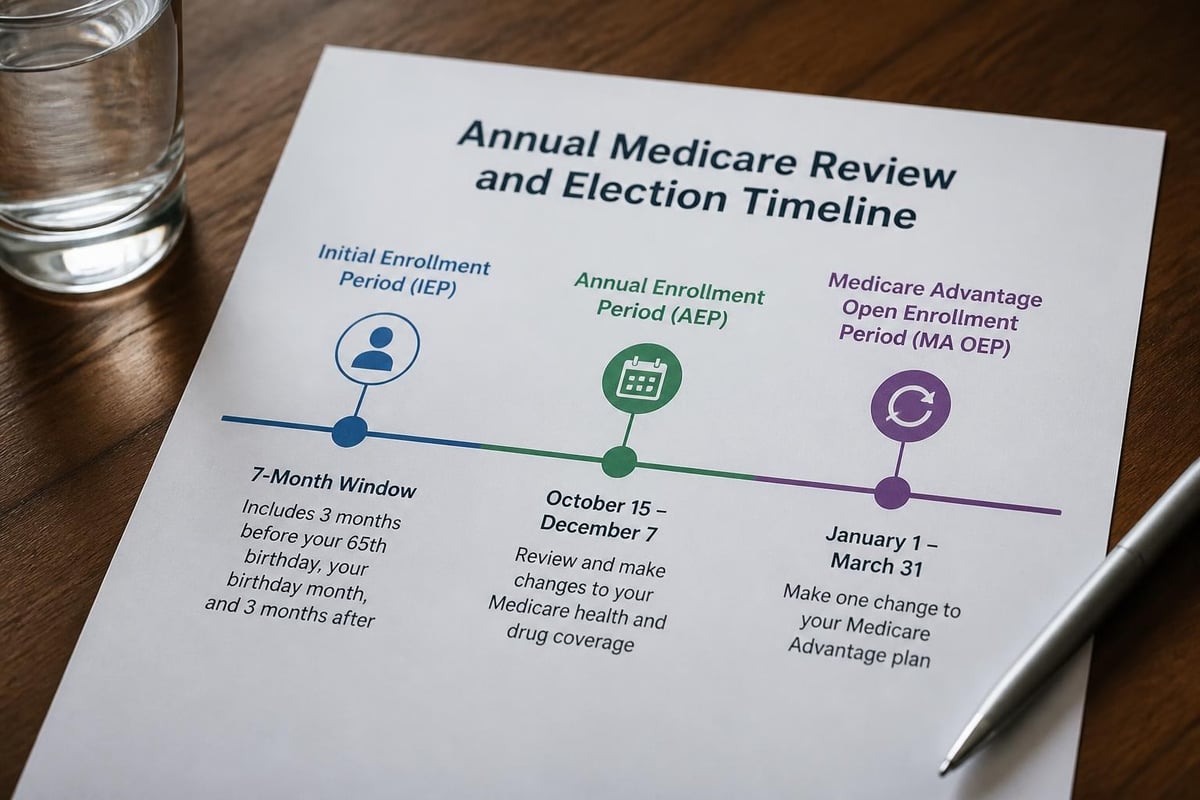
However, if you haven't claimed Social Security yet, you must actively enroll in Medicare during your Initial Enrollment Period (IEP).
Your Initial Enrollment Period includes:
- The three months before your 65th birthday month
- Your birthday month
- The three months after your birthday month
Missing this window can result in permanent late enrollment penalties for Part B and Part D coverage.
Coordinating Benefits When Still Working
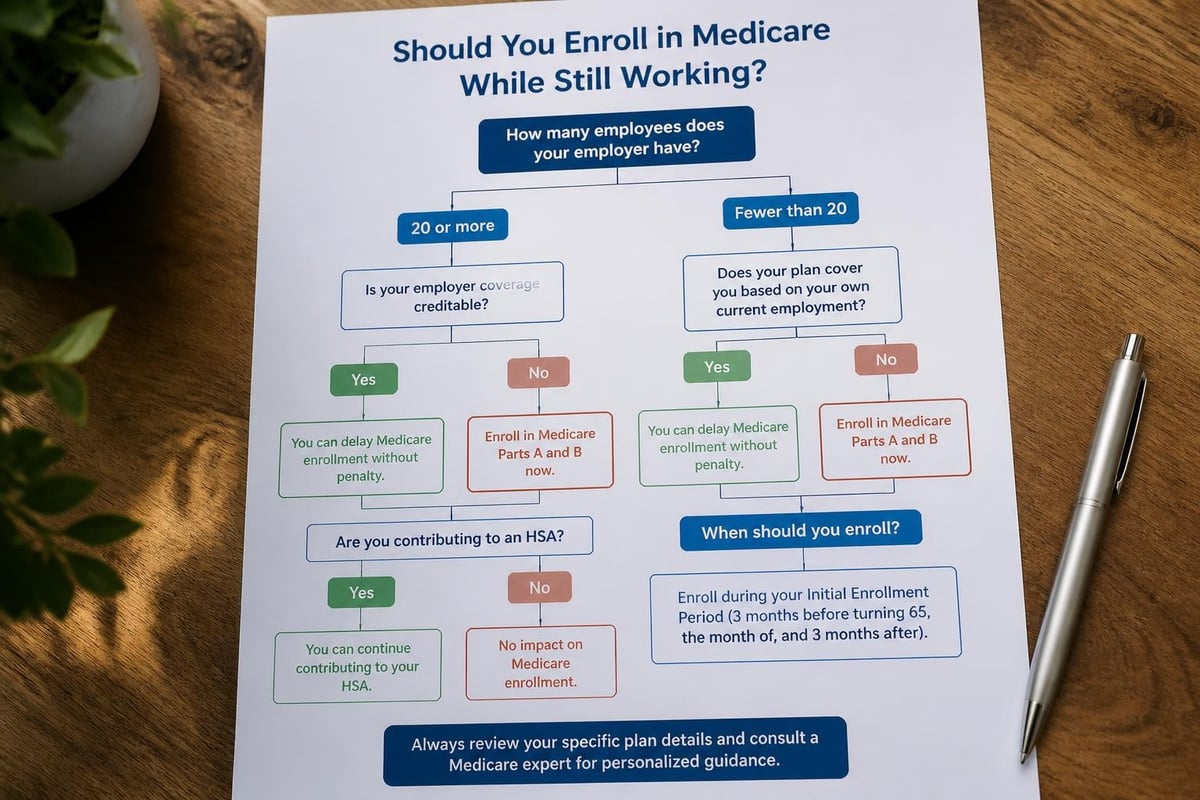
Many people in the Greensboro, High Point, and Winston Salem areas continue working past age 65. If you have creditable employer health coverage through your or your spouse's current employment (company with 20+ employees), you can delay Medicare Part B without penalty.
You should still enroll in Part A at 65 if it's premium-free, as it provides primary coverage for hospital stays. However, if you're contributing to a Health Savings Account (HSA), enrolling in Medicare Part A ends your HSA contribution eligibility.
Coverage Gaps and Supplemental Options
Original Medicare (Parts A and B) leaves significant out-of-pocket costs through deductibles, coinsurance, and copayments. Understanding these gaps helps you plan for healthcare expenses in retirement.
What Original Medicare Doesn't Cover
Coverage limitations include:
- Part A deductible: $1,676 per benefit period (2026)
- Part B deductible: $240 annually (2026)
- 20% coinsurance for most Part B services (no cap)
- Prescription drugs (unless you add Part D)
- Dental care, vision care, hearing aids
- Long-term custodial care
The 20% coinsurance creates unlimited financial exposure. A $100,000 hospital bill would leave you responsible for $20,000 after Medicare pays its share.
Medicare Supplement Plans Fill the Gaps
Medicare Supplement plans (Medigap) are private insurance policies designed specifically to cover these out-of-pocket costs. These standardized plans work alongside Original Medicare, paying some or all of the deductibles, coinsurance, and copayments that Medicare doesn't cover.
Medigap plans are guaranteed renewable and accepted by any provider who accepts Medicare, offering complete flexibility in choosing your doctors and hospitals. Residents throughout Kernersville and the broader Triad Area can explore these options to protect against unpredictable medical expenses.
Medicare Advantage as an Alternative
Medicare Advantage plans provide an alternative to the Original Medicare plus Medigap combination. These plans often include prescription drug coverage and may offer additional benefits like dental, vision, and hearing coverage.
Research from the Kaiser Family Foundation shows enrollment trends demonstrating how beneficiaries split between traditional Medicare with supplements versus Medicare Advantage options based on their individual healthcare needs and preferences.
Financial Sustainability and Future Reforms
Both social security and medicare face long-term financing challenges that may affect future benefits and coverage.
Trust Fund Projections
The Social Security and Medicare Trustees issue annual reports projecting the programs' financial health. The Medicare Trustees Report provides detailed analysis of the Hospital Insurance Trust Fund that finances Part A.
Current projections indicate the Medicare Hospital Insurance Trust Fund may face depletion in the 2030s without legislative changes. Similarly, Social Security's combined trust funds face potential shortfalls within the next decade.
Potential Reform Options
Policy experts across the political spectrum acknowledge the need for reforms to ensure these programs' sustainability. The Brookings Institution has outlined various reform approaches that balance preserving benefits with ensuring long-term solvency.
Possible reform measures include:
- Adjusting the payroll tax cap
- Gradually raising the full retirement age
- Modifying benefit formulas for higher earners
- Increasing Medicare premiums for wealthy beneficiaries
- Implementing means-testing for benefits
- Allowing Medicare to negotiate more drug prices
The recently enacted Inflation Reduction Act already began allowing Medicare to negotiate prices for certain high-cost prescription drugs, representing one reform approach to controlling costs.
Strategic Planning for Social Security and Medicare
Coordinating these two programs requires strategic timing and careful consideration of your unique circumstances.
Optimal Claiming Strategies
Your Social Security claiming decision significantly impacts your lifetime benefits. Delaying Social Security from age 62 to 70 can increase your monthly benefit by as much as 76%, not including cost-of-living adjustments.
Claiming considerations:
- Health status and life expectancy: Better health may favor delaying
- Financial need: Immediate income requirements may necessitate early claiming
- Spousal benefits: Coordinating with your spouse's benefits
- Work status: Earnings limits if claiming before full retirement age
- Tax implications: How benefits will be taxed based on other income
Medicare enrollment, however, should generally occur at age 65 to avoid penalties, even if you delay Social Security. For those continuing to work with creditable employer coverage, careful documentation prevents future penalty assessments.
Healthcare Cost Planning
The official Medicare & You handbook provides comprehensive guidance on estimating your healthcare costs under different coverage scenarios.
Average healthcare costs in retirement can exceed $300,000 per couple over their lifetime, not including long-term care. Planning for these expenses requires understanding:
- Your likely Medicare premiums based on projected income
- Expected out-of-pocket costs based on health conditions
- Supplemental coverage costs (Medigap or Medicare Advantage)
- Prescription drug expenses under Part D
- Services Medicare doesn't cover
Regional Considerations for Triad Area Residents
Healthcare costs and coverage options can vary significantly by location. Those in Greensboro, Winston Salem, High Point, and Kernersville should understand local factors affecting their coverage.
Local Medicare Advantage Availability
Medicare Advantage plan availability and costs differ by county and ZIP code. The Triad Area typically offers multiple Medicare Advantage options from various carriers, each with different:
- Monthly premiums (ranging from $0 to $100+)
- Provider networks
- Prescription drug formularies
- Additional benefits
Comparing plans annually during the Annual Enrollment Period (October 15 to December 7) ensures you maintain optimal coverage as your health needs change.
Medigap Pricing in North Carolina
North Carolina uses community rating for Medigap policies, meaning insurers cannot charge different premiums based on age. However, they can consider tobacco use and gender when setting rates.
The guaranteed issue period for Medigap begins when you first enroll in Medicare Part B at age 65 or older. During this six-month window, insurance companies must sell you any Medigap policy they offer, regardless of health conditions, and cannot charge higher premiums due to health issues.
Maximizing Your Benefits
Understanding how social security and medicare work together allows you to maximize the value of both programs throughout retirement.
Tax-Efficient Withdrawal Strategies
Social Security benefits may be taxable depending on your combined income (adjusted gross income + nontaxable interest + half of Social Security benefits). Up to 85% of benefits can be subject to federal income tax.
Strategic withdrawal planning from retirement accounts can minimize taxes on Social Security while managing Medicare IRMAA surcharges. Since IRMAA uses income from two years prior, large withdrawals or Roth conversions can trigger higher Medicare premiums in subsequent years.
Coordinating With Other Retirement Income
Social security and medicare interact with your other retirement resources, including:
- 401(k) and IRA withdrawals
- Pension income
- Part-time employment earnings
- Investment income
- Rental property income
Balancing these income sources while minimizing taxes and Medicare surcharges requires careful planning, ideally beginning several years before retirement.
Special Enrollment Situations
Certain circumstances create special rules for social security and medicare enrollment.
Disability Benefits
Individuals who receive Social Security Disability Insurance (SSDI) for 24 months automatically qualify for Medicare, regardless of age. This provides critical healthcare coverage for younger disabled individuals who haven't reached age 65.
End-Stage Renal Disease
People with permanent kidney failure requiring dialysis or a kidney transplant qualify for Medicare regardless of age. Coverage typically begins three months after dialysis treatments start.
Working Past 70
Some people continue working well beyond traditional retirement age. While Social Security benefits max out at age 70 (no additional delayed retirement credits), you can continue working and earning benefits simultaneously without reduction.
Medicare remains your primary insurance once enrolled, with employer coverage potentially serving as secondary coverage, depending on employer size and plan coordination rules.
Making Informed Decisions
The complexity of social security and medicare requires careful research and often professional guidance. Understanding your coverage options ensures you avoid costly gaps while maximizing your retirement security.
Both programs offer significant value but require active management. Reviewing your coverage annually, staying informed about program changes, and adjusting your strategy as circumstances evolve helps maintain optimal protection throughout retirement.
For personalized assistance, contact Moser Insurance Group Inc at 336-862-1763, email moserinsurancegroup@gmail.com, or visit moserinsurancegroup.com to explore how these programs fit into your comprehensive retirement plan.
Understanding how social security and medicare work together forms the foundation of successful retirement planning. With the right knowledge about enrollment timing, coverage options, and strategic claiming decisions, you can maximize these essential benefits while protecting yourself from unexpected healthcare costs. Moser Insurance Group Inc specializes in helping individuals and families throughout the Triad Area navigate Medicare options with clear, personalized guidance. Contact Moser Insurance Group Inc at 336-862-1763 or moserinsurancegroup@gmail.com to discuss your specific Medicare needs and make confident insurance decisions without pressure.
Recent Comments