

Buying a home represents one of the most significant financial commitments most families will ever make. With that commitment comes the question: what happens to your mortgage if you pass away unexpectedly? Mortgage protection insurance offers one potential solution, designed specifically to pay off your remaining home loan balance so your family doesn't lose the house during an already difficult time. Understanding how this coverage works, what it costs, and whether it makes sense for your situation requires careful examination of the details and alternatives available.
What Is Mortgage Protection Insurance
Mortgage protection insurance is a specialized type of decreasing term life insurance policy designed to pay off your outstanding mortgage balance if you die before the loan is fully repaid. Unlike traditional life insurance where beneficiaries receive the death benefit directly, mortgage protection insurance typically pays the lender directly, ensuring the home loan is satisfied.
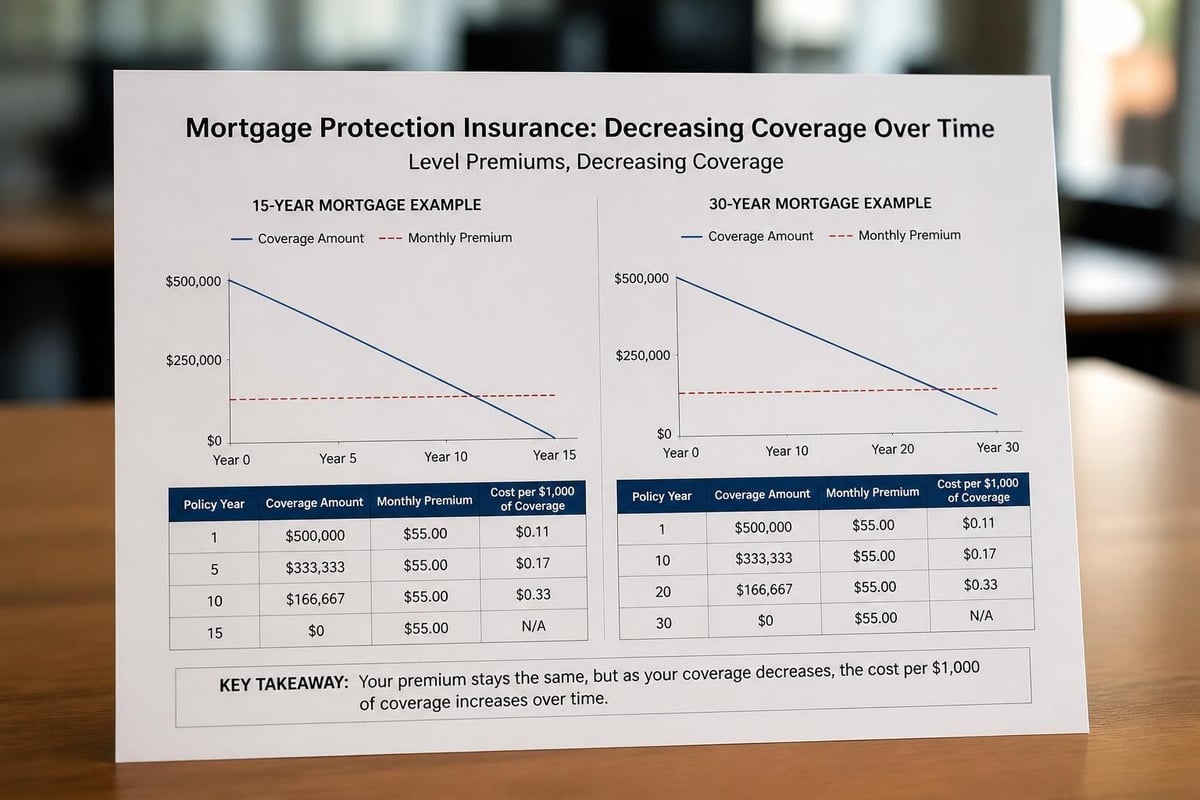
The coverage amount decreases over time as you pay down your mortgage principal. This declining benefit structure mirrors your shrinking loan balance, which is why insurers can often offer lower premiums than level-term policies with fixed death benefits.
Key Features of MPI Coverage
When you purchase mortgage protection insurance, you're essentially buying peace of mind that your family won't face foreclosure or be forced to sell the home after your death. The policy remains active as long as you continue paying premiums and maintain your mortgage.
Core characteristics include:
- Death benefit goes directly to mortgage lender
- Coverage amount decreases as mortgage balance declines
- Premiums typically remain fixed throughout the policy term
- No medical exam required for most policies
- Approval process is usually faster than traditional life insurance
Most policies will also include options for disability riders or critical illness coverage, though these additions increase your monthly cost. The standard mortgage protection insurance policy focuses solely on death benefits tied to your remaining mortgage balance.

How Mortgage Protection Insurance Works
The mechanics of mortgage protection insurance are relatively straightforward compared to other insurance products. When you apply for coverage, you specify your current mortgage balance and loan term. The insurance company structures a policy that matches these parameters.
The Application Process
Getting approved for mortgage protection insurance typically involves less scrutiny than traditional life insurance. Many providers offer guaranteed issue policies that don't require medical exams or extensive health questionnaires. This simplified underwriting makes MPI attractive to people with pre-existing health conditions who might struggle to qualify for standard life insurance.
Application steps usually include:
- Requesting a quote based on your mortgage amount and remaining term
- Completing a basic application with health questions
- Reviewing and signing policy documents
- Beginning premium payments
- Receiving coverage confirmation
Your premium amount depends on several factors including your age, mortgage balance, loan term length, and whether you add optional riders. The Consumer Financial Protection Bureau notes that mortgage protection insurance differs from private mortgage insurance (PMI), which protects lenders when borrowers make small down payments.
Payment Structure and Beneficiaries
With mortgage protection insurance, your mortgage lender is the beneficiary, not your spouse or children. When you pass away, your family files a claim with the insurance company, which then pays the remaining mortgage balance directly to the lender. This arrangement ensures the home is paid off but leaves your family without additional funds for other expenses.
The premium payment schedule offers flexibility, with monthly, quarterly, or annual payment options available from most providers. These payments remain constant even as your coverage amount decreases, which some consumers find less favorable compared to alternatives like term life insurance.
Costs and Coverage Amounts
Understanding the true cost of mortgage protection insurance requires looking beyond the monthly premium to evaluate the overall value proposition. Since coverage decreases while premiums stay flat, you're paying the same amount for less protection as years pass.
| Coverage Factor | Typical Range | Notes |
|---|---|---|
| Monthly Premium | $50-$300 | Based on age, health, mortgage size |
| Initial Coverage | $100,000-$500,000 | Matches mortgage balance |
| Policy Term | 15-30 years | Aligns with mortgage term |
| Medical Exam | Usually not required | Simplified underwriting |
Factors Affecting Premium Costs
Insurance companies calculate your mortgage protection insurance premiums using several variables. Your age at application significantly impacts cost, with older applicants paying substantially more than younger ones. The size of your mortgage also plays a major role, as larger loan balances require higher initial coverage amounts.
Premium determinants include:
- Current age and gender
- Smoking status
- Overall health condition
- Mortgage balance and term
- Optional riders added
- State of residence
Residents in the Triad Area, including Greensboro, Kernersville, High Point, and Winston Salem, should compare quotes from multiple providers as rates can vary considerably based on local regulations and market competition.
Comparing Value Over Time
One challenge with mortgage protection insurance is that you're paying level premiums for declining coverage. In the first year, you might pay $100 monthly for $300,000 in coverage. Ten years later, you're still paying $100 monthly, but your mortgage balance (and coverage amount) has dropped to $200,000. This creates a situation where your cost per dollar of coverage increases significantly over the policy's life.
Financial experts often point out that term life insurance may offer better value since the death benefit remains constant while premiums stay level. Your beneficiaries receive the full amount regardless of when you pass away during the term.
Alternatives to Mortgage Protection Insurance
Before purchasing mortgage protection insurance, you should evaluate other options that might provide better financial protection for your family. Several alternatives offer more flexibility and potentially better value depending on your circumstances.
Term Life Insurance Comparison
Term life insurance provides a fixed death benefit for a specified term, typically 10, 20, or 30 years. Your beneficiaries receive the full death benefit and can use it for any purpose, including paying off the mortgage, covering funeral expenses, replacing lost income, or funding children's education.
| Feature | Mortgage Protection Insurance | Term Life Insurance |
|---|---|---|
| Beneficiary | Mortgage lender | Family/person you choose |
| Coverage amount | Decreases over time | Remains level |
| Flexibility | Mortgage payoff only | Any financial need |
| Medical exam | Usually not required | Often required |
| Cost | Higher per dollar of coverage | Often lower overall |
| Portability | Tied to specific mortgage | Portable regardless of home |
If you sell your home or refinance, your mortgage protection insurance may not transfer to the new loan. Term life insurance remains in force regardless of your housing situation, providing continuity of coverage.
Disability Insurance Considerations
Becoming disabled and unable to work can be just as financially devastating as death. Standard mortgage protection insurance doesn't help if you're alive but can't earn income to make mortgage payments. Some MPI policies offer disability riders, but dedicated disability insurance often provides more comprehensive coverage.
Short-term and long-term disability policies replace a portion of your income if illness or injury prevents you from working. This income can cover your mortgage payment plus all other living expenses your family needs.
Building Emergency Savings
Rather than paying monthly premiums for mortgage protection insurance, some financial advisors recommend building a substantial emergency fund that could cover six to twelve months of mortgage payments. This self-insurance approach provides liquidity for any emergency, not just death or disability.
For a $1,500 monthly mortgage payment, an emergency fund of $9,000 to $18,000 would provide six to twelve months of coverage. Contributing $150 monthly would build this fund in five to ten years while maintaining complete control over the money.
Who Should Consider Mortgage Protection Insurance
Mortgage protection insurance makes sense for specific situations, though it's not the right choice for everyone. Understanding when this coverage provides genuine value helps you make an informed decision about protecting your home and family.
Ideal Candidates for MPI
People with serious health conditions that make traditional life insurance difficult or impossible to obtain may find mortgage protection insurance appealing. The simplified underwriting process, often with guaranteed approval, provides access to coverage that might otherwise be unavailable.
Situations where MPI might be appropriate:
- Significant health issues preventing traditional life insurance approval
- Immediate coverage needed without time for medical exams
- Single-income households where mortgage payment would be unaffordable after breadwinner's death
- Older homebuyers who face high term life insurance premiums
- Desire for simplicity over maximum flexibility
Families in Greensboro, High Point, Winston Salem, or Kernersville who want absolute certainty their mortgage will be paid off might appreciate the straightforward nature of mortgage protection insurance, even if other options offer better overall value.
When to Look Elsewhere
If you're relatively healthy and can qualify for traditional life insurance, you'll almost always get better value and flexibility from a term life policy. The ability to direct death benefits to any purpose provides your family with options during a difficult time.
Young homebuyers with 30-year mortgages should carefully consider whether they want coverage that decreases over time. The same premium dollars invested in term life insurance provide constant protection throughout the policy period, potentially covering multiple financial needs beyond just the mortgage.
If you're considering life insurance for your parents or other family members, traditional policies typically offer more versatility than mortgage-specific coverage.
Making an Informed Decision
Choosing whether to purchase mortgage protection insurance requires evaluating your complete financial picture, not just your mortgage situation. This decision affects your family's long-term financial security and deserves thorough analysis.
Questions to Ask Before Buying
Start by assessing your total life insurance needs, not just mortgage coverage. Calculate the income replacement your family would need, add debt payoff amounts including the mortgage, factor in funeral expenses, and consider future costs like children's education. This comprehensive approach reveals whether mortgage-focused coverage addresses all your priorities.
Critical evaluation questions:
- What total death benefit does my family need for complete protection?
- Can I qualify for traditional term life insurance?
- How does the cost per dollar of coverage compare between MPI and term life?
- Will my family need funds beyond just mortgage payoff?
- What happens if I refinance or move before the policy ends?
Chase Bank’s analysis suggests homeowners carefully weigh the convenience of guaranteed approval against the limitations of decreasing coverage and restricted beneficiary options.
Getting Professional Guidance
Working with an experienced insurance professional helps you navigate the complexities of different coverage options. A knowledgeable advisor can compare multiple products, explain subtle policy differences, and recommend solutions tailored to your specific circumstances.
For personalized guidance, contact Moser Insurance Group Inc at 336-862-1763 or email moserinsurancegroup@gmail.com. Our team serves families throughout the Triad Area and can help you evaluate whether mortgage protection insurance or alternative solutions better meet your needs.

Common Misconceptions About Mortgage Protection Insurance
Several myths about mortgage protection insurance lead to confusion among homebuyers. Clearing up these misunderstandings helps you make decisions based on facts rather than marketing claims.
Myth: MPI Is Required to Get a Mortgage
Many first-time homebuyers believe mortgage protection insurance is mandatory, confusing it with private mortgage insurance (PMI). Capital One clarifies that MPI is completely optional. Lenders may offer it at closing, but you're never required to purchase it to qualify for your home loan.
Private mortgage insurance, by contrast, is often required when you make a down payment below 20%. PMI protects the lender if you default on the loan. It has nothing to do with life insurance or protecting your family.
Myth: MPI Provides the Best Value for Mortgage Protection
Marketing materials often emphasize the convenience and simplicity of mortgage protection insurance without comparing it to alternatives. While MPI does offer streamlined approval, it rarely provides the best value per premium dollar spent.
Reality checks on common claims:
- "No medical exam required" – Many term life policies also offer no-exam options
- "Guaranteed approval" – Traditional guaranteed issue life insurance exists too
- "Specifically designed for your mortgage" – This limits flexibility, not enhances it
- "Simple and convenient" – Term life insurance is also straightforward
The perspective from The Week suggests that most homeowners benefit more from traditional term life insurance that provides comprehensive family protection rather than single-purpose mortgage coverage.
Myth: Your Family Receives the Death Benefit
A critical misunderstanding involves who receives the money when you pass away. Many people assume mortgage protection insurance works like regular life insurance, with their family getting a check they can use as needed. In reality, the lender receives direct payment to satisfy the mortgage.
Your family gets the benefit of a paid-off home but receives no additional cash. If they need money for immediate expenses, lost income replacement, or other bills, they must find those funds elsewhere. This limitation makes MPI less versatile than policies where your beneficiaries control how death benefits are used.
Policy Features and Important Details
Understanding the fine print of mortgage protection insurance policies helps you avoid surprises and make accurate comparisons. Several key features distinguish one policy from another and significantly impact their value.
Renewability and Conversion Options
Most mortgage protection insurance policies are not renewable beyond the initial term. When your coverage period ends (typically when your mortgage is paid off or reaches term), the policy simply terminates. You cannot extend coverage without applying for a completely new policy, likely at much higher rates due to your increased age.
Some policies offer conversion privileges that allow you to switch to permanent life insurance without a medical exam. This feature can be valuable if you develop health issues during the mortgage term and want to maintain some coverage after the policy ends. However, conversions typically come with significantly higher premiums.
Exclusions and Limitations
Like all insurance products, mortgage protection insurance includes specific exclusions that prevent death benefit payment under certain circumstances. Common exclusions involve suicide within the first two years of coverage, death while committing a felony, or death resulting from activities specifically excluded in your policy.
Typical policy exclusions:
- Suicide during initial contestability period (usually two years)
- Death during participation in hazardous activities if not disclosed
- Deaths occurring during military service in some policies
- Material misrepresentations on the application
- Deaths outside covered territory for some international policies
Reading the entire policy document before purchase reveals these important limitations. What seems like comprehensive coverage might have gaps that affect your family's protection.
Portability Concerns
Your mortgage protection insurance is tied to your specific home loan. If you sell your house and buy a new one, your existing MPI typically doesn't transfer to the new mortgage. You'll need to apply for new coverage, which means new underwriting, potentially higher premiums due to your increased age, and possible denial if your health has deteriorated.
This lack of portability contrasts sharply with term life insurance, which remains in force regardless of where you live or whether you own a home. For people who might move or refinance before paying off their mortgage, this inflexibility creates significant disadvantages.
Tax Implications and Financial Planning
Understanding how mortgage protection insurance fits into your broader financial and tax planning helps maximize its value if you decide to purchase coverage. Several tax-related considerations affect the overall cost-benefit analysis.
Premium Tax Treatment
Premiums you pay for mortgage protection insurance are generally not tax-deductible. The IRS treats these payments as personal expenses similar to other life insurance premiums. Even though the death benefit goes to pay off a secured debt, you cannot deduct the cost from your taxable income.
This differs from mortgage interest, which is often tax-deductible for homeowners who itemize deductions. The lack of tax benefits on premiums increases the effective cost of mortgage protection insurance compared to the stated premium amount.
Death Benefit Taxation
The good news is that death benefits from mortgage protection insurance are typically received income-tax-free. When the insurance company pays off your mortgage after your death, your family doesn't owe income taxes on that payment. This tax-free treatment applies to nearly all life insurance death benefits, whether from MPI or traditional policies.
However, estate taxes might apply if your total estate exceeds federal or state exemption thresholds. For 2026, the federal estate tax exemption is substantial, so most families won't face this issue. But high-net-worth individuals should consult with estate planning attorneys about strategies to minimize estate tax exposure.
Integrating MPI Into Comprehensive Planning
Mortgage protection insurance should be evaluated as one piece of your complete financial protection strategy. Consider how it works alongside emergency funds, other life insurance policies, disability coverage, and retirement savings.
For comprehensive guidance on life insurance options that work together with your overall financial plan, visit moserinsurancegroup.com or call 336-862-1763. Residents throughout Greensboro, Winston Salem, High Point, and Kernersville can receive personalized recommendations that consider all aspects of financial security.
Shopping for Mortgage Protection Insurance
If you decide mortgage protection insurance suits your needs, shopping carefully ensures you get the best available coverage at competitive rates. The process differs somewhat from buying traditional life insurance but requires similar diligence.
Comparing Quotes and Providers
Request quotes from at least three to five different insurance companies. Premium rates for similar coverage can vary significantly between providers, and features like riders, conversion options, and exclusions differ across policies.
When comparing quotes, ensure you're evaluating equivalent coverage. Verify the initial death benefit, premium payment schedule, policy term length, and any included riders. Small differences in these details can make direct price comparisons misleading.
Essential comparison factors:
- Monthly or annual premium amounts
- Total premium payments over policy life
- Initial coverage amount and decreasing schedule
- Guaranteed versus non-guaranteed premiums
- Conversion and renewal rights
- Financial strength rating of insurance company
- Customer service reputation and claims processing speed
MoneyGeek’s detailed analysis emphasizes the importance of understanding exactly what you're buying, as policies marketed as "mortgage protection insurance" can vary significantly in their actual terms and conditions.
Reading the Policy Document
Never purchase insurance based solely on marketing materials or sales presentations. Request and carefully read the complete policy document, including all exclusions, limitations, and conditions. Pay special attention to circumstances under which the death benefit might not be paid.
Look for clear definitions of key terms, the specific claims process your family must follow, and any requirements for maintaining coverage. Understanding these details before purchase prevents unpleasant surprises when your family needs to file a claim.
Verifying Company Financial Strength
Your insurance is only as reliable as the company backing it. Research the financial strength ratings of any insurer you're considering. Rating agencies like AM Best, Moody's, and Standard & Poor's evaluate insurance companies' ability to pay claims.
Choose companies with strong ratings (A- or better from AM Best) to ensure they'll be around to pay claims potentially decades in the future. A slightly lower premium from a financially weak company is a poor trade-off if that company fails when your family needs it most.
Mortgage protection insurance offers targeted coverage that pays off your home loan if you pass away, providing peace of mind that your family won't lose the house. However, it's important to compare this specialized coverage against more flexible alternatives like term life insurance that might better serve your family's comprehensive needs. If you're exploring protection options for your mortgage or other financial obligations, Moser Insurance Group Inc can help you understand all your choices without pressure. Contact us at 336-862-1763, email moserinsurancegroup@gmail.com, or visit Moser Insurance Group Inc to discuss personalized solutions for families in the Triad Area.
Recent Comments