

Navigating Medicare coverage can feel overwhelming, especially when you discover that Original Medicare doesn't cover all your healthcare costs. This is where Medicare Supplement insurance, commonly known as Medigap, becomes essential. These standardized policies help fill the gaps in Original Medicare by covering out-of-pocket expenses like deductibles, copayments, and coinsurance. For residents in the Triad Area, including Greensboro, Kernersville, High Point, and Winston-Salem, understanding your supplemental coverage options is crucial for protecting your financial health while maintaining access to quality healthcare. Whether you're approaching 65 or already enrolled in Medicare, this comprehensive guide will help you make informed decisions about Medicare supplement coverage.
Understanding Medicare Supplement Insurance Fundamentals
A Medicare supplement policy works alongside Original Medicare Parts A and B to reduce your out-of-pocket medical expenses. Unlike Medicare Advantage plans that replace Original Medicare, Medicare Supplement insurance (Medigap) provides additional coverage that pays after Medicare pays its share.
Private insurance companies sell these standardized policies, but the federal government regulates what they must cover. This standardization means that Plan G from one company offers identical benefits to Plan G from another company, though premiums may differ.
What Medicare Supplement Policies Cover
Medicare supplement plans help pay for various healthcare costs that Original Medicare doesn't fully cover:
- Part A coinsurance and hospital costs up to an additional 365 days after Medicare benefits are exhausted
- Part B coinsurance or copayment for doctor visits and outpatient services
- Blood transfusions for the first three pints each year
- Part A hospice care coinsurance or copayment
- Skilled nursing facility care coinsurance
- Part A deductible (on most plans)
- Part B deductible (only on certain plans)
- Part B excess charges when doctors charge more than Medicare-approved amounts
- Foreign travel emergency care up to plan limits
Most Medicare supplement policies do not cover prescription drugs, vision care, dental care, hearing aids, or long-term care. For prescription coverage, you'll need to enroll separately in a Medicare Part D prescription drug plan.

Standardized Medicare Supplement Plans Available in 2026
The Centers for Medicare & Medicaid Services (CMS) has standardized Medicare supplement plans into lettered categories. Each plan type offers a specific set of benefits, making it easier to compare Medigap policies across different insurance companies.
Current Plan Options
| Plan Type | Part A Deductible | Part B Deductible | Part B Excess Charges | Foreign Travel Emergency |
|---|---|---|---|---|
| Plan A | No | No | No | No |
| Plan B | Yes | No | No | No |
| Plan D | Yes | No | No | Yes |
| Plan G | Yes | No | Yes | Yes |
| Plan K | 50% | No | No | No |
| Plan L | 75% | No | No | No |
| Plan M | 50% | No | No | Yes |
| Plan N | Yes | No | No | Yes |
Plan G has become the most popular Medicare supplement choice since 2020 when Plan C and Plan F became unavailable to new Medicare beneficiaries. Plan G offers comprehensive coverage, paying for everything except the Part B deductible, which is $257 in 2026.
High-deductible Plan G provides an alternative for those willing to pay more out-of-pocket before coverage begins. After meeting the annual deductible of $2,870 in 2026, this plan covers 100% of covered services, and premiums are significantly lower than standard Plan G.
Plans No Longer Available to New Enrollees
If you became eligible for Medicare on or after January 1, 2020, you cannot purchase Plan C or Plan F. These plans covered the Part B deductible, which federal legislation prohibited for new enrollees. However, if you were eligible for Medicare before 2020, you may still purchase or keep these plans.
Plans E, H, I, and J were discontinued in 2010 but some beneficiaries still maintain coverage under these legacy policies.
Who Can Enroll in Medicare Supplement Coverage
Eligibility for Medicare supplement insurance requires enrollment in both Medicare Part A and Part B. You cannot have a Medicare Advantage plan and a Medicare supplement policy simultaneously, as these represent different coverage approaches.
Open Enrollment Period Advantages
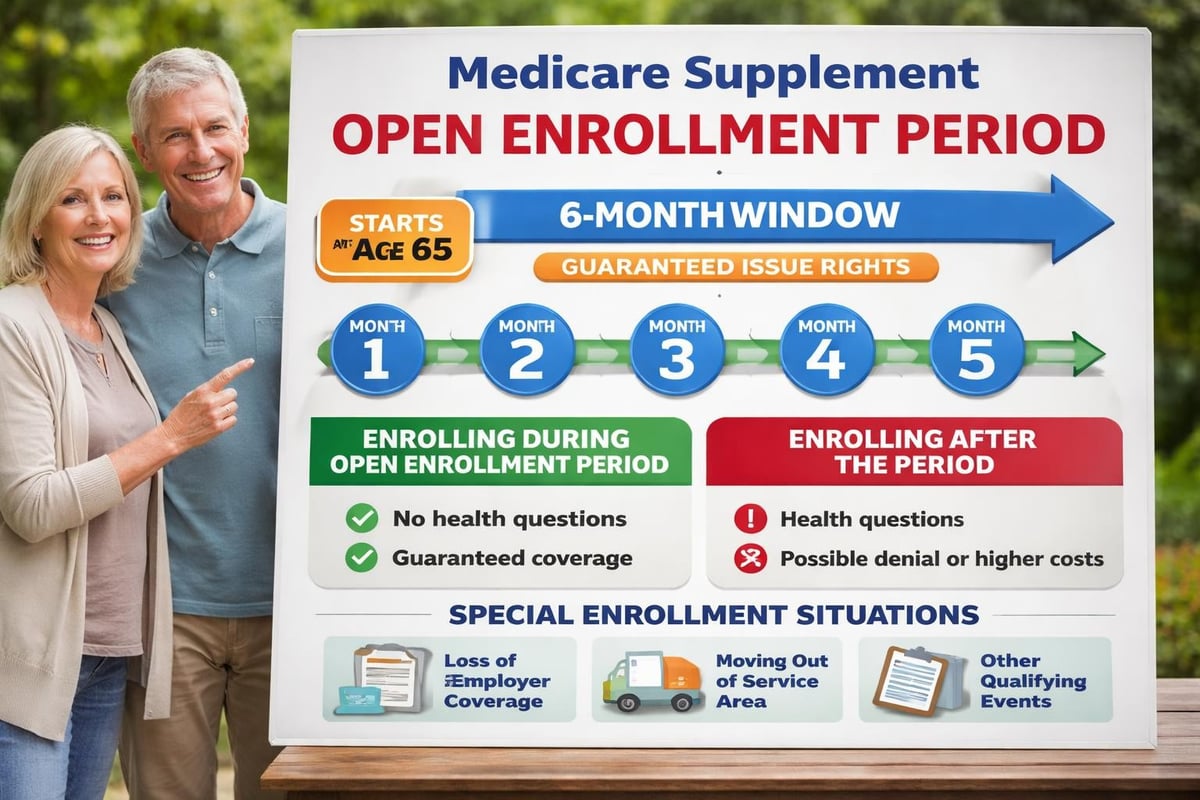
Your Medigap Open Enrollment Period begins the month you turn 65 and are enrolled in Part B. This six-month window provides guaranteed issue rights, meaning insurance companies cannot:
- Deny you coverage based on health conditions
- Charge higher premiums due to pre-existing conditions
- Impose waiting periods for coverage to begin
During this period, you have the strongest consumer protections. For residents in the Triad Area seeking personalized guidance, Moser Insurance Group Inc offers free consultations at 336-862-1763 or moserinsurancegroup@gmail.com.
Enrollment Outside the Open Enrollment Period
After your open enrollment period ends, insurance companies can use medical underwriting to determine your eligibility and premium rates. They may deny coverage or charge significantly higher premiums based on your health status.
Guaranteed issue rights provide exceptions to these underwriting rules in specific situations:
- You're dropping a Medicare Advantage plan within the first year
- Your Medicare Advantage plan is leaving Medicare or stops providing services in your area
- You move outside your plan's service area
- Your insurance company goes bankrupt or misleads you
North Carolina provides additional state-specific protections. Understanding these rights helps you make strategic decisions about when to apply for coverage.
Medicare Supplement Costs and Premium Factors
Medicare supplement premiums vary significantly based on multiple factors, making comparison shopping essential. Research from the Kaiser Family Foundation shows substantial premium variation even within the same geographic area.
Premium Pricing Methods
Insurance companies use three different methods to price Medicare supplement policies:
Community-rated (no-age-rated) policies charge the same premium regardless of age. A 65-year-old pays the same amount as an 85-year-old, though premiums may still increase due to inflation or other factors.
Issue-age-rated policies base premiums on your age when you first buy the policy. Your premium doesn't increase as you get older, but it may rise due to inflation.
Attained-age-rated policies increase premiums as you age. These often have the lowest premiums for younger beneficiaries but can become expensive as you grow older.
Factors Affecting Your Premium
Several elements influence what you'll pay for Medicare supplement coverage:
- Geographic location significantly impacts costs. Greensboro, Kernersville, High Point, and Winston-Salem residents may see different rates even within the Triad Area
- Plan type determines benefits and costs, with Plan G typically priced higher than Plan N
- Insurance company sets its own rates within regulatory guidelines
- Gender affects pricing in some states, though not in all
- Tobacco use often results in higher premiums
- Household discounts may apply when spouses both purchase policies
In 2026, monthly premiums for Plan G typically range from $120 to $300 depending on these factors, while high-deductible Plan G premiums generally cost between $45 and $80 monthly.
Comparing Medicare Supplement to Medicare Advantage
One of the most common questions for new Medicare beneficiaries involves choosing between Medicare Supplement insurance and Medicare Advantage. These represent fundamentally different approaches to Medicare coverage.
Coverage Structure Differences
| Feature | Medicare Supplement | Medicare Advantage |
|---|---|---|
| Medicare Relationship | Works with Original Medicare | Replaces Original Medicare |
| Provider Network | Any Medicare-accepting doctor | Usually requires network use |
| Out-of-Pocket Maximum | Varies by plan, can be low | Always has annual limit |
| Prescription Coverage | Separate Part D needed | Often included |
| Monthly Costs | Higher premiums, lower out-of-pocket | Lower premiums, higher out-of-pocket |
| Travel Coverage | Use anywhere in U.S. | May have geographic limits |
Medicare supplement policies provide predictable costs and maximum flexibility. You can see any doctor who accepts Medicare without referrals or network restrictions. This matters especially for residents in Greensboro, Winston-Salem, High Point, and Kernersville who may seek specialized care in the Triad Area or elsewhere in North Carolina.
Medicare Advantage plans typically offer lower monthly premiums but require you to use network providers and may have higher costs when you need care. These plans bundle hospital, medical, and often prescription coverage into one policy.
Which Option Makes Financial Sense
Your personal situation determines the best choice. Consider Medicare supplement insurance if you:
- Want predictable healthcare costs
- Travel frequently or spend time in multiple states
- Have chronic conditions requiring regular specialist care
- Prefer maximum provider choice without network restrictions
- Can afford higher monthly premiums for lower out-of-pocket costs
Medicare Advantage may work better if you:
- Want lower monthly premiums
- Don't mind network restrictions
- Stay primarily in one geographic area
- Want bundled coverage including prescriptions
- Have limited healthcare needs
For personalized analysis of your specific situation, visit moserinsurancegroup.com or call 336-862-1763 to discuss your options with experienced Medicare advisors.
Enrollment Process and Timeline Considerations
Understanding when and how to enroll in Medicare supplement coverage prevents costly gaps and ensures you receive the best rates. The enrollment process differs from Original Medicare and requires attention to specific deadlines.
Step-by-Step Enrollment Process
- Confirm Medicare Part A and Part B enrollment before applying for any Medicare supplement plan
- Identify your open enrollment period which typically begins when you turn 65 and have Part B
- Research available plans in your area and compare benefits for your needs
- Compare premiums from multiple insurance companies for identical plan types
- Complete the application during your guaranteed issue period when possible
- Answer health questions honestly if applying outside guaranteed issue periods
- Review and sign the policy documents carefully before submitting
- Submit payment for your first premium to activate coverage
The application process typically takes 2-4 weeks from submission to policy activation. Some insurance companies offer conditional coverage that begins immediately upon application approval.
Critical Timing Decisions
Avoid coverage gaps by coordinating your Medicare supplement start date with other coverage ending. If you're transitioning from employer coverage, time your application so Medicare supplement coverage begins when workplace insurance ends.
Don't delay applications even if your open enrollment period hasn't started. Some insurance companies allow applications up to 90 days before your effective date, ensuring coverage begins exactly when you need it.
For residents turning 65 and needing Medicare help, starting the research process 3-4 months before your birthday provides adequate time to understand options and make informed decisions.
Plan G Benefits and Why It's the Most Popular Choice
Since Plan F became unavailable to new Medicare beneficiaries in 2020, Plan G has emerged as the gold standard for comprehensive Medicare supplement coverage. Understanding why this plan dominates the market helps you evaluate whether it's right for your situation.
Complete Coverage with One Exception
Plan G covers virtually all Medicare out-of-pocket costs except the Part B deductible. In 2026, this deductible is $257 annually, meaning you pay the first $257 of Part B services before Plan G coverage begins.
After meeting this deductible, Plan G provides:
- 100% coverage of Part B coinsurance and copayments
- Full coverage of the Part A deductible ($1,676 per benefit period in 2026)
- Complete protection from Part B excess charges
- 365 additional days of hospital coverage after Medicare benefits exhaust
- 80% coverage of foreign travel emergencies after a small deductible
- Full coverage of skilled nursing facility coinsurance
- No network restrictions allowing you to see any Medicare-accepting provider
This comprehensive coverage means you'll have minimal surprise costs throughout the year. Most beneficiaries find budgeting easier when they know their maximum annual out-of-pocket cost is the Part B deductible plus monthly premiums.
Financial Comparison to Plan F
Some beneficiaries eligible for Plan F wonder whether they should switch to Plan G. The math typically favors Plan G for most people.
Plan F premiums average $30-50 more monthly than Plan G in most areas. Over a year, this represents $360-600 in additional premium costs. Since Plan F covers the $257 Part B deductible that Plan G doesn't, you're paying substantially more in premiums to avoid a smaller deductible.
The savings with Plan G become even more significant over time as premiums increase annually. Starting with the lower-cost option provides long-term financial benefits.
Plan N as a Cost-Effective Alternative
For beneficiaries seeking comprehensive coverage at lower premiums, Plan N presents an attractive middle-ground option between high-deductible plans and Plan G. This plan offers substantial benefits while requiring modest copayments for certain services.
What Makes Plan N Different
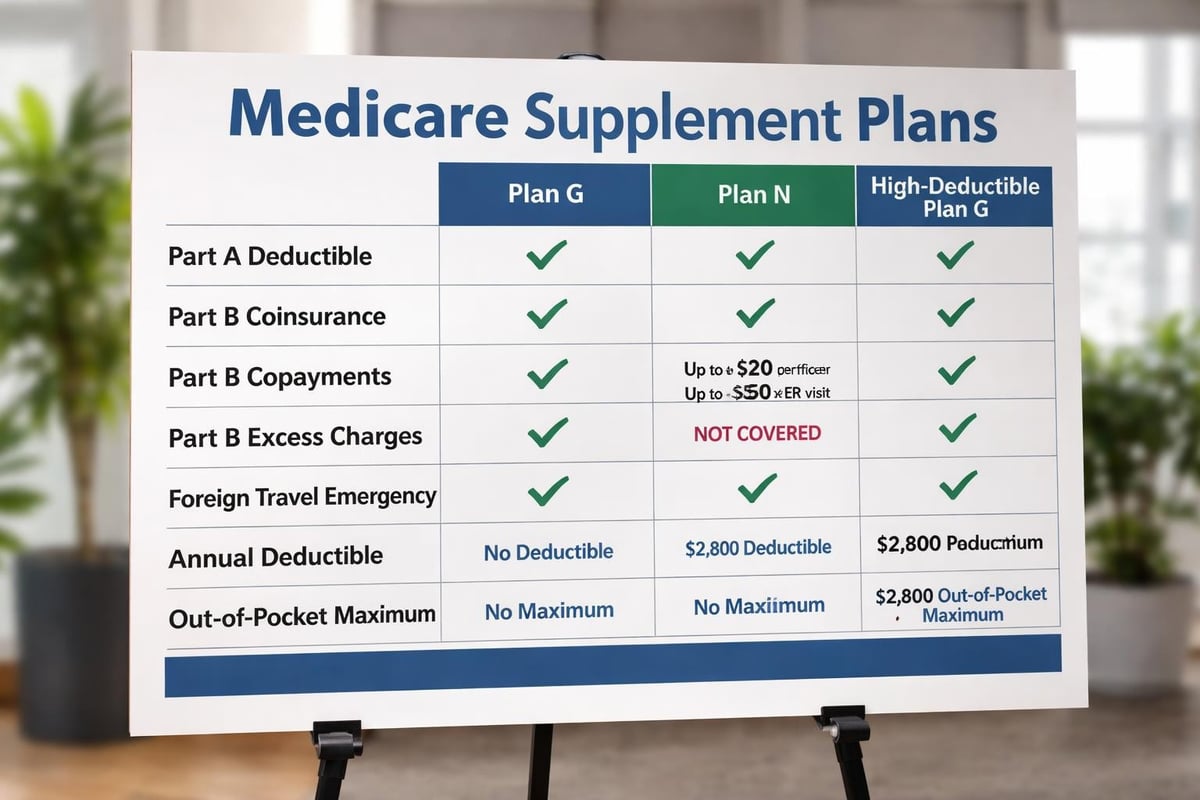
Plan N covers nearly everything Plan G does, with a few key differences:
- $20 copayment for doctor's office visits
- $50 copayment for emergency room visits (waived if admitted)
- Part B excess charges not covered requiring you to pay the difference when doctors charge above Medicare-approved amounts
- All other benefits identical to Plan G including Part A deductible, Part B coinsurance, foreign travel emergency, and additional hospital days
The monthly premium savings typically range from $30-60 compared to Plan G, translating to $360-720 annually. For many beneficiaries, especially those in good health who don't visit doctors frequently, these savings exceed the copayments they'll pay.
Who Benefits Most from Plan N
This plan works well for beneficiaries who:
- Visit the doctor infrequently (less than once monthly)
- Want lower premiums than Plan G
- Live in states where Part B excess charges are rare
- Don't mind budgeting for small, predictable copayments
- Maintain good overall health with minimal specialist needs
North Carolina has relatively low rates of doctors charging excess charges, making Plan N particularly attractive for Triad Area residents. Before selecting Plan N, confirm whether your regular doctors accept Medicare assignment, which prevents excess charges.
High-Deductible Options for Budget-Conscious Beneficiaries
High-deductible Plan G offers the same comprehensive benefits as standard Plan G, but requires you to pay a substantial deductible before coverage begins. This option appeals to beneficiaries who want catastrophic protection while minimizing monthly premium costs.
How High-Deductible Plan G Works
You pay 100% of Medicare-covered costs until reaching the annual deductible of $2,870 in 2026. After meeting this threshold, the plan covers 100% of all covered services for the remainder of the year.
Monthly premiums for high-deductible Plan G typically cost 60-70% less than standard Plan G. Many beneficiaries pay $45-80 monthly compared to $150-250 for standard coverage.
Out-of-pocket calculation requires careful consideration. If your annual healthcare costs remain low, you'll save significantly with lower premiums. However, a hospital stay or major medical event could require you to pay the full $2,870 deductible plus twelve months of premiums.
Financial Break-Even Analysis
Consider this comparison for a beneficiary in Greensboro:
| Scenario | Standard Plan G | High-Deductible Plan G |
|---|---|---|
| Monthly Premium | $185 | $65 |
| Annual Premiums | $2,220 | $780 |
| Part B Deductible | $257 | Included in plan deductible |
| Plan Deductible | $0 | $2,870 |
| Total if Healthy Year | $2,477 | $780 |
| Total if Major Medical Event | $2,477 | $3,650 |
High-deductible Plan G saves money when you have minimal healthcare needs but costs more during years with significant medical expenses. Some beneficiaries use the premium savings to fund a health savings account (though Medicare beneficiaries cannot contribute to HSAs, they can spend existing balances).
Switching Medicare Supplement Plans
Many beneficiaries don't realize they can change Medicare supplement policies at any time. Unlike Medicare Advantage, which has specific enrollment periods, you can apply for a different Medicare supplement plan whenever you choose.
Reasons to Consider Switching
Several situations might prompt a plan change:
- Premium increases make your current policy unaffordable
- Better rates from other companies for identical coverage
- Plan changes to reduce or increase coverage based on health needs
- Moving to a different area with different pricing
- Household discount eligibility when a spouse also needs coverage
You might also switch from one plan type to another. For example, switching from Plan N to Plan G eliminates copayments, while moving from Plan G to high-deductible Plan G reduces premiums.
The Underwriting Challenge
Here's the crucial consideration: After your initial open enrollment period, insurance companies can use medical underwriting when you apply for a different plan. They may:
- Deny your application based on health conditions
- Charge higher premiums than their standard rates
- Exclude coverage for pre-existing conditions for up to six months
This means switching becomes risky if you've developed health conditions since your original enrollment. Some beneficiaries get "locked in" to higher-priced plans because switching would require medical underwriting they couldn't pass.
Guaranteed Issue Exceptions
Certain situations provide guaranteed issue rights when switching plans:
- Your insurance company goes bankrupt or loses its license
- The company misleads you or violates contract terms
- You're moving outside your plan's service area (for Medicare SELECT plans)
- You're leaving a Medicare Advantage plan within the first year
North Carolina law provides additional protections, including a 30-day period each year when beneficiaries can switch to a different letter plan with the same company without underwriting. Understanding these state-specific rules helps you make strategic decisions.
Before switching, contact Moser Insurance Group Inc at 336-862-1763 to discuss your options and understand the implications for your specific situation.
Medicare Supplement in North Carolina: State-Specific Considerations
North Carolina provides certain protections and benefits for Medicare supplement beneficiaries that differ from federal requirements. Understanding these state-level provisions helps you maximize your coverage options in the Triad Area and throughout the state.
North Carolina Standardization Rules
North Carolina follows federal standardization for Medicare supplement plans with some state-specific regulations:
- Insurance companies must offer Plan A if they offer any Medigap policies
- Birthday rule allows switching to a lower-benefit plan without underwriting within 30 days of your birthday each year
- Guaranteed issue rights extend beyond federal requirements in certain situations
- Premium rate increases require state approval and justification
The birthday rule provides unique flexibility. Each year during the 30 days following your birthday, you can switch to any plan with equal or lesser benefits from any insurance company without answering health questions. This allows you to shop for better rates annually without underwriting concerns.
Regional Considerations for Triad Area Residents
Premium rates vary across North Carolina, with Greensboro, Winston-Salem, High Point, and Kernersville residents typically paying moderate rates compared to Charlotte or Raleigh areas. However, costs still vary significantly between insurance companies operating in the region.
Medicare beneficiaries in the Triad Area benefit from access to numerous major healthcare systems, including Cone Health, Novant Health, and Wake Forest Baptist Health. Medicare supplement policies work with all these providers since they accept Medicare assignment.
Excess Charges in North Carolina
Part B excess charges occur when doctors charge more than Medicare-approved amounts. In North Carolina, fewer than 5% of providers charge excess amounts, making this coverage less critical than in states like New York or Florida where excess charges are common.
This reality makes Plan N more attractive for North Carolina residents compared to Plan G, since you're unlikely to encounter the excess charges that Plan G covers but Plan N doesn't.
Prescription Drug Coverage with Medicare Supplement
Medicare supplement policies do not include prescription drug coverage, with the exception of legacy plans purchased before 2006. Beneficiaries need separate Part D coverage to protect against high medication costs.
Why Separate Part D Enrollment Matters
Late enrollment penalties apply if you delay Part D enrollment beyond your initial enrollment period. Medicare calculates this penalty as 1% of the national base beneficiary premium for each month you went without creditable coverage, and you pay this penalty for as long as you have Part D.
In 2026, the national base beneficiary premium is $34.70, meaning each month without coverage adds approximately $0.35 to your monthly Part D premium permanently. A two-year delay creates a penalty of roughly $8.40 monthly, or over $100 annually, for the rest of your life.
Coordinating Part D with Medicare Supplement
Your Medicare supplement and Part D policies work independently:
- Medicare supplement covers medical costs
- Part D covers prescription medications
- Both policies require separate monthly premiums
- Different insurance companies typically provide each coverage type
- No coordination of benefits required between the policies
Many beneficiaries purchase Medicare supplement insurance from one company and Part D from another, choosing each based on the best value for that specific coverage type. This differs from Medicare Advantage, which often bundles prescription coverage.
For comprehensive guidance on prescription drug coverage and how it coordinates with your Medicare supplement policy, experienced advisors can help you understand the coverage gap and choose the right Part D plan.
Total Monthly Cost Budgeting
When budgeting for Medicare with supplement coverage, include these components:
- Part B premium ($185 standard in 2026, higher for higher-income beneficiaries)
- Medicare supplement premium ($65-$300 depending on plan)
- Part D prescription drug plan premium ($15-$100 depending on plan)
- Part B deductible ($257 annually if Plan G or Plan N)
- Part D deductible (varies by plan, up to $590 in 2026)
- Copayments for Plan N enrollees ($20 office visits, $50 ER)
A typical middle-income beneficiary with Plan G and average Part D might budget $350-$450 monthly for all Medicare-related costs.
Common Medicare Supplement Mistakes to Avoid
Even well-informed beneficiaries sometimes make costly errors when selecting or managing Medicare supplement coverage. Awareness of these pitfalls helps you make better decisions and protect your financial health.
Timing and Enrollment Errors
Missing the open enrollment period represents the most expensive mistake. Some people delay enrollment thinking they'll wait until they need coverage, not realizing that medical underwriting after the initial period can result in denial or dramatically higher premiums.
Dropping coverage prematurely creates problems if you later want to re-enroll. Once you cancel a Medicare supplement policy, getting new coverage requires underwriting unless you qualify for guaranteed issue rights.
Assuming employer coverage continues indefinitely causes issues when that coverage ends unexpectedly. You may lose guaranteed issue rights if you don't enroll in Medicare supplement during specific windows when employer coverage ends.
Coverage Understanding Mistakes
Believing Medicare supplement covers everything leads to surprise costs. These policies don't cover prescription drugs, dental care, vision care, hearing aids, or long-term care. Understanding what's excluded prevents unrealistic expectations.
Not understanding the difference between Medicare Advantage and Medicare Supplement causes confusion. Some beneficiaries enroll in both, which is not allowed and wastes money. According to CMS data, this misunderstanding affects thousands of beneficiaries annually.
Assuming all Plan G policies are identical is technically true for benefits but false for premiums. Beneficiaries who don't compare prices across multiple companies often overpay significantly.
Shopping and Comparison Failures
Choosing based on brand recognition alone rather than comparing identical coverage from multiple companies costs money. A well-known company's Plan G offers the same benefits as a lesser-known company's Plan G, but premiums might differ by $50-100 monthly.
Ignoring rate increase history when selecting a company can lead to future sticker shock. Some companies offer very low initial premiums but increase rates aggressively, while others maintain more stable pricing over time.
Not reviewing coverage annually means missing opportunities to switch carriers under North Carolina's birthday rule or other guaranteed issue situations.
For residents of High Point, Kernersville, Winston-Salem, and Greensboro seeking expert guidance to avoid these mistakes, professional Medicare advisors provide unbiased education at no cost. Contact moserinsurancegroup@gmail.com for personalized assistance.
The Role of Insurance Agents in Medicare Supplement Selection
Navigating Medicare supplement options becomes significantly easier with professional guidance. Licensed insurance agents who specialize in Medicare provide valuable services at no cost to beneficiaries.
What Medicare Supplement Agents Provide
Professional agents offer several important services:
- Unbiased plan comparison across multiple insurance companies
- Premium quotes from numerous carriers for identical coverage
- Enrollment assistance ensuring accurate, complete applications
- Ongoing support for claims questions or policy changes
- Annual reviews to confirm your coverage remains optimal
- Special enrollment situation guidance maximizing your rights
These services cost you nothing. Insurance companies pay agent commissions, and regulations prevent agents from charging beneficiaries for Medicare supplement assistance. The commission is the same regardless of which company you choose, eliminating financial incentive for agents to steer you toward particular carriers.
Questions to Ask Potential Advisors
When selecting an advisor to help with Medicare supplement decisions:
- How many insurance companies do you represent for Medicare supplement?
- How long have you specialized in Medicare insurance?
- Can you provide references from current clients?
- What ongoing support do you provide after enrollment?
- How do you stay updated on Medicare changes and regulations?
- Do you offer in-home consultations or only office meetings?
Experienced Medicare specialists typically represent 10 or more insurance companies and focus exclusively on Medicare products rather than offering general insurance services.
Local Expertise Benefits
Working with local advisors in Greensboro, Winston-Salem, High Point, or Kernersville provides advantages beyond just convenience. Local professionals understand:
- Regional healthcare systems and provider networks
- North Carolina-specific regulations and consumer protections
- Premium rate patterns in your specific area
- Common questions and concerns from Triad Area residents
Moser Insurance Group Inc serves the Triad Area with personalized Medicare guidance, helping individuals and families understand their options without pressure. Schedule a consultation by calling 336-862-1763 or visiting moserinsurancegroup.com to discuss your Medicare supplement needs.
Medicare Supplement for Special Populations
Certain groups face unique considerations when evaluating Medicare supplement coverage. Understanding how policies work for these populations ensures appropriate coverage decisions.
Those Under Age 65 on Medicare
Federal law does not require insurance companies to sell Medicare supplement policies to people under 65 who qualify for Medicare due to disability. However, North Carolina law provides protections, requiring companies to offer at least one plan option to disabled Medicare beneficiaries during a six-month open enrollment period when they first enroll in Part B.
This means younger Medicare beneficiaries may have limited plan choices and potentially higher premiums compared to those 65 and older. Some find Medicare Advantage plans provide better value during these years, then switch to Medicare supplement when they turn 65 and gain full access to all standardized plans.
End-Stage Renal Disease (ESRD) Patients
Individuals with ESRD face the most restrictive Medicare supplement market. Until recently, insurance companies could deny coverage entirely to ESRD patients. The 21st Century Cures Act changed this beginning January 1, 2020.
Now, during your Medicare supplement open enrollment period (the six months starting when you're 65 or older and enrolled in Part B), companies cannot deny coverage or charge higher premiums due to ESRD. However, this protection only applies during that initial window.
Those with Employer Coverage
Many people turning 65 continue working and maintain employer health insurance. Critical decision points include:
- Whether to delay Part B enrollment if employer coverage is creditable
- When to apply for Medicare supplement as retirement approaches
- How to coordinate benefits between employer coverage and Medicare
- Special enrollment periods available when employer coverage ends
Working with knowledgeable advisors prevents costly mistakes during these transitions, particularly regarding which coverage serves as primary versus secondary payer.
Future of Medicare Supplement Insurance
The Medicare supplement landscape continues evolving due to legislative changes, market forces, and shifting beneficiary preferences. Understanding likely trends helps you make forward-looking decisions.
Legislative and Regulatory Trends
Congress periodically considers Medicare reforms that could affect supplement coverage. Recent proposals have included:
- Out-of-pocket limits on all Medigap policies
- Restrictions on first-dollar coverage to encourage cost consciousness
- Beneficiary cost-sharing changes in Original Medicare affecting supplement benefits
- New standardized plan options addressing coverage gaps
While major changes require Congressional action and typically include long implementation timelines, staying informed about potential reforms helps you plan appropriately.
Market Dynamics and Premium Trends
Statistical data from CMS shows Medicare supplement enrollment has remained relatively stable even as Medicare Advantage enrollment has grown dramatically. Approximately 25-30% of Medicare beneficiaries maintain supplement coverage, representing a reliable market for insurance companies.
Premium increases typically track medical inflation plus some additional percentage. Annual rate increases of 4-8% represent common patterns, though specific companies and plans vary considerably.
Some insurance companies have exited the Medicare supplement market, while others have entered or expanded their presence. This turnover emphasizes the importance of choosing financially stable carriers with long-term commitment to this market.
Technology and Enrollment Simplification
The application and enrollment process continues modernizing. Most insurance companies now offer:
- Online quote tools and plan comparisons
- Digital application submissions
- Electronic policy delivery
- Mobile apps for accessing policy documents
- Virtual consultations with licensed agents
Despite these technological advances, many beneficiaries still prefer working with local advisors who can explain options in person and provide ongoing relationship-based service.
Understanding Medicare supplement insurance options empowers you to make confident coverage decisions that protect your health and financial security. The standardized plans, guaranteed issue rights during open enrollment, and flexibility to see any Medicare-accepting provider make these policies valuable for millions of beneficiaries nationwide.
Whether you're approaching 65 or seeking to review your current coverage, Moser Insurance Group Inc provides personalized guidance tailored to your specific situation in Greensboro, Winston-Salem, High Point, Kernersville, and throughout the Triad Area. We help you understand your options without pressure, ensuring you can make informed decisions about your Medicare coverage. Contact us today at 336-862-1763, email moserinsurancegroup@gmail.com, or visit Moser Insurance Group Inc to discuss how we can help you navigate Medicare supplement insurance with clarity and confidence.
Recent Comments