

Medicare prescription plans provide essential coverage for medications that Original Medicare doesn't include. As healthcare costs continue rising, understanding your prescription drug options becomes increasingly important for managing both your health and budget. Whether you're new to Medicare or reviewing your current coverage, knowing how these plans work can save you thousands of dollars annually while ensuring you have access to the medications you need.
Understanding Medicare Prescription Plans
Medicare prescription plans, officially known as Medicare Part D, are offered by private insurance companies approved by Medicare. These plans help cover the cost of prescription drugs, including many recommended vaccines. Part D coverage is available as a standalone plan that works alongside Original Medicare, or as part of a Medicare Advantage Plan that bundles hospital, medical, and prescription coverage together.
Every Medicare prescription plan has its own formulary-a list of covered drugs organized into different cost tiers. Plans must cover at least two drugs in each therapeutic category, but they have flexibility in deciding which specific medications to include. This variation means that one plan might cover your medications affordably while another charges significantly more for the same drugs.
Who Needs Part D Coverage
Anyone with Medicare Parts A and B can enroll in a prescription drug plan. Even if you currently take few or no medications, enrollment during your Initial Enrollment Period protects you from late enrollment penalties that increase your premium permanently.
The penalty calculation adds 1% of the national base beneficiary premium for each month you delay enrollment without creditable coverage. In 2026, this adds up quickly and never goes away.
- Beneficiaries taking multiple medications daily
- People managing chronic conditions requiring ongoing treatment
- Those wanting protection against unexpected prescription costs
- Individuals transitioning from employer coverage to Medicare
How Medicare Prescription Plans Work
Part D plans operate on a tiered structure that affects your out-of-pocket costs. The Centers for Medicare & Medicaid Services establishes annual coverage phases that all plans must follow, though specific costs vary by plan.
Coverage Phases Explained
| Phase | What It Means | Your Costs |
|---|---|---|
| Annual Deductible | Amount you pay before plan coverage begins | Up to $590 in 2026 |
| Initial Coverage | Standard cost-sharing period | Copays or coinsurance per tier |
| Coverage Gap | Temporary coverage reduction | 25% of drug costs |
| Catastrophic Coverage | Maximum out-of-pocket protection | $0 or minimal copays |
Understanding these phases helps you budget for medication expenses throughout the year. Many people in the Triad Area, including residents of Greensboro, Kernersville, High Point, and Winston Salem, find that their costs vary significantly as they move through different coverage stages.

After you meet the catastrophic coverage threshold in 2026, you'll pay the greater of 5% coinsurance or small copayments for covered drugs. This provides important financial protection for beneficiaries with high medication needs.
Choosing the Right Plan
Selecting appropriate prescription drug coverage requires careful evaluation of your specific medication needs and budget. What drug plans cover varies significantly, making comparison essential.
Key Factors to Evaluate
Monthly Premium: Plans in 2026 range from under $10 to over $100 monthly. Lower premiums don't always mean lower total costs, especially if your medications fall into higher tiers or aren't covered at all.
Formulary Inclusion: Check whether your current medications appear on the plan's formulary. The formulary guidance from CMS requires plans to cover certain categories, but specific drug selection varies widely.
Pharmacy Network: Preferred pharmacies offer lower copays than standard network pharmacies. Some plans include mail-order options that reduce costs for maintenance medications.
Prior Authorization Requirements: Certain medications require your doctor to obtain approval before the plan covers them. This can delay access to needed drugs if you're not prepared.
- List all current medications with dosages
- Gather information on any drugs your doctor plans to prescribe
- Use the Medicare Plan Finder tool with your drug list
- Compare total estimated annual costs, not just premiums
- Verify your preferred pharmacy participates in the network
- Review plan ratings for customer service and quality
Many beneficiaries benefit from discussing their options with knowledgeable professionals. If you need personalized guidance comparing Medicare Supplement Plans and prescription coverage, professional assistance can clarify which combination provides the best value for your situation.
Enrollment Periods and Deadlines
Medicare prescription plans have specific enrollment windows that determine when you can join, switch, or drop coverage. Missing these periods can result in coverage gaps or permanent penalties.
Initial Enrollment Period
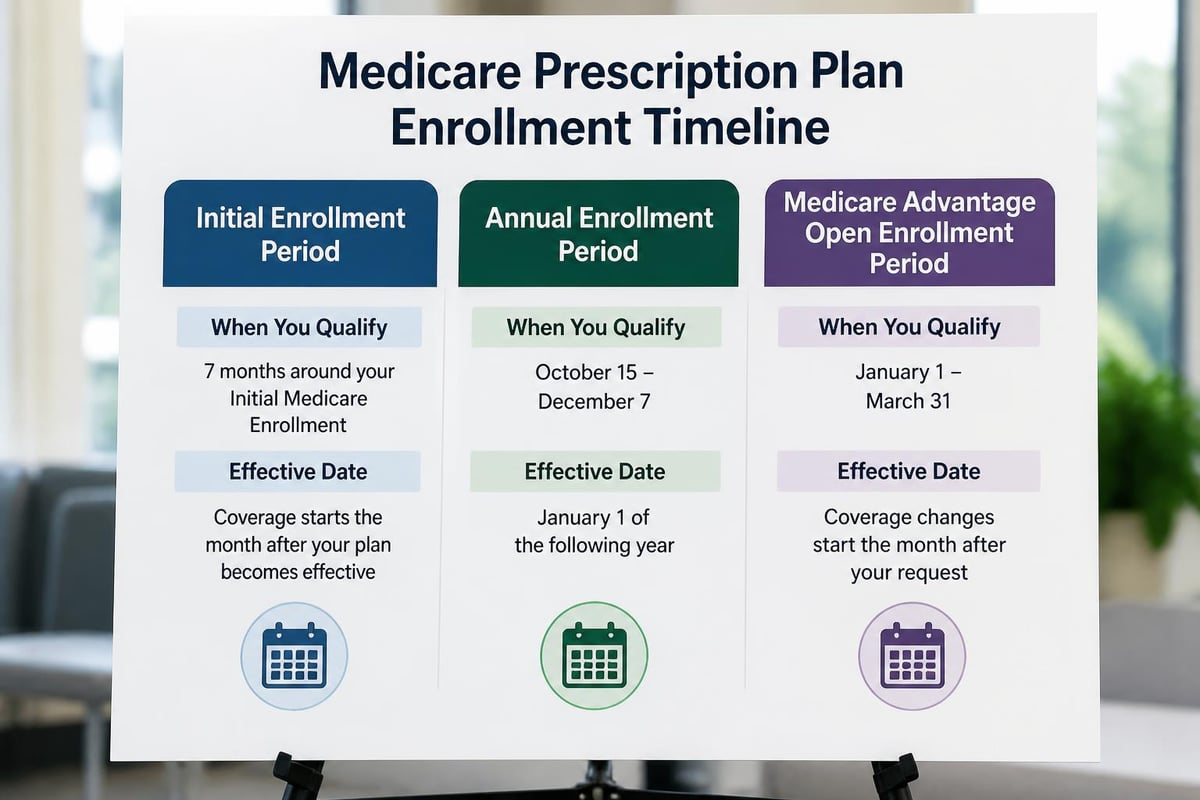
Your Initial Enrollment Period for Part D aligns with your Medicare eligibility-typically the seven-month window surrounding your 65th birthday month. This includes the three months before, your birthday month, and three months after.
If you're still working with employer coverage, verify whether your prescription benefits qualify as creditable coverage. Medicare basics explain how creditable coverage prevents late enrollment penalties when you eventually transition to Part D.
Annual Enrollment Period
October 15 through December 7 each year is Annual Enrollment Period (AEP). During these weeks, you can:
- Enroll in a Part D plan for the first time
- Switch from one Part D plan to another
- Drop Part D coverage entirely
- Move between Original Medicare with Part D and Medicare Advantage
- Change from one Medicare Advantage plan to another
Changes made during AEP take effect January 1 of the following year. This timing allows you to review how your medication needs and costs evolved during the current year and adjust coverage accordingly.
Special Enrollment Periods
Qualifying life events trigger Special Enrollment Periods that allow plan changes outside normal windows:
- Moving to a new service area
- Losing employer or union coverage
- Qualifying for Extra Help with costs
- Involuntary loss of current coverage
- Entering or leaving a skilled nursing facility
These periods typically last two months from the qualifying event date. Documentation proving the qualifying event may be required.
Understanding Plan Costs
Medicare prescription plans involve multiple cost components that combine to determine your total annual expense. Comparing plans requires looking beyond monthly premiums to understand your complete financial responsibility.
Premium Considerations
Monthly premiums represent just one piece of your total cost. Most beneficiaries pay premiums through automatic deduction from Social Security benefits, though you can also pay by check or automatic bank withdrawal.
High-income earners pay an additional amount called the Income-Related Monthly Adjustment Amount (IRMAA). This surcharge applies when your modified adjusted gross income exceeds certain thresholds, with costs increasing at higher income levels.
| Individual Income | Premium Surcharge 2026 |
|---|---|
| $106,000 or less | Standard premium only |
| $106,001-$133,000 | +$12.90/month |
| $133,001-$167,000 | +$33.30/month |
| $167,001-$200,000 | +$53.80/month |
| Above $200,000 | +$74.20/month |
Deductibles and Cost-Sharing
The annual deductible for 2026 can reach $590, though many plans offer $0 deductibles for certain drug tiers. After meeting your deductible, you enter initial coverage where you pay copays or coinsurance based on your medication's tier placement.
Tier structure typically follows this pattern:
- Tier 1: Preferred generic drugs (lowest cost)
- Tier 2: Generic drugs
- Tier 3: Preferred brand-name drugs
- Tier 4: Non-preferred brand-name drugs
- Tier 5: Specialty drugs (highest cost)
Your out-of-pocket costs vary dramatically based on tier placement. A 30-day supply might cost $5 in Tier 1 but $150 in Tier 4, even after meeting your deductible.
Coverage Gaps and Catastrophic Protection
The coverage gap, sometimes called the "donut hole," begins after you and your plan together spend a certain amount on covered drugs. In 2026, this threshold is $5,030 in total drug costs.
During the gap, you pay 25% of the price for covered brand-name and generic drugs. Both what you pay and the manufacturer discount count toward moving you out of the gap into catastrophic coverage.
Reaching Catastrophic Coverage
Once your true out-of-pocket costs reach $8,000 in 2026, catastrophic coverage begins. At this point, you pay the greater of:
- 5% coinsurance, or
- $4.50 for generic drugs and $11.20 for brand-name drugs
This protection ensures that even beneficiaries with extremely high medication needs have an annual cost ceiling. Understanding what Medicare does not cover helps you plan for gaps in other areas while your prescription coverage provides this catastrophic protection.
Extra Help and Low-Income Subsidies
The Extra Help program, also called the Low-Income Subsidy, assists Medicare beneficiaries who have limited income and resources. This federal program can pay for Part D premiums, deductibles, and copayments.
Eligibility requirements for 2026:
- Income below $23,630 (individual) or $32,010 (married couple)
- Resources below $17,220 (individual) or $34,360 (married couple)
Resources exclude your primary home, one vehicle, personal belongings, and certain life insurance policies. If you qualify, Extra Help provides substantial financial relief that makes medications affordable.
Applying for Extra Help
You can apply for Extra Help online at the Social Security website, by phone at 1-800-772-1213, or in person at your local Social Security office. Some people automatically qualify if they receive Medicaid or Supplemental Security Income.
For personalized assistance understanding your options in the Triad Area, you can reach Moser Insurance Group Inc at 336-862-1763 or moserinsurancegroup@gmail.com. Professional guidance helps ensure you're accessing all available benefits.
Comparing Part D Plans in Your Area
Medicare prescription plans vary significantly by geographic region. What's available in Greensboro may differ from options in High Point or Winston Salem, even though these communities sit close together.

Using the Medicare Plan Finder
The Medicare Plan Finder tool on Medicare.gov provides personalized plan comparisons. Enter your medications with dosages and your preferred pharmacy to see estimated annual costs for each available plan.
This comparison reveals significant cost differences. The same medication list might cost $2,000 annually with one plan but $4,500 with another, even when monthly premiums appear similar.
Steps for effective plan comparison:
- Create or log into your Medicare.gov account
- Enter all current medications accurately
- Add any drugs your doctor plans to prescribe
- Select your preferred pharmacy location
- Review the cost estimates for each plan
- Check plan star ratings for quality and service
- Verify formulary restrictions and requirements
Plans receive star ratings from one to five based on customer satisfaction, member complaints, health outcomes, and customer service. Higher-rated plans generally provide better overall experiences, though they may not always offer the lowest costs for your specific drugs.
Reviewing Coverage Annually
Your medication needs change over time. New prescriptions, discontinued drugs, or dose adjustments mean last year's best plan might not remain optimal. Annual review during the enrollment period ensures your coverage aligns with current needs.
Insurance professionals in Kernersville, High Point, Winston Salem, and throughout the region can assist with these annual reviews. Visit moserinsurancegroup.com or call 336-862-1763 to schedule a personalized consultation that evaluates your complete Medicare strategy.
Medicare Advantage Prescription Coverage
Medicare Advantage Plans often include prescription drug coverage as part of their bundled benefits. These plans, also called Part C, combine hospital coverage (Part A), medical coverage (Part B), and usually prescription coverage (Part D) into a single plan.
Top Medicare Advantage plans offer additional benefits beyond Original Medicare, such as dental, vision, hearing, and fitness programs. When evaluating these options, prescription coverage should factor heavily into your decision since switching plans later requires waiting for specific enrollment periods.
Standalone Part D vs. Medicare Advantage
Standalone Part D plans work with Original Medicare and any Medigap policy you might have. You maintain freedom to see any provider who accepts Medicare, and you can combine your coverage pieces according to your preferences.
Medicare Advantage with drug coverage bundles everything together, often with lower premiums. However, you must use network providers except in emergencies, and your prescription coverage is tied to your medical coverage-you can't change one without changing both.
| Feature | Standalone Part D | Medicare Advantage with Rx |
|---|---|---|
| Provider Freedom | Any Medicare provider | Network restrictions |
| Works with Medigap | Yes | No |
| Premium | Part D premium only | Combined premium |
| Coverage Changes | Change drug plan independently | Must change entire plan |
| Additional Benefits | None | Often includes extras |
Your choice depends on whether you prioritize provider flexibility or comprehensive bundled coverage with potential cost savings.
Pharmacy Networks and Mail Order
Most Medicare prescription plans organize pharmacies into network tiers that affect your costs. Preferred pharmacies offer lower copays, while standard network pharmacies charge more for the same medications.
Preferred vs. Standard Pharmacies
The cost difference between preferred and standard pharmacies can reach 20-30% for the same prescription. Before enrolling in a plan, verify that convenient pharmacies near your home in Greensboro, High Point, Kernersville, or Winston Salem participate as preferred locations.
Mail-order pharmacy benefits:
- Lower costs for 90-day maintenance medication supplies
- Home delivery eliminates pharmacy trips
- Automatic refill programs prevent gaps in medication
- Convenient for managing multiple chronic conditions
Mail-order typically works best for stable, long-term prescriptions rather than antibiotics or other short-term medications. Initial prescriptions often require filling at a retail pharmacy while mail-order enrollment processes.
Specialty Pharmacy Requirements
High-cost specialty medications-those treating complex conditions like cancer, rheumatoid arthritis, or multiple sclerosis-often require use of specific specialty pharmacies. These medications typically fall into Tier 5 and involve substantial costs even after insurance.
Specialty pharmacies provide additional support services including medication counseling, coordination with your doctor, and assistance accessing manufacturer assistance programs. Understanding these requirements before you need specialty drugs prevents delays in accessing critical treatments.
Prior Authorization and Step Therapy
Medicare prescription plans can place coverage restrictions on certain medications to manage costs and encourage use of equally effective but less expensive alternatives.
Prior Authorization Explained
Prior authorization requires your doctor to contact the plan and justify why you need a specific medication before the plan covers it. This process can take several days, so planning ahead when starting new prescriptions prevents treatment delays.
Common reasons plans require prior authorization:
- High-cost medications with lower-cost alternatives available
- Drugs that may be misused or overused
- Medications typically prescribed by specialists
- Treatments requiring special handling or administration
Your doctor's office handles most prior authorization paperwork. If the plan denies authorization, you have appeal rights to challenge the decision.
Step Therapy Requirements
Step therapy requires trying one or more lower-cost medications before the plan covers a more expensive drug. For example, you might need to try two generic medications before the plan approves a brand-name alternative.
While step therapy can be frustrating, exceptions exist for beneficiaries who previously tried required medications without success. Documentation from your doctor about previous treatment failures can accelerate exception approvals.
Making Changes to Your Coverage
Medicare prescription plans aren't locked in permanently. You can make changes during specific enrollment periods or when qualifying events occur.
When You Can Switch Plans
Annual Enrollment Period from October 15 to December 7 represents the primary opportunity to change Part D plans. Changes made during this window take effect January 1, giving you time to research options without rushing.
Medicare Advantage Open Enrollment from January 1 to March 31 allows people currently in Medicare Advantage plans to switch to a different Medicare Advantage plan or return to Original Medicare and join a standalone Part D plan. This provides a second chance to adjust coverage if your initial choice doesn't meet expectations.
Disenrollment Process
Switching plans automatically disenrolls you from your current coverage when your new plan begins. You don't need to separately cancel your old plan-Medicare handles the transition.
Important disenrollment considerations:
- Never cancel coverage before new coverage begins
- Maintain continuous coverage to avoid penalties
- Verify your new plan covers all current medications
- Confirm your pharmacy participates in the new network
For guidance navigating plan changes in the Winston Salem, Greensboro, High Point, or Kernersville areas, contact Moser Insurance Group Inc at 336-862-1763 to discuss your specific situation.
Appeals and Coverage Disputes
Sometimes Medicare prescription plans deny coverage for medications your doctor prescribes. Understanding your appeal rights ensures you can access needed treatments.
Coverage Determination Requests
When your plan denies a drug or requires you to pay more than expected, you can request a coverage determination. Your doctor can support this request by explaining why you need the specific medication despite formulary restrictions.
Plans must respond to standard requests within 72 hours or expedited requests within 24 hours. If they deny your request, written notice explains the reason and your appeal rights.
The Appeals Process
Five levels of appeals exist for Part D coverage disputes:
- Redetermination by your plan
- Reconsideration by an independent review entity
- Hearing before an Administrative Law Judge
- Review by the Medicare Appeals Council
- Judicial review in federal court
Most disputes resolve at the first or second level. Your doctor's documentation supporting medical necessity of the disputed drug strengthens your appeal significantly.
Common Prescription Plan Mistakes
Understanding frequent errors helps you avoid costly coverage problems.
Enrollment Timing Errors
Waiting too long to enroll triggers permanent late enrollment penalties. These add to your premium for as long as you have Part D coverage. Calculate penalties by multiplying 1% of the national base beneficiary premium by the number of months you were eligible but didn't enroll.
A 12-month delay creates a permanent 12% premium increase. Over decades of Medicare coverage, this seemingly small percentage compounds into thousands of dollars in unnecessary costs.
Failing to Review Coverage Annually
Your plan can change its formulary, pharmacy network, or costs each year. The best Medicare Part D plans for 2025 might not hold that distinction in 2026 after making changes.
Annual review prevents situations where your medication suddenly costs significantly more or drops from coverage entirely. Discovering these changes during Annual Enrollment Period allows you to switch to better options before problems arise.
Ignoring Generic Alternatives
Brand-name loyalty can cost hundreds or thousands annually when equally effective generic alternatives exist. While some conditions genuinely require specific brand-name medications, many beneficiaries pay premium prices unnecessarily.
Discuss generic options with your doctor. Many physicians default to brand names without considering cost implications for patients. Requesting generic alternatives when medically appropriate dramatically reduces prescription expenses.
Planning for Future Medication Needs
Effective prescription coverage planning extends beyond current medications to anticipated future needs.
Chronic Condition Considerations
Progressive conditions like diabetes, heart disease, or arthritis often require additional medications over time. When comparing plans, consider:
- Coverage for medications commonly added as conditions progress
- Network inclusion of specialists who manage your conditions
- Prior authorization policies for stepped-up treatments
- Formulary coverage for newer medications in your condition category
This forward-thinking approach prevents situations where next year's anticipated prescriptions aren't covered adequately by your current plan choice.
Seasonal Medication Variations
Some beneficiaries take certain medications seasonally-allergy drugs in spring, for example-while others maintain consistent prescriptions year-round. Ensure your plan comparison includes all medications you'll need throughout the year, not just current prescriptions.
Medicare's plan comparison tool allows entering medications you take periodically. Including these provides accurate annual cost estimates rather than underestimating your true expenses.
Medicare prescription plans offer essential protection against high medication costs, but choosing the right coverage requires careful evaluation of your specific needs, medications, and budget. Reviewing your options annually ensures your plan continues to provide optimal value as your health needs evolve. Moser Insurance Group Inc helps individuals and families throughout the Triad Area-including Greensboro, Kernersville, High Point, and Winston Salem-understand Medicare prescription plans with clear guidance and personalized support. Contact us at 336-862-1763, email moserinsurancegroup@gmail.com, or visit moserinsurancegroup.com to schedule a consultation and make confident decisions about your prescription drug coverage.
Recent Comments