

Understanding when you become eligible for Medicare is one of the most important financial and health decisions you'll face as you approach retirement. The medicare eligibility age determines when you can access comprehensive health coverage through the federal program, but the rules extend beyond simply reaching a certain birthday. Whether you're planning years ahead or approaching enrollment soon, knowing the specific criteria, exceptions, and enrollment windows will help you avoid coverage gaps and potential penalties that could cost you thousands of dollars over time.
Standard Medicare Eligibility Age Requirements
The standard medicare eligibility age is 65 years old. This threshold has remained consistent since Medicare's inception in 1965, even as other retirement program ages have shifted. Most Americans become eligible for Medicare on the first day of the month they turn 65, with one notable exception: if your birthday falls on the first day of the month, your Medicare coverage begins on the first day of the previous month.
This age-based eligibility applies regardless of whether you're still working, have employer coverage, or have already retired. You don't need to be collecting Social Security benefits to enroll in Medicare at 65, though many people coordinate both programs simultaneously.
How the 65-Year Threshold Works
When you reach the medicare eligibility age, you qualify for:
- Medicare Part A (Hospital Insurance): Covers inpatient hospital stays, skilled nursing facility care, hospice, and some home health services
- Medicare Part B (Medical Insurance): Covers doctor visits, outpatient care, preventive services, and medical equipment
- Medicare Part D (Prescription Drug Coverage): Optional coverage for prescription medications through private insurers
- Medicare Advantage (Part C): Alternative to Original Medicare offered by private companies
Most people receive premium-free Part A if they or their spouse paid Medicare taxes for at least 10 years (40 quarters) during their working life. Part B requires a monthly premium regardless of your work history, with the standard premium set at $185 per month in 2026.

Exceptions to the Standard Eligibility Age
While 65 represents the standard medicare eligibility age, several important exceptions allow younger individuals to qualify for coverage. These exceptions recognize that certain health conditions and circumstances create urgent coverage needs before traditional retirement age.
Disability-Based Eligibility
If you've been receiving Social Security Disability Insurance (SSDI) or Railroad Retirement Board disability benefits for 24 consecutive months, you automatically qualify for Medicare regardless of your age. This waiting period begins from your disability entitlement date, not necessarily when you first became disabled or when you applied for benefits.
The 24-month waiting period serves as a qualification threshold, but once met, you receive the same comprehensive Medicare benefits available to those who qualify based on age. According to Kaiser Family Foundation’s Medicare overview, approximately 8.3 million disabled beneficiaries under age 65 were enrolled in Medicare as of 2024.
End-Stage Renal Disease (ESRD)
Individuals diagnosed with permanent kidney failure requiring regular dialysis or a kidney transplant qualify for Medicare at any age. There's no 24-month waiting period for ESRD coverage. Coverage typically begins:
- The fourth month after starting dialysis treatments
- The month of admission for a kidney transplant (if you've had at least one dialysis treatment before admission)
- The month before transplant surgery if you receive the transplant before starting dialysis
Amyotrophic Lateral Sclerosis (ALS)
People diagnosed with ALS (Lou Gehrig's disease) receive immediate Medicare eligibility without any waiting period. Coverage begins the same month your SSDI benefits start, eliminating the standard 24-month waiting requirement that applies to other disabilities.
| Eligibility Category | Minimum Age | Waiting Period | Coverage Start |
|---|---|---|---|
| Age-based | 65 | None | Month of 65th birthday |
| SSDI/Disability | Any | 24 months | After 24 months of SSDI |
| ESRD | Any | None | 4th month after dialysis starts |
| ALS | Any | None | Same month as SSDI starts |
Initial Enrollment Period Timing
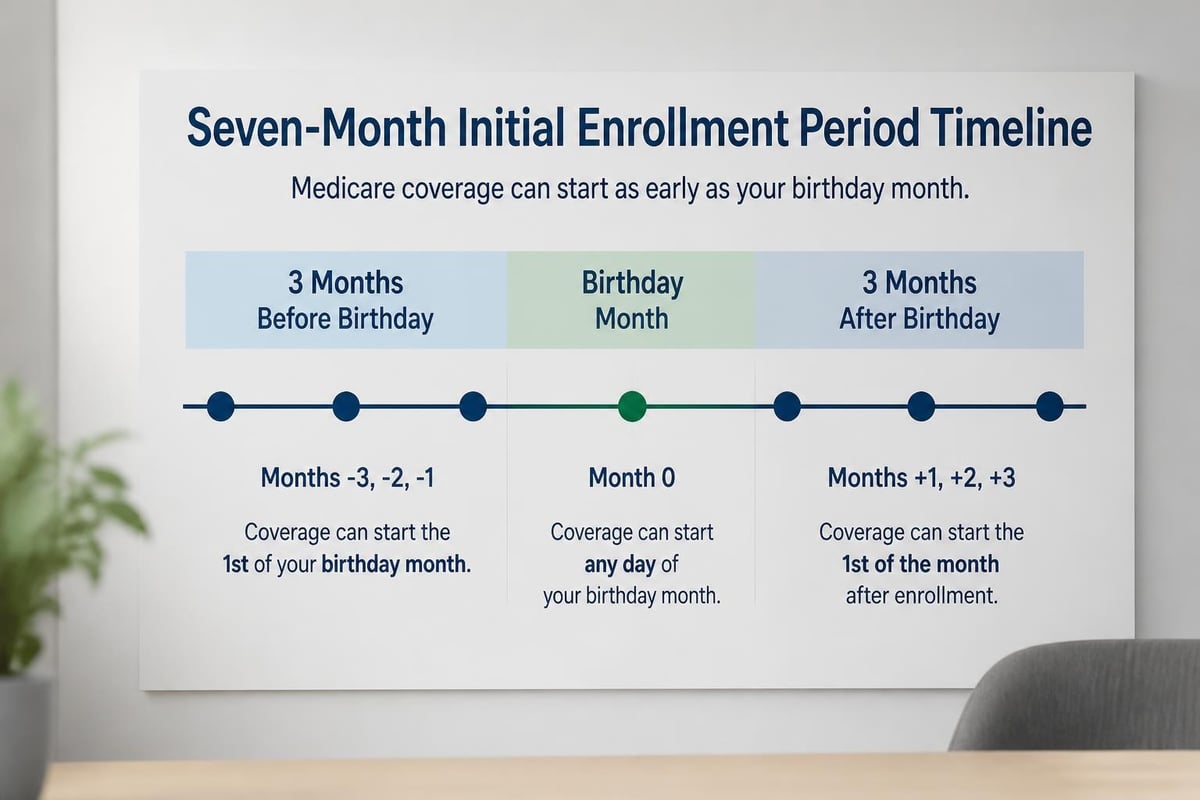
Understanding your Initial Enrollment Period (IEP) is critical because missing this window can result in permanent late enrollment penalties and coverage gaps. Your IEP is a seven-month period that provides a specific timeframe for signing up when you first become eligible for Medicare.
For those qualifying based on the standard medicare eligibility age of 65, your IEP includes:
- The three months before your 65th birthday month
- Your birthday month itself
- The three months after your birthday month
Important timing consideration: When you enroll during your IEP affects when your coverage begins. If you enroll during the three months before your birthday month, coverage typically starts the month you turn 65. Enrolling during your birthday month means coverage starts the following month. Waiting until after your birthday month can delay coverage even further.
Strategic Enrollment Timing
Most Medicare advisors recommend enrolling during the three months before your birthday month to ensure seamless coverage beginning on your 65th birthday. This prevents any gap between losing employer coverage or turning 65 and gaining Medicare protection.
You can check your specific enrollment periods and sign up for Medicare through the official Medicare.gov portal, which provides personalized guidance based on your situation.
Special Enrollment Periods and Delayed Enrollment
Not everyone needs to enroll in Medicare immediately upon reaching the medicare eligibility age. If you or your spouse currently work for an employer with 20 or more employees and you have creditable group health coverage through that employer, you can delay Medicare enrollment without penalty.
Qualifying for Special Enrollment
A Special Enrollment Period (SEP) allows you to sign up for Medicare outside your Initial Enrollment Period if you meet specific criteria:
- You're covered under a group health plan based on current employment (yours or your spouse's)
- The employer has 20 or more employees
- You enroll within 8 months of losing that coverage or employment ending
During your SEP, you can enroll in Part A and Part B without facing late enrollment penalties. However, you must enroll within the eight-month window after your coverage ends to maintain this protection.
Working Past 65: What You Need to Know
Many people in the Triad Area continue working past 65, particularly in industries centered around Greensboro, Winston-Salem, and High Point. If you're in this situation, here's what you need to consider:
Small employer exception: If your employer has fewer than 20 employees, Medicare becomes the primary payer when you turn 65, and your employer plan becomes secondary. In this case, you should enroll in Medicare at 65 to avoid coverage gaps.
COBRA doesn't count: If you're on COBRA coverage when you turn 65, this is not considered current employment coverage. You must enroll during your Initial Enrollment Period or face late enrollment penalties.
Health Savings Accounts (HSAs): You cannot contribute to an HSA once your Medicare coverage begins. If you're still contributing to an HSA, carefully coordinate your Medicare enrollment timing to avoid tax penalties.
Late Enrollment Penalties: Long-Term Financial Impact
Missing your enrollment windows can trigger permanent penalties that increase your Medicare costs for as long as you have coverage. These penalties exist to discourage people from waiting until they need medical care to enroll, which would undermine the program's risk pool.
Part B Late Enrollment Penalty
The Part B penalty equals 10% of the standard premium for each full 12-month period you were eligible but didn't enroll. For 2026, with the standard premium at $185 monthly, each year of delay adds approximately $18.50 to your monthly premium permanently.
For example, if you delayed enrollment for three years without qualifying for a Special Enrollment Period, your penalty would be 30% of the standard premium. Instead of paying $185 monthly, you'd pay approximately $240 monthly for the rest of your life.
Part A Late Enrollment Penalty
While most people receive premium-free Part A, those who must pay premiums face a 10% penalty for twice the number of years they could have enrolled but didn't. This penalty lasts for twice as long as you delayed enrollment.
Part D Prescription Drug Penalty
The Part D penalty equals 1% of the national base beneficiary premium ($34.70 in 2026) multiplied by the number of full months you went without creditable prescription drug coverage after your Initial Enrollment Period. This penalty also remains in effect as long as you have Part D coverage.
| Penalty Type | Calculation | Duration |
|---|---|---|
| Part B | 10% per year delayed | Lifetime |
| Part A | 10% × 2 × years delayed | Twice the delay period |
| Part D | 1% × months delayed × base premium | Lifetime |
Policy Proposals to Change Medicare Eligibility Age
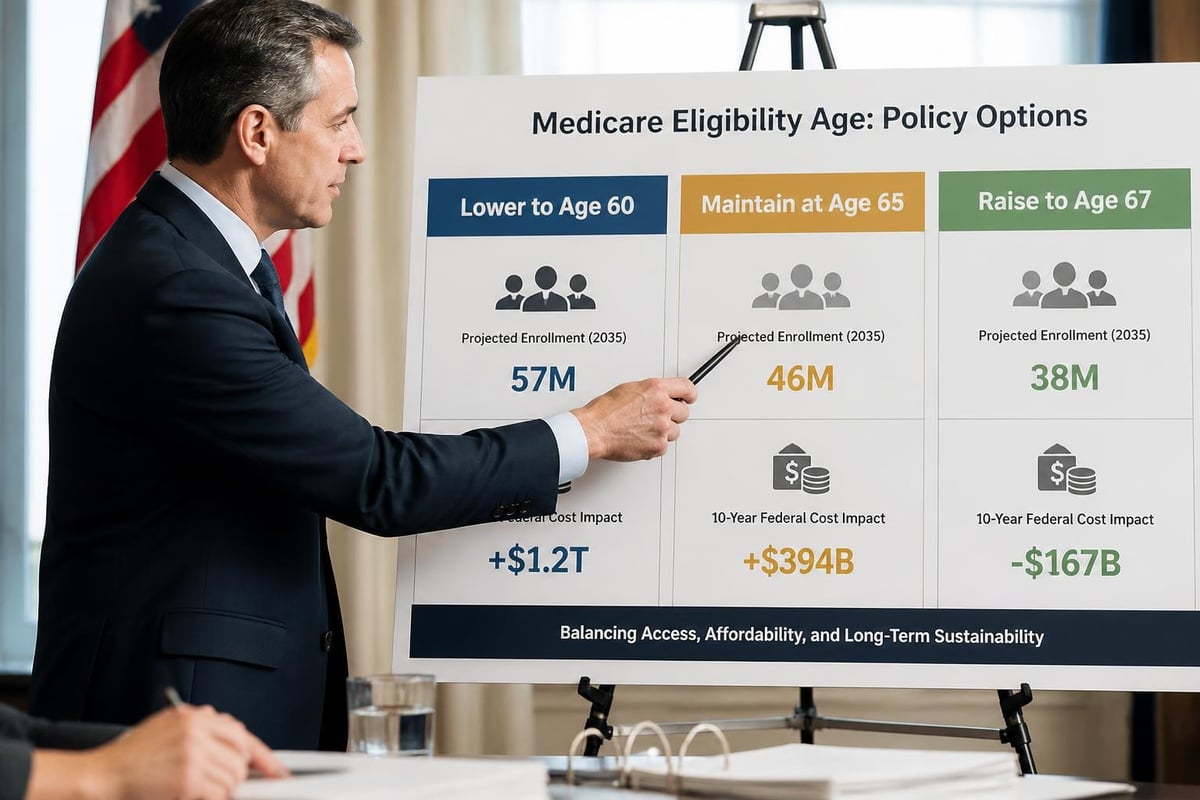
The medicare eligibility age has been the subject of ongoing policy debates, with proposals ranging from lowering the age to 60 or expanding eligibility to lowering it to 50, to raising it to 67 or higher to address program solvency concerns. Understanding these proposals helps you anticipate potential changes, though any modifications would likely include transition periods for those approaching eligibility.
Proposals to Lower the Age
Several recent legislative proposals have suggested reducing the medicare eligibility age to improve coverage for older adults not yet 65. Advocates argue this would:
- Reduce the number of uninsured Americans in their early 60s
- Lower costs for this age group compared to private insurance premiums
- Improve health outcomes by providing earlier access to preventive care
- Reduce financial stress for early retirees
Research analyzing the coverage implications shows that lowering the age to 60 could extend coverage to approximately 23 million additional Americans, though it would also significantly increase program costs and shift enrollment away from employer-sponsored plans and the Affordable Care Act marketplaces.
Proposals to Raise the Age
Conversely, some policymakers have suggested gradually increasing the medicare eligibility age to 67, aligning it with the full retirement age for Social Security. The Urban Institute has analyzed how this change would affect beneficiaries and the broader health system.
Potential effects of raising the age include:
- Reduced federal Medicare spending in the short term
- Increased out-of-pocket costs for individuals aged 65-67
- Higher premiums for those purchasing private insurance during those years
- Potential negative health impacts from delayed care access
Research on Health Outcomes
Peer-reviewed research examining the relationship between Medicare eligibility and health outcomes has found that access to Medicare at 65 significantly reduces mortality rates and improves management of chronic conditions. Changes to the eligibility age could therefore have measurable public health consequences beyond financial considerations.
Coordinating Medicare with Other Coverage
When you reach the medicare eligibility age, you may have other insurance coverage to coordinate. Understanding how Medicare interacts with employer plans, retiree coverage, COBRA, and Veterans Affairs benefits ensures you maintain comprehensive protection without overpaying for redundant coverage.
Medicare and Employer Coverage
Large employer plans (20+ employees): Medicare serves as secondary coverage while you're actively employed. Your employer plan pays first, and Medicare covers some remaining costs. Many people delay Part B enrollment in this situation to avoid paying premiums for secondary coverage.
Small employer plans (fewer than 20 employees): Medicare becomes your primary coverage at 65, regardless of employment status. Your employer plan, if you keep it, pays secondary. You should enroll in both Part A and Part B at 65.
Medicare and Retiree Coverage
Some employers offer retiree health coverage to former employees. This coverage may:
- Work alongside Medicare as supplemental coverage
- Require you to enroll in Medicare Part B to maintain retiree benefits
- Provide prescription drug coverage that's creditable (equivalent to Part D)
Always check with your former employer's benefits administrator before making enrollment decisions. Some retiree plans integrate seamlessly with Medicare, while others may reduce or eliminate benefits once you become Medicare-eligible.
Medicare and Veterans Affairs (VA) Benefits
Having VA benefits doesn't affect your Medicare eligibility or enrollment requirements. However, understanding how these programs work together optimizes your coverage:
- VA benefits and Medicare are separate programs that don't coordinate benefits
- You can have both VA coverage and Medicare simultaneously
- VA coverage alone doesn't satisfy the requirement for creditable prescription drug coverage for Part D penalty purposes
- Medicare cannot pay for care received at VA facilities
Many veterans in areas like Kernersville and Winston-Salem use Medicare for civilian care while maintaining VA benefits for service-connected conditions or care at VA facilities.
Choosing the Right Medicare Coverage at Eligibility
Once you reach the medicare eligibility age and enroll in Original Medicare (Parts A and B), you face an important decision: should you add supplemental coverage, and if so, what type? The choices you make during your Initial Enrollment Period can significantly impact your out-of-pocket costs and coverage flexibility.
Medicare Supplement Plans (Medigap)
Medicare Supplement plans help cover the gaps in Original Medicare, including deductibles, copayments, and coinsurance. These standardized plans, labeled A through N, are sold by private insurance companies but must follow federal and state regulations.
Key advantages of Medigap:
- Freedom to see any doctor or specialist who accepts Medicare
- No network restrictions
- Predictable out-of-pocket costs
- Coverage that travels with you anywhere in the United States
Initial enrollment considerations: You have a six-month Medigap Open Enrollment Period beginning the month you're both 65 or older and enrolled in Part B. During this period, insurance companies cannot deny you coverage or charge higher premiums based on pre-existing health conditions.
Medicare Advantage Plans
Medicare Advantage (Part C) plans offer an alternative to Original Medicare, bundling Parts A, B, and usually D into a single plan offered by private insurers. Most Medicare Advantage plans include additional benefits like dental, vision, and hearing coverage.
Considerations for Medicare Advantage:
- Typically lower monthly premiums than Medigap plus Part D
- Network restrictions (HMO, PPO, or regional PPO)
- Annual out-of-pocket maximums that limit your costs
- May require referrals for specialist care depending on plan type
Part D Prescription Drug Coverage
Whether you choose Original Medicare with Medigap or a Medicare Advantage plan, evaluate your prescription drug coverage needs carefully. Stand-alone Part D plans vary significantly in:
- Monthly premiums (ranging from $0 to over $100 in 2026)
- Drug formularies (lists of covered medications)
- Pharmacy networks
- Coverage during the donut hole (coverage gap)
Regional Considerations for Medicare Enrollment
Your location affects your Medicare coverage options, costs, and available resources. In the Triad Area, including Greensboro, High Point, Kernersville, and Winston-Salem, beneficiaries have access to numerous Medicare Advantage plans, Medigap insurers, and Part D options, but specific availability varies by ZIP code.
Local Medicare Resources in North Carolina
North Carolina residents can access state-specific Medicare assistance through:
- The North Carolina Seniors' Health Insurance Information Program (SHIIP), which provides free, unbiased Medicare counseling
- Local Social Security offices for enrollment assistance
- Community-based organizations offering Medicare education workshops
- Licensed insurance agents specializing in Medicare products
Cost Variations by Region
While Original Medicare (Parts A and B) costs remain consistent nationwide, supplemental coverage costs vary by location. Factors affecting regional pricing include:
- Local healthcare costs and utilization patterns
- Competition among insurance carriers
- State insurance regulations
- Population demographics
In 2026, North Carolina residents may see different Medigap premiums compared to national averages, and Medicare Advantage plan availability and benefits differ from county to county across the Triad region.
Finding Local Support
Working with a local insurance professional who understands regional healthcare systems, provider networks, and plan options specific to Greensboro, Winston-Salem, High Point, and Kernersville can simplify your Medicare decisions. Local agents can explain how regional hospitals and physician groups participate in various Medicare Advantage networks and help you evaluate whether your current doctors accept Medicare assignment.
For personalized guidance on Medicare options in the Triad Area, contact Moser Insurance Group Inc at 336-862-1763 or email moserinsurancegroup@gmail.com.
Common Medicare Eligibility Mistakes to Avoid
Even with clear guidelines about the medicare eligibility age and enrollment periods, many new beneficiaries make costly mistakes during their transition to Medicare. Awareness of these common errors helps you avoid financial penalties and coverage gaps.
Mistake 1: Missing Your Initial Enrollment Period
The most expensive mistake is missing your IEP without qualifying for a Special Enrollment Period. This triggers permanent late enrollment penalties and forces you to wait until the General Enrollment Period (January 1 through March 31 each year) to sign up, with coverage not beginning until July 1.
Prevention: Mark your calendar three months before your 65th birthday and begin researching your options. Set reminders to ensure you don't miss the enrollment window.
Mistake 2: Assuming Employer Coverage Equals Creditable Coverage
Not all employer coverage qualifies for delayed enrollment. Coverage through employers with fewer than 20 employees doesn't protect you from late enrollment penalties. Similarly, COBRA, retiree coverage, and health sharing ministries may not qualify as creditable coverage.
Prevention: Request written confirmation from your employer's benefits administrator about whether your coverage is creditable and qualifies you for a Special Enrollment Period.
Mistake 3: Enrolling in Part A Without Understanding HSA Implications
Medicare Part A coverage triggers automatic stop dates for HSA contributions, potentially six months retroactively. This can result in excess contribution penalties if you continue funding your HSA after Part A coverage begins.
Prevention: If you're still contributing to an HSA, consult with a tax advisor before enrolling in any part of Medicare, even premium-free Part A.
Mistake 4: Choosing Coverage Based Solely on Premium Costs
The lowest-premium Medicare Advantage or Part D plan isn't always the most affordable option when you account for:
- Deductibles and copayments
- Out-of-pocket maximums
- Prescription drug costs
- Network restrictions that may require changing doctors
Prevention: Calculate your total estimated annual costs, including premiums, expected medical services, and current prescriptions, before selecting coverage.
Mistake 5: Not Reviewing Coverage Annually
Medicare Advantage plans and Part D plans change their benefits, costs, and covered drugs every year. What worked well in 2026 might not be the best choice for 2027.
Prevention: Review your coverage each year during the Annual Enrollment Period (October 15 through December 7) to ensure your plan still meets your needs and provides the best value.
Next Steps as You Approach Medicare Eligibility Age
Preparing for Medicare enrollment several months before reaching the medicare eligibility age ensures a smooth transition and helps you make informed decisions about your coverage. A systematic approach reduces stress and minimizes the risk of costly mistakes.
Three Months Before Your 65th Birthday
Begin by gathering essential information:
- Verify your Social Security earnings record shows at least 40 quarters of Medicare-covered employment
- Create or access your my Social Security account online
- List your current medications, dosages, and pharmacy preferences
- Identify your preferred doctors and check whether they accept Medicare
- Review any employer or retiree coverage you currently have
Research your coverage options by comparing Medicare Advantage plans and Medigap policies available in your area. The official Medicare.gov guidance on enrollment timing provides detailed information about your specific enrollment periods and deadlines.
Two Months Before Eligibility
Make preliminary decisions about your coverage path:
- Decide between Original Medicare plus supplements or Medicare Advantage
- Compare at least three plans in your chosen category
- Verify provider networks include your preferred doctors and hospitals
- Calculate estimated annual costs for each option based on your health needs
- Consider whether you need extra benefits like dental or vision coverage
One Month Before Your 65th Birthday
Finalize your enrollment:
- Submit your Medicare application through Social Security (online, phone, or in-person)
- Enroll in your chosen supplemental coverage (Medigap or Medicare Advantage)
- Select and enroll in a Part D plan if you chose Original Medicare
- Save confirmation numbers and documentation
- Note your effective coverage dates
After Enrollment
Once enrolled, take these steps to ensure smooth coverage activation:
- Receive and review your Medicare card (typically arrives within 30 days)
- Confirm your supplemental coverage is in effect
- Update your prescription drug coverage with your pharmacy
- Inform your doctors' offices about your new Medicare coverage
- Set reminders for future Annual Enrollment Periods
For residents throughout the Triad Area seeking guidance through this process, visit moserinsurancegroup.com or call 336-862-1763 to speak with a licensed Medicare specialist who can provide personalized recommendations based on your specific health needs and budget.
Understanding the medicare eligibility age and associated enrollment rules empowers you to make confident decisions about your healthcare coverage as you transition into Medicare. Whether you're approaching 65, qualifying through disability, or planning several years ahead, knowing your options, deadlines, and potential pitfalls helps you secure the comprehensive coverage you need while avoiding unnecessary costs. Moser Insurance Group Inc specializes in helping individuals and families throughout Greensboro, High Point, Kernersville, and Winston-Salem navigate Medicare decisions with clear, pressure-free guidance tailored to your unique situation-contact us at 336-862-1763 or moserinsurancegroup@gmail.com to discuss your Medicare coverage options today.
Recent Comments