

Understanding medicare creditable coverage is essential for anyone approaching Medicare eligibility or currently enrolled in the program. This designation determines whether your current prescription drug coverage meets Medicare's standards and directly impacts your future costs. Many beneficiaries don't realize that failing to maintain creditable coverage can result in permanent penalties that follow them throughout their Medicare enrollment. Whether you're transitioning from employer coverage, military benefits, or another health plan, knowing how medicare creditable coverage works protects your financial interests and ensures you make informed decisions about when to enroll in Part D.
What Medicare Creditable Coverage Means
Medicare creditable coverage refers to prescription drug coverage that is expected to pay, on average, at least as much as Medicare's standard Part D coverage. The Centers for Medicare & Medicaid Services establishes creditable coverage standards to ensure beneficiaries maintain adequate protection against prescription drug costs.
This designation matters because Medicare imposes a late enrollment penalty on individuals who go 63 consecutive days or longer without creditable prescription drug coverage after becoming eligible for Part D. The penalty calculation is straightforward but permanent: 1% of the national base beneficiary premium multiplied by the number of months you were without creditable coverage.
How the Creditable Coverage System Works
When you have prescription drug coverage through an employer, union, TRICARE, or the Department of Veterans Affairs, that entity must notify you annually whether their coverage is creditable. According to Medicare.gov’s creditable coverage guidance, you should receive this notice before October 15th each year and whenever your coverage changes.
The notification requirement serves two purposes:
- Protects beneficiaries from unknowingly losing creditable status
- Creates documentation you can use to prove continuous coverage
- Triggers enrollment decisions when coverage becomes non-creditable
Keep every creditable coverage notice you receive. These documents become crucial if you need to prove you maintained qualifying coverage and should not face penalties.

Types of Coverage That May Be Creditable
Not all prescription drug coverage qualifies as creditable. Understanding which plans meet Medicare's standards helps you avoid gaps that trigger penalties.
| Coverage Type | Usually Creditable? | Notes |
|---|---|---|
| Employer/Union Group Plans | Often Yes | Depends on plan design; check annual notice |
| TRICARE | Yes | Military health coverage meets standards |
| VA Benefits | Yes | Veterans Affairs coverage qualifies |
| FEHB Plans | Usually Yes | Federal employee health benefits typically qualify |
| State Pharmaceutical Assistance | Varies | Check with program administrator |
| Individual Health Plans (ACA) | Sometimes | Review plan details and notifications |
Medicare creditable coverage determinations depend on the actuarial value of the prescription benefit. A plan might cover medications but still not meet the creditable threshold if copays, deductibles, or coverage limits fall short of Part D standards.
Employer Coverage After Retirement
Many retirees maintain prescription drug coverage through former employers. These plans frequently qualify as creditable, but employers reassess their coverage annually. What was creditable in 2025 might not qualify in 2026 if the employer reduces benefits or increases out-of-pocket costs.
If your employer coverage loses creditable status, you receive a Special Enrollment Period to join a Part D plan without penalty. This window typically lasts 63 days from when you receive the non-creditable notice.
For residents in the Triad Area, including Greensboro, Kernersville, High Point, and Winston Salem, understanding these transitions becomes particularly important when local employers restructure their retiree health benefits.
The Late Enrollment Penalty Explained
The medicare creditable coverage penalty operates differently than most insurance penalties because it never disappears. Once assessed, you pay it every month for as long as you have Part D coverage.
Calculating Your Potential Penalty
The penalty formula uses three components:
- National base beneficiary premium (changes annually)
- Number of months without creditable coverage
- 1% multiplier applied to months without coverage
In 2026, if the national base beneficiary premium is $34.70 and you went 24 months without creditable coverage, your calculation would be:
$34.70 × 24 × 0.01 = $8.33 per month added to your Part D premium permanently.
This penalty increases whenever the national base beneficiary premium rises, even though your coverage gap occurred years earlier.
When the Penalty Clock Starts
Your penalty clock begins 63 days after your Initial Enrollment Period ends if you don't enroll in Part D or maintain other creditable coverage. For most people, the Initial Enrollment Period is the seven-month window surrounding your 65th birthday (three months before, your birthday month, and three months after).
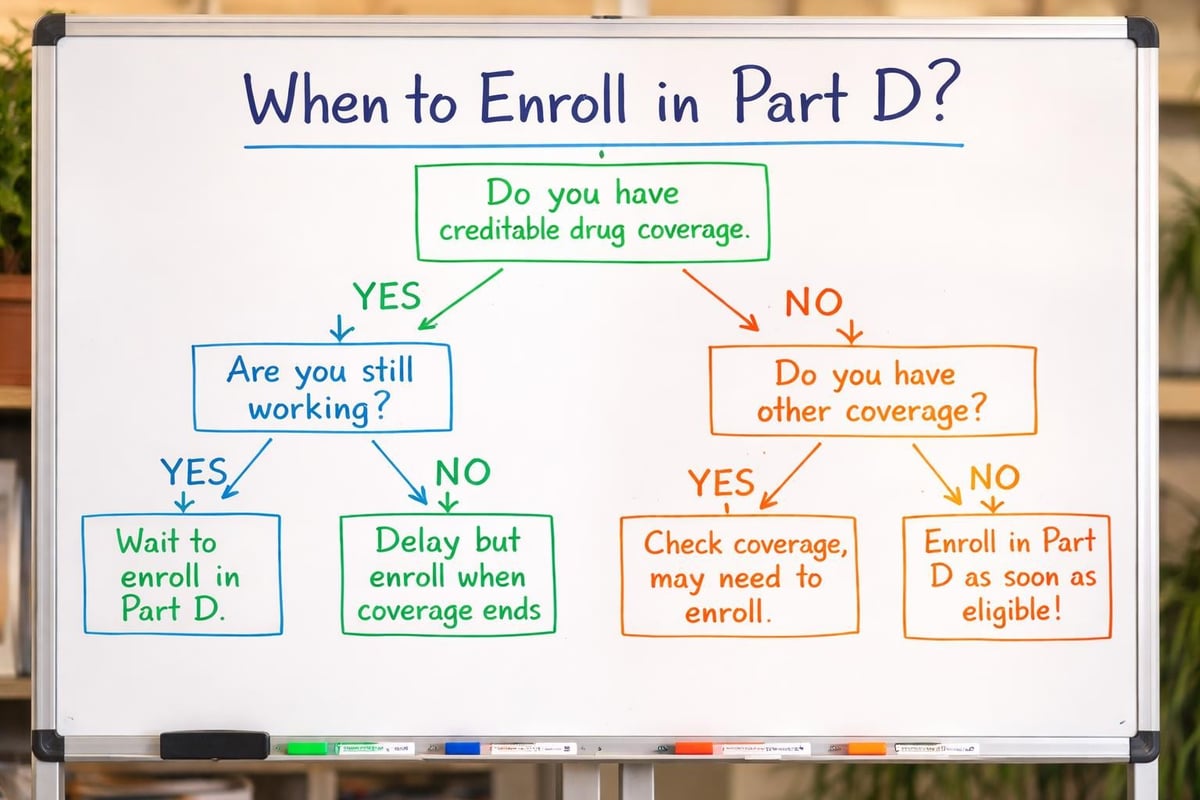
Important exception: If you maintain creditable coverage through an employer plan, VA benefits, or TRICARE, the penalty clock doesn't start. You can delay Part D enrollment without penalty as long as your coverage remains creditable.

Proving Your Creditable Coverage History
Documentation becomes critical when you eventually enroll in Part D. Medicare requires proof that you maintained creditable coverage to waive late enrollment penalties.
Essential Documentation Practices
Keep these records indefinitely:
- Annual creditable coverage notices from all sources
- Certificates of creditable coverage issued when coverage ends
- Letters from employers or plan administrators confirming coverage dates
- Explanation of Benefits statements showing prescription coverage
Moser Insurance Group Inc recommends creating a dedicated Medicare file starting at age 64. File every notice chronologically with contact information for each coverage source. This simple practice prevents penalties and streamlines your Part D enrollment process.
If you've lost documentation, contact your former employer's benefits department or the plan administrator immediately. Request written confirmation of your coverage dates and creditable status. Most organizations maintain these records for several years.
Special Situations and Creditable Coverage
Several scenarios create confusion about medicare creditable coverage requirements and how they interact with Part D enrollment decisions.
Working Past 65 With Employer Coverage
Many Americans work beyond age 65, maintaining employer-sponsored health coverage. If your employer has 20 or more employees, their coverage typically qualifies as primary insurance, and you can delay Medicare Part B enrollment without penalty.
However, Medicare Part D follows different rules. You can delay Part D enrollment while maintaining creditable employer prescription coverage, but you must verify your coverage is actually creditable. Small employers sometimes offer plans that don't meet Medicare's standards.
Moving Between Coverage Types
Transitions between different types of creditable coverage require careful attention. When you move from TRICARE to employer coverage, from VA benefits to a spouse's plan, or any similar change, obtain written confirmation that you maintained continuous creditable coverage.
The 63-day rule applies to gaps between creditable coverage types. If you have 62 days between your last employer coverage and starting a new creditable plan, you're protected. Day 63 without coverage starts the penalty clock.
For those exploring Medicare Supplement plans as they transition from employer coverage, understanding how creditable coverage requirements affect timing is essential.
Annual Review Requirements
Both beneficiaries and coverage providers have annual obligations related to medicare creditable coverage.
What Entities Must Disclose
Any organization providing prescription drug coverage to Medicare-eligible individuals must:
- Disclose creditable status annually before October 15th
- Notify upon enrollment within 60 days of when coverage begins
- Report to CMS about their coverage's creditable status
- Alert to changes if coverage becomes non-creditable mid-year
The CMS creditable coverage disclosure requirements create a systematic notification process. However, beneficiaries should never assume silence means creditable status.
Your Annual Checklist
Every September, complete these steps:
- Review your creditable coverage notice when it arrives
- Compare your current prescription costs against Part D options
- Evaluate whether maintaining current coverage makes financial sense
- Document everything for your Medicare file
Contact your coverage provider directly if you haven't received a notice by October 1st. Don't wait for them to send it automatically.
Creditable Coverage and Part D Enrollment Periods
Understanding how medicare creditable coverage interacts with enrollment periods helps you avoid gaps and penalties.
The Annual Enrollment Period (October 15 – December 7)
During this window, you can:
- Switch from creditable coverage to Part D without penalty
- Change Part D plans for better coverage or lower costs
- Enroll in Part D for the first time if you missed your Initial Enrollment Period
You don't need a special reason to enroll during this period. Having creditable coverage doesn't prevent you from choosing Part D instead.
Special Enrollment Periods
Several situations trigger Special Enrollment Periods for Part D:
| Triggering Event | Enrollment Window | Notes |
|---|---|---|
| Loss of creditable coverage | 63 days after loss | Includes voluntary and involuntary loss |
| Moving outside plan service area | 2 months before to 2 months after | Must enroll in new area plan |
| Entering/leaving a skilled nursing facility | At any time | Can make one change per move |
| Qualifying for Extra Help | At any time | Low-income subsidy eligibility |
The most common Special Enrollment Period relates to losing creditable coverage. Whether your employer terminates the plan, reduces benefits to non-creditable levels, or you retire and lose coverage, you have 63 days to enroll without penalty.
Coordination With Other Medicare Components
Medicare creditable coverage primarily affects Part D prescription drug coverage, but it intersects with other Medicare decisions.
Medicare Advantage Plans With Drug Coverage
Medicare Advantage plans (Part C) that include prescription drug coverage automatically provide creditable coverage. If you're enrolled in a Medicare Advantage plan with drug benefits, you satisfy the creditable coverage requirement.
Residents exploring top Medicare Advantage plans in the Greensboro, High Point, Winston Salem, and Kernersville areas should verify whether their chosen plan includes Part D coverage or requires separate enrollment.
Original Medicare and Standalone Part D
If you choose Original Medicare (Parts A and B) without a Medicare Advantage plan, you'll need standalone Part D coverage to avoid penalties unless you maintain other creditable coverage.
The notice of creditable coverage from Medicare.gov explains how these components work together and when you must make enrollment decisions.
Common Mistakes to Avoid
Several errors can cost beneficiaries thousands of dollars over their Medicare enrollment. Awareness prevents these costly mistakes.
Assuming All Prescription Coverage Is Creditable
The most expensive assumption is believing any prescription coverage qualifies as creditable. Health Savings Account (HSA) contributions, discount cards, and limited benefit plans typically don't meet creditable standards.
Even comprehensive-seeming plans might fall short. Always verify creditable status through official notices rather than assuming coverage qualifies.
Discarding Creditable Coverage Notices
Many beneficiaries treat these notices as junk mail and discard them immediately. Years later, when enrolling in Part D, they cannot prove they maintained creditable coverage and face unnecessary penalties.
Storage solution: Create a physical or digital folder labeled "Medicare Creditable Coverage" and file every notice the day it arrives. This five-minute habit can save thousands of dollars.
Missing the 63-Day Window
The 63-day grace period provides flexibility, but day 64 triggers penalties. When your creditable coverage ends, mark your calendar immediately with:
- Day 63 as your absolute deadline
- Day 45 as your action reminder
- Day 30 as your research start date
This staggered approach ensures you research plans, compare costs, and enroll with time to spare.
Failing to Report Coverage Changes
If your coverage status changes mid-year (employer drops prescription benefits, plan modifications reduce coverage), you must act quickly. Don't wait until Annual Enrollment Period if your coverage becomes non-creditable. Use your Special Enrollment Period to enroll in Part D immediately.
How to Verify Creditable Coverage Status
Proactive verification prevents surprises and protects you from penalties.
Direct Contact Methods
Contact your coverage provider's benefits department and ask these specific questions:
- "Is this prescription drug coverage considered creditable under Medicare Part D standards?"
- "When will I receive my annual creditable coverage notice?"
- "How will you notify me if the coverage becomes non-creditable?"
- "Can you provide written confirmation of creditable status now?"
Document the date, time, representative name, and answers to every question. Follow up phone calls with email requests for written confirmation.
CMS Resources
The CMS creditable coverage webpage provides model notices, FAQs, and detailed guidance. Review these resources to understand what proper notices should contain and verify your notifications match the standards.
Professional Guidance
Insurance professionals who specialize in Medicare can review your creditable coverage notices and help interpret complex situations. This is particularly valuable when:
- Transitioning between multiple coverage types
- Dealing with employer plan changes
- Coordinating spousal coverage situations
- Managing coverage across state lines
For personalized assistance, reach out to Moser Insurance Group Inc at 336-862-1763 or moserinsurancegroup@gmail.com, or visit moserinsurancegroup.com to schedule a consultation.
Planning Your Coverage Transition
Strategic planning prevents coverage gaps and optimizes your prescription drug costs during major life transitions.
Pre-Retirement Planning (12-18 Months Out)
- Request creditable coverage status in writing from your employer
- Research Part D plans available in your area
- Calculate prescription costs under current coverage vs. Part D options
- Understand your employer's retiree benefits if applicable
At Retirement
- Obtain Certificate of Creditable Coverage from your employer
- Verify exact coverage end date including any COBRA or continuation options
- Enroll in Part D before your creditable coverage ends
- File all documentation in your Medicare records
After 65 While Still Working
- Verify employer size (20+ employees for primary coverage status)
- Confirm creditable status annually even if still working
- Understand coordination of benefits between employer coverage and Medicare
- Plan for eventual transition to full Medicare coverage
Geographic Considerations for Local Residents
Part D plan availability and costs vary by location. Residents in the Triad Area have access to multiple plan options, but availability differs between Greensboro, High Point, Winston Salem, and Kernersville.
Service Area Variations
Insurance carriers define service areas by county or ZIP code. A plan available in one part of the Triad might not be offered in another. When comparing Part D options:
- Check availability in your specific ZIP code
- Verify pharmacy networks include your preferred locations
- Consider mail-order options that serve the entire region
- Review provider directories if you use specialty pharmacies
Local Resources
The North Carolina Senior Health Insurance Information Program (SHIIP) provides free counseling about medicare creditable coverage and Part D enrollment. Local offices in the Triad Area can help you:
- Understand creditable coverage notices
- Compare Part D plans available in your area
- Determine if you qualify for Extra Help (Low-Income Subsidy)
- Navigate enrollment processes
Access these services through local senior centers or by contacting the North Carolina Department of Insurance.
Financial Impact Analysis
Understanding the true cost of maintaining or losing medicare creditable coverage requires comprehensive financial analysis.
Comparing Coverage Costs
| Factor | Creditable Employer Coverage | Part D Plan | No Coverage (Penalty) |
|---|---|---|---|
| Monthly Premium | Varies (often employer-subsidized) | $0-$100+ | N/A |
| Late Enrollment Penalty | None | None if enrolled timely | 1% × months without coverage |
| Annual Deductible | Varies by plan | $0-$545 (2026 max) | N/A |
| Coverage Gap | Varies | Possible (brand drugs) | Full cost |
| Catastrophic Protection | Varies | Yes ($8,000 out-of-pocket max) | None |
This comparison shows that Part D provides catastrophic protection absent in some employer plans, even when those plans qualify as creditable.
Long-Term Cost Projection
A beneficiary who goes 36 months without creditable coverage faces:
Penalty calculation: $34.70 (2026 base) × 36 months × 1% = $12.49/month
Over 20 years of Medicare enrollment:
- Monthly penalty: $12.49 (increases annually)
- Total penalty paid: $3,000-$4,500 (accounting for base premium increases)
- Opportunity cost: Additional thousands in investment returns
This calculation demonstrates why maintaining creditable coverage or enrolling in Part D timely is critical.
Working With Insurance Professionals
Navigating medicare creditable coverage rules, Part D enrollment, and coverage transitions requires specialized knowledge. Professional guidance helps you avoid costly mistakes.
When to Seek Professional Help
Consider consulting a Medicare insurance specialist when you:
- Approach initial Medicare eligibility while maintaining employer coverage
- Receive a notice that your coverage is no longer creditable
- Face retirement and need to transition from employer to individual coverage
- Move between states and need to verify coverage continuity
- Have questions about Special Enrollment Periods
Questions to Ask Your Insurance Advisor
Prepare for consultations by asking:
- "Based on my current prescription needs, should I maintain my employer coverage or switch to Part D?"
- "How do I document my creditable coverage history to avoid penalties?"
- "What happens to my coverage if I move to a different state?"
- "Which Part D plans in my area cover my specific medications most cost-effectively?"
Quality advisors provide clear, documented answers and help you maintain records proving continuous creditable coverage.
Understanding medicare creditable coverage protects you from unnecessary penalties and ensures you maintain adequate prescription drug protection throughout your Medicare years. By tracking your coverage status, maintaining documentation, and making informed enrollment decisions, you can navigate Medicare's complex rules confidently. Whether you're transitioning from employer coverage, managing retirement benefits, or coordinating multiple coverage sources, Moser Insurance Group Inc provides the personalized guidance you need. Contact us at 336-862-1763, email moserinsurancegroup@gmail.com, or visit Moser Insurance Group Inc to discuss your Medicare options and ensure you're protected without overpaying.
Recent Comments