

Life insurance can feel overwhelming when you're trying to protect your family's financial future. You want coverage that makes sense, fits your budget, and gives you peace of mind without unnecessary complexity. Level term insurance offers exactly that-straightforward protection with predictable costs for a specific period when your loved ones need it most. This type of policy has become increasingly popular among families in the Triad Area, Greensboro, Kernersville, High Point, and Winston Salem who want reliable coverage without breaking the bank.
What Level Term Insurance Really Means
Level term insurance is a specific type of life insurance where both your premium and death benefit remain constant throughout the entire policy term. Unlike other insurance products where costs can increase or benefits can change, this policy locks in your rate from day one until the term ends.
The fundamental characteristics include:
- Fixed monthly or annual premium payments
- Guaranteed death benefit amount
- Coverage for a predetermined period (typically 10, 20, or 30 years)
- No cash value accumulation
- Predictable budgeting throughout the term
When you purchase a level term insurance policy, you're essentially buying financial protection for a specific window of time. If you pass away during that term, your beneficiaries receive the full death benefit tax-free. The National Association of Insurance Commissioners provides comprehensive consumer guidance on how these policies work within the broader life insurance landscape.
How Level Term Differs From Other Life Insurance
The market offers several life insurance variations, but level term insurance stands apart due to its simplicity and affordability. Unlike universal life insurance, which builds cash value and offers flexible premiums, level term focuses exclusively on death benefit protection.
| Feature | Level Term Insurance | Whole Life | Universal Life |
|---|---|---|---|
| Premium Stability | Fixed for entire term | Fixed for life | Flexible adjustments |
| Cash Value | None | Builds guaranteed | Builds with market variation |
| Coverage Duration | Specific term only | Lifetime | Lifetime |
| Cost | Lowest | Highest | Moderate to high |
The straightforward nature of level term insurance makes it particularly appealing for families who need maximum coverage during peak financial responsibility years-when mortgages need paying, children need support, and income replacement is critical.

Why People Choose Level Term Insurance
The decision to purchase level term insurance typically stems from specific life circumstances and financial obligations. According to the 2024 Insurance Barometer Study, consumers increasingly recognize the importance of affordable protection during their working years.
Income Replacement Needs
Your family depends on your income to maintain their standard of living. Level term insurance ensures that if something happens to you, your beneficiaries receive a lump sum payment that can replace years of lost earnings. Many financial advisors recommend coverage equal to 10-15 times your annual income.
Common income replacement scenarios:
- Supporting a spouse who stays home with children
- Covering living expenses for 10-20 years
- Maintaining the family's lifestyle without financial strain
- Ensuring college funds remain intact
- Paying off remaining debts
Mortgage and Debt Protection
Homeownership represents one of the largest financial commitments most families make. Level term insurance can be structured to align with your mortgage duration, ensuring your family can keep the home if you're no longer there to make payments. This differs from credit insurance products, which serve narrower purposes.
A 30-year level term policy paired with a 30-year mortgage provides perfect alignment. Your death benefit can cover the remaining mortgage balance, property taxes, and even future maintenance costs.
Business Continuity Planning
Business owners throughout Winston Salem and High Point use level term insurance to protect their companies and partners. Buy-sell agreements funded by level term policies ensure smooth ownership transitions without financial disruption.
Understanding Premium Structures and Costs
One of the most attractive features of level term insurance is its predictable pricing model. When you lock in your rate, you know exactly what you'll pay for the entire term-no surprises, no annual increases, no adjustments based on age or health changes.
Factors That Determine Your Premium
Insurance companies calculate your level term insurance premium based on several risk assessment factors at the time of application. These remain frozen throughout your policy term.
Key pricing variables include:
- Age at application – Younger applicants pay significantly less
- Health status and medical history – Pre-existing conditions increase costs
- Tobacco use – Smokers pay substantially higher premiums
- Coverage amount – Higher death benefits mean higher premiums
- Term length – Longer terms typically cost more annually
- Gender – Women often pay less due to longer life expectancy
- Occupation and hobbies – High-risk activities increase rates
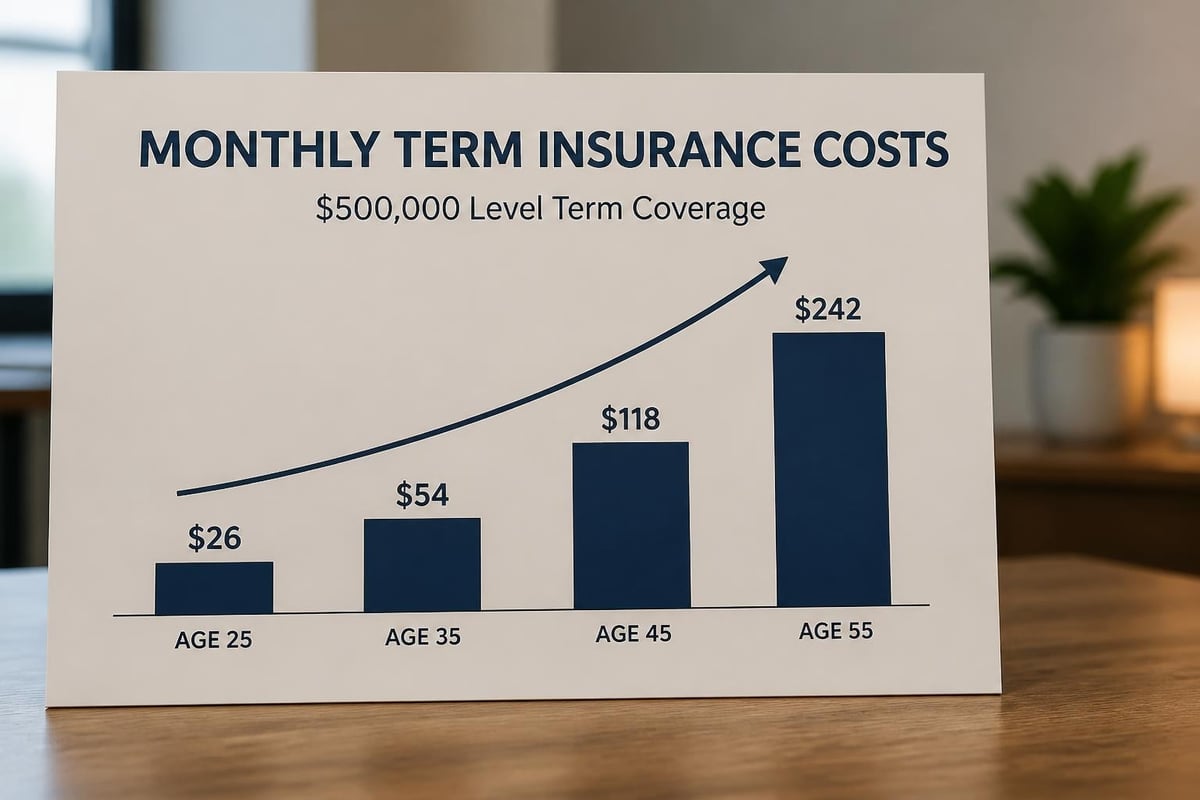
A healthy 35-year-old non-smoker in Greensboro might pay $30-$50 monthly for a $500,000 20-year level term policy, while a 50-year-old with health concerns could pay $150-$200 for the same coverage.
Term Length Selection Strategy
Choosing the right term length requires thinking about when your financial obligations will decrease. Most people select terms that align with specific life milestones.
| Term Length | Best For | Common Use Cases |
|---|---|---|
| 10 Years | Short-term needs | Temporary debt, brief business obligations |
| 20 Years | Working families | Child-rearing years, medium-term mortgages |
| 30 Years | Long-term protection | 30-year mortgages, young children, maximum coverage period |
The Society of Actuaries research on consumer decision-making reveals that many buyers underestimate how long they'll need coverage, leading to gaps when policies expire.

The Application and Underwriting Process
Obtaining level term insurance involves several steps designed to assess your risk profile and determine your premium. Understanding this process helps you prepare and potentially secure better rates.
Medical Underwriting Requirements
Most level term insurance policies require medical underwriting, though some insurers offer simplified or guaranteed issue options for smaller coverage amounts. The standard process typically includes:
- Detailed health questionnaire covering personal and family medical history
- Prescription drug database check
- Motor vehicle records review
- Paramedical exam (height, weight, blood pressure, blood and urine samples)
- Attending physician statement for specific health conditions
The underwriting process usually takes 4-6 weeks, though accelerated underwriting programs can provide decisions in days for qualified applicants. Being honest and thorough during application prevents claim denials later.
Improving Your Insurability
Taking steps to improve your health before applying can result in better premium classifications and significant savings over the policy term.
Actionable improvements include:
- Quitting tobacco (often requires 12 months nicotine-free)
- Losing excess weight to improve BMI
- Managing chronic conditions like diabetes or hypertension
- Reducing alcohol consumption
- Scheduling preventive care appointments
Even small health improvements can move you from a "standard" to "preferred" rating class, potentially saving hundreds or thousands of dollars over a 20-30 year term.
Policy Features and Riders Worth Considering
While level term insurance provides basic death benefit protection, optional riders can enhance your coverage to meet specific needs. These additions typically increase your premium but offer valuable flexibility.
Convertibility Options
A conversion rider allows you to change your level term insurance into a permanent policy (whole life or universal life) without new medical underwriting. This proves invaluable if you develop health issues during your term and want to maintain coverage beyond the original expiration date.
Most conversion riders include restrictions:
- Conversion must occur within a specific timeframe (often first 10-15 years)
- Limited permanent policy options available
- New permanent policy premium based on your current age
This feature provides a safety net for changing circumstances without losing insurability.
Return of Premium Rider
Return of premium (ROP) riders refund all paid premiums if you outlive your term. While this sounds attractive, it significantly increases your annual cost-often 50-100% more than standard level term insurance.
Pros and cons comparison:
| Advantage | Disadvantage |
|---|---|
| Get all premiums back if you survive | Much higher monthly payments |
| Feels less like "lost money" | Reduced investment opportunity cost |
| Forced savings mechanism | Lower total return than investing difference |
For most families in Kernersville and the surrounding area, the extra premium cost exceeds the potential benefit, especially when those funds could be invested elsewhere.
Waiver of Premium Rider
This rider continues your coverage without premium payments if you become disabled and cannot work. The insurance company essentially pays your premiums until you recover or the term ends.
Specific provisions vary by insurer, but generally require:
- Total disability lasting at least six months
- Inability to perform your occupation
- Disability occurring before a certain age (often 60 or 65)
For primary breadwinners, this rider offers critical protection at a modest cost increase.
Common Misconceptions About Level Term Insurance
Despite its straightforward nature, several myths persist about level term insurance that prevent people from making informed decisions.
"Term Insurance Is Wasted Money"
This frequently heard objection misses the fundamental purpose of insurance-protection, not investment. You don't consider car insurance "wasted money" when you don't have an accident. The American Council of Life Insurers data shows that term life insurance provides the most death benefit per premium dollar.
Level term insurance serves a specific purpose during high-risk, high-responsibility years. Most policies expire because the insured successfully reaches a point where they no longer need coverage-their mortgage is paid, children are independent, and retirement assets are sufficient.
"I Have Coverage Through Work"
Employer-provided group term life insurance offers convenience but comes with significant limitations. According to Milliman’s workplace life insurance research, the median group coverage equals only 1-2 times annual salary-far below recommended levels.
Key limitations of employer coverage:
- Coverage ends when you leave or lose your job
- Typically insufficient amounts for family protection
- No portability between employers
- May become uninsurable if you develop health issues after leaving
Individual level term insurance provides control and continuity regardless of employment changes.
"I'm Too Young to Need Insurance"
Youth represents your greatest advantage when purchasing level term insurance. Premiums lock in at your application age, so a 25-year-old pays dramatically less than a 45-year-old for identical coverage.
Early purchase also ensures insurability before health issues emerge. Young families in the Triad Area often face the highest financial vulnerability-new mortgages, young children, limited savings-making affordable level term insurance particularly valuable.
Selecting the Right Coverage Amount
Determining appropriate coverage represents one of the most important decisions when purchasing level term insurance. Too little leaves your family financially vulnerable; too much wastes premium dollars on unnecessary coverage.
The DIME Method for Calculation
Financial planners often recommend the DIME formula for comprehensive coverage calculation:
- Debt – Total all outstanding debts (mortgage, car loans, credit cards)
- Income – Multiply annual income by years of replacement needed
- Mortgage – Include remaining mortgage balance (may overlap with debt)
- Education – Estimate future college costs for children
For example, a family with $300,000 mortgage, $50,000 other debts, $80,000 annual income needing 15 years replacement, and $100,000 college costs would calculate: $300,000 + $50,000 + ($80,000 × 15) + $100,000 = $1,650,000 recommended coverage.
Adjusting for Existing Assets
Your calculation should account for resources your family already possesses. Subtract existing savings, investments, retirement accounts, and other life insurance from your total needs to determine the level term insurance gap.
Asset considerations:
- Emergency funds and liquid savings
- Retirement account balances (though accessing these early has penalties)
- Existing life insurance through work or other policies
- Social Security survivor benefits
- Investment portfolio value
This more nuanced approach prevents over-insurance while ensuring adequate protection.
When Level Term Insurance Might Not Be the Best Choice
Despite its advantages, level term insurance doesn't suit every situation. Understanding when alternative coverage makes more sense helps you make informed decisions aligned with your actual needs.
Permanent Coverage Needs
If you need lifetime coverage for estate planning, final expenses, or leaving a guaranteed legacy, permanent insurance like whole life or universal life insurance may better serve your goals. These policies cost more but never expire if premiums are maintained.
Examples of permanent need scenarios:
- Estate tax obligations requiring guaranteed liquidity
- Special needs dependent requiring lifetime financial support
- Charitable giving goals at death
- Business succession planning spanning decades
- Final expense coverage regardless of longevity
Very Short-Term Needs
For coverage needs under five years, Term Life Insurance with annual renewable terms might offer more flexibility than a 10-year level term policy, despite potentially higher per-year costs in later years.
High-Net-Worth Estate Planning
Wealthy individuals often require sophisticated insurance strategies that combine permanent policies, trusts, and business arrangements. These complex needs typically exceed what straightforward level term insurance provides.
Shopping and Comparing Level Term Insurance Policies
The level term insurance market offers numerous carriers with varying rates, underwriting standards, and policy features. Strategic shopping can save thousands of dollars over your policy term.
Getting Accurate Quotes
Quality quotes require providing accurate health information, lifestyle details, and coverage specifications. NerdWallet’s level term life insurance guide emphasizes the importance of comparing identical coverage amounts and terms across carriers.
Working with an independent agent gives you access to multiple carriers without repeated applications. You share information once, and your agent shops it to various insurers to find the best combination of price, financial strength, and policy features.
Essential comparison points:
- Monthly or annual premium cost
- Insurer financial strength ratings (AM Best, Moody's)
- Conversion options and limitations
- Available riders and their costs
- Policy exclusions and limitations
- Customer service reputation and claim payment history
Understanding Financial Strength Ratings
Your level term insurance policy is only as reliable as the company backing it. Financial strength ratings assess an insurer's ability to pay claims decades into the future.
| Rating Agency | Top Rating | Recommended Minimum |
|---|---|---|
| AM Best | A++ | A- or higher |
| Moody's | Aaa | A3 or higher |
| Standard & Poor's | AAA | A- or higher |
Stick with insurers rated A- or better by major agencies to ensure your beneficiaries receive their death benefit when needed.
The Role of Independent Agents
Independent insurance agents represent multiple carriers rather than a single company. This arrangement provides several advantages when shopping for level term insurance.
At Moser Insurance Group Inc, we help clients throughout the Triad Area understand their options without pressure or obligation. You can reach us at 336-862-1763 or moserinsurancegroup@gmail.com to discuss your specific situation and receive personalized guidance. Our approach focuses on education first-ensuring you understand how level term insurance works, what it costs, and whether it fits your family's needs.
Independent agents can:
- Compare quotes from multiple carriers simultaneously
- Identify which insurer offers the best rates for your specific profile
- Navigate underwriting requirements and medical history questions
- Explain policy features and rider options in plain language
- Provide ongoing service throughout your policy term
Policy Management and Beneficiary Considerations
Purchasing level term insurance isn't a "set it and forget it" transaction. Proper management ensures your policy performs as intended when your family needs it most.
Keeping Beneficiary Designations Current
Your beneficiary designation controls who receives your death benefit, overriding even your will. Review and update beneficiaries after major life events:
- Marriage or divorce
- Birth or adoption of children
- Death of a named beneficiary
- Changes in family relationships
- Significant wealth changes
Name both primary and contingent beneficiaries to avoid probate complications. Be specific with full legal names and relationship information.
Understanding the Claims Process
When you pass away, your beneficiaries must file a death claim with your insurance carrier. This process typically requires:
- Obtaining certified copies of the death certificate
- Completing the insurer's claim forms
- Providing policy information
- Submitting required documentation
- Allowing the insurer to verify information
Most claims settle within 30-60 days if documentation is complete and there are no complications. Beneficiaries should contact the insurer promptly and keep copies of all submitted materials.
Premium Payment Strategies
Missing premium payments can result in policy lapse and loss of coverage. Set up automatic payments through bank draft or credit card to ensure consistent payment. Most insurers offer a 30-31 day grace period, but don't rely on it.
Payment frequency options:
- Monthly (highest total annual cost, most convenient)
- Quarterly (moderate cost and convenience)
- Semi-annual (lower total cost)
- Annual (lowest total cost, requires large single payment)
Paying annually typically saves 3-8% compared to monthly payments, but choose the frequency that ensures consistent payment.
Special Considerations for Families and Medicare-Age Individuals
While level term insurance primarily serves younger, working individuals, certain situations make it relevant for older adults and those approaching retirement.
Coverage During Retirement Transition
Many people maintain level term insurance into their 60s to bridge the gap until retirement assets become sufficient. If you're approaching Medicare eligibility but still have financial obligations, extending term coverage makes sense.
The team at Moser Insurance Group Inc works extensively with Medicare-age clients who need to coordinate their health insurance through Medicare with their life insurance protection. Visit moserinsurancegroup.com or call 336-862-1763 to discuss how different insurance types work together as you transition into retirement.
Coordinating With Other Coverage
Level term insurance often complements rather than replaces other financial protection. Strategic coordination maximizes your family's security:
- Pair level term with disability insurance to protect income while living
- Maintain term coverage while building permanent policy cash value
- Use term insurance to supplement insufficient employer coverage
- Coordinate death benefits with Social Security survivor benefits
This layered approach provides comprehensive protection at various price points and policy durations.
Level term insurance offers straightforward, affordable protection during the years your family depends on your income most. Understanding how premiums stay level, coverage works, and policies compare helps you make confident decisions about protecting those you love. If you're in Greensboro, Winston Salem, High Point, Kernersville, or anywhere in the Triad Area and want personalized guidance on life insurance options without pressure, Moser Insurance Group Inc can help you understand your choices clearly-call us at 336-862-1763 or email moserinsurancegroup@gmail.com to start a conversation about your family's protection needs.
Recent Comments