

Navigating the world of insurance medicare can feel overwhelming, especially as you approach eligibility or help a loved one make important coverage decisions. With approximately 65 million Americans enrolled in Medicare as of 2026, understanding how this federal health insurance program works is essential for making informed choices about your healthcare future. Whether you're turning 65, dealing with a disability, or simply planning ahead, knowing the fundamentals of insurance medicare helps you avoid costly mistakes and find coverage that truly meets your needs.
Understanding the Foundation of Insurance Medicare
Insurance medicare represents the federal health insurance program primarily designed for people aged 65 and older, along with certain younger individuals with disabilities or specific medical conditions. The program was established in 1965 and has evolved significantly over the decades to meet the changing healthcare needs of millions of Americans.
The foundation of insurance medicare rests on four distinct parts, each addressing different aspects of healthcare coverage. Part A covers hospital stays, skilled nursing facility care, hospice care, and some home health services. Part B handles medical insurance, including doctor visits, outpatient care, preventive services, and medical equipment. Part C, known as Medicare Advantage, offers an alternative way to receive your Medicare benefits through private insurance companies. Part D provides prescription drug coverage.
Understanding how Medicare works requires recognizing that you have choices in how you receive your benefits. You can stick with Original Medicare (Parts A and B) and add supplemental coverage, or you can choose a Medicare Advantage plan that bundles everything together.
The Four Parts Explained
Each component of insurance medicare serves a specific purpose and comes with its own costs and coverage rules.
| Medicare Part | Coverage Focus | 2026 Monthly Premium | Deductible |
|---|---|---|---|
| Part A | Hospital insurance | $0 for most | $1,632 per benefit period |
| Part B | Medical insurance | $174.70 standard | $240 annual |
| Part C | Medicare Advantage | Varies by plan | Varies by plan |
| Part D | Prescription drugs | Varies by plan | Varies by plan |
Most people don't pay a premium for Part A because they or their spouse paid Medicare taxes while working. Part B requires a monthly premium that higher-income individuals may pay more for due to Income-Related Monthly Adjustment Amounts (IRMAA).

Enrollment Periods and Timing Considerations
Getting your insurance medicare timing right is crucial because missing deadlines can result in coverage gaps and permanent penalties. The Initial Enrollment Period (IEP) begins three months before your 65th birthday month and extends three months after, giving you a seven-month window to enroll.
If you're still working and have creditable coverage through an employer with 20 or more employees, you may delay Part B enrollment without penalty. When that coverage ends, you qualify for a Special Enrollment Period that lasts eight months.
The Annual Enrollment Period runs from October 15 through December 7 each year, allowing you to switch from Original Medicare to Medicare Advantage, change Medicare Advantage plans, or adjust your Part D prescription drug coverage. Changes made during this period take effect January 1 of the following year.
Key Enrollment Scenarios
For residents in the Triad Area, including Greensboro, Kernersville, High Point, and Winston Salem, understanding local enrollment options is particularly important. Here are common situations:
- Turning 65 while employed: Coordinate with HR to determine if your employer coverage is creditable
- Retiring before 65: You may need marketplace coverage until Medicare eligibility begins
- COBRA and Medicare: COBRA is not creditable coverage for Medicare purposes
- Disability-based eligibility: You're automatically enrolled after 24 months of disability benefits
Missing your enrollment window for Part B can result in a 10% premium penalty for each 12-month period you were eligible but didn't enroll. This penalty lasts as long as you have Medicare coverage. For more information about applying for Medicare, specific guidance tailored to your situation can prevent these costly mistakes.
Coverage Gaps and Supplemental Insurance Options
Original Medicare (Parts A and B) covers a substantial portion of healthcare costs, but significant gaps remain. Understanding these gaps helps you decide whether additional insurance medicare protection makes sense for your situation.
Medicare Part A covers hospital stays but requires a deductible of $1,632 per benefit period in 2026. For stays longer than 60 days, you'll pay coinsurance of $408 per day for days 61-90. Part B requires you to pay 20% of the Medicare-approved amount for most doctor services and outpatient care, with no annual out-of-pocket maximum.
These gaps can create substantial financial exposure. Medicare Supplement Plans (Medigap) are specifically designed to cover these costs. These private insurance policies work alongside Original Medicare to pay for deductibles, coinsurance, and copayments.
Comparing Coverage Approaches
Medigap Benefits:
- Freedom to see any doctor who accepts Medicare nationwide
- Predictable out-of-pocket costs
- No network restrictions
- Coverage travels with you
- Generally higher monthly premiums but lower costs when you need care
Medicare Advantage Considerations:
- Often lower monthly premiums (sometimes $0)
- Network-based care with specific doctors and hospitals
- Annual out-of-pocket maximums provide catastrophic protection
- May include extra benefits like dental, vision, and hearing
- Prior authorization requirements for some services
The choice between these approaches depends on your health status, budget, travel habits, and preferred doctors. According to KFF’s analysis of Medicare coverage sources, approximately 54% of Medicare beneficiaries have some form of supplemental coverage.
Medicare Advantage as an Alternative Path
Medicare Advantage plans represent a fundamentally different approach to receiving your insurance medicare benefits. Instead of the government paying your healthcare claims directly, you receive all your Part A and Part B benefits through a private insurance company approved by Medicare.
These plans must cover everything Original Medicare covers, but they can do so with different rules, costs, and restrictions. Most Medicare Advantage plans include prescription drug coverage, eliminating the need for a separate Part D plan. Many also offer additional benefits that Original Medicare doesn't cover, such as routine dental care, vision exams, eyewear, hearing aids, and fitness memberships.
The trade-off typically involves accepting network restrictions. Most Medicare Advantage plans operate as Health Maintenance Organizations (HMOs) or Preferred Provider Organizations (PPOs), requiring you to use specific doctors and hospitals or pay more for out-of-network care.
Evaluating Medicare Advantage Plans
When comparing insurance medicare options through Medicare Advantage, consider these factors:
- Network adequacy: Are your current doctors in the plan's network?
- Prescription drug formulary: Does the plan cover your medications at a reasonable cost?
- Out-of-pocket maximum: What's the most you could pay in a bad year?
- Prior authorization requirements: Which services require approval before treatment?
- Geographic coverage: Does the plan provide coverage when you travel?
For 2026, the average Medicare Advantage premium is approximately $18 per month, though many plans charge $0 premium beyond what you already pay for Part B. However, focusing solely on premium can be misleading. Examine the total potential costs, including copays for common services, specialist visits, and hospital stays.

Prescription Drug Coverage Under Medicare
Prescription drug coverage represents a critical component of comprehensive insurance medicare protection. Medicare Part D provides this coverage through private insurance plans approved by Medicare. Whether you choose Original Medicare or Medicare Advantage, understanding drug coverage is essential.
Part D plans vary significantly in terms of which drugs they cover, how much you pay, and which pharmacies you can use. Each plan maintains a formulary (list of covered drugs) organized into tiers, with generic drugs typically costing less than brand-name medications.
The standard Part D benefit structure for 2026 includes several cost phases:
| Coverage Phase | You Pay | Plan Pays |
|---|---|---|
| Deductible (up to $545) | 100% | 0% |
| Initial Coverage | 25% | 75% |
| Coverage Gap | 25% | 75% |
| Catastrophic Coverage | Greater of $4.15/$10.35 or 5% | 95% |
The coverage gap, once known as the "donut hole," has been significantly reduced under recent legislation. Most beneficiaries now pay consistent coinsurance throughout the year until reaching catastrophic coverage.
Choosing the Right Part D Plan
Selecting appropriate prescription drug coverage requires analyzing your specific medications and pharmacy preferences:
- Review the formulary: Confirm all your medications are covered
- Check tier placement: Lower-tier drugs cost less than higher-tier options
- Understand restrictions: Some drugs require prior authorization or step therapy
- Compare pharmacy options: Mail-order may offer savings for maintenance medications
- Calculate total annual costs: Add premiums, deductibles, and estimated copays
If you don't enroll in Part D when first eligible and lack creditable prescription coverage, you'll pay a late enrollment penalty of 1% of the national base premium for each month you delayed enrollment. This penalty persists for as long as you have Medicare coverage.
Special Situations and Lesser-Known Insurance Medicare Rules
Insurance medicare contains numerous special provisions that apply to specific situations. Understanding these rules helps you maximize benefits and avoid unexpected costs.
End-Stage Renal Disease (ESRD): Individuals with ESRD become eligible for Medicare regardless of age after a three-month waiting period once dialysis begins. This creates unique coordination issues if you have other insurance.
Working Past 65: If you or your spouse work for an employer with 20 or more employees, that coverage is typically primary, and Medicare becomes secondary. For employers with fewer than 20 employees, Medicare is usually primary. These coordination of benefits rules significantly impact which insurance pays claims first.
Veterans Benefits and Medicare: Many veterans mistakenly believe VA benefits eliminate the need for insurance medicare. In reality, VA coverage and Medicare serve different purposes and don't coordinate. VA coverage alone may not satisfy Medicare enrollment requirements.
For residents in Greensboro, Kernersville, High Point, Winston Salem, and throughout the Triad Area, local healthcare provider participation in Medicare can vary. Verifying that your preferred doctors and hospitals accept Medicare and participate in any Medicare Advantage networks you're considering is particularly important.
Coordination with Other Coverage
Understanding how insurance medicare coordinates with other insurance prevents surprise bills and maximizes your benefits. The Medicare Secondary Payer rules determine which insurance pays first in various scenarios.
When you have multiple types of coverage, the primary payer processes claims first, then the secondary payer covers some or all of the remaining costs. Medicare's coordination of benefits applies to:
- Employer group health plans
- COBRA coverage
- Retiree coverage
- Veterans benefits
- Medicaid (for dual-eligible individuals)
- Liability insurance (after accidents or injuries)
Dual-eligible individuals who qualify for both Medicare and Medicaid receive coordinated benefits, with Medicare typically paying first for covered services and Medicaid potentially covering Medicare premiums, deductibles, and services Medicare doesn't cover.
Costs Beyond Premiums: The Full Financial Picture
When evaluating insurance medicare options, premiums represent just one component of total healthcare costs. A comprehensive analysis includes deductibles, coinsurance, copayments, and out-of-pocket maximums.
Original Medicare has no out-of-pocket maximum, meaning costs can theoretically continue indefinitely if you have serious health issues. This unlimited exposure is precisely why many beneficiaries add Medigap coverage despite higher monthly premiums.
Medicare Advantage plans must include an annual out-of-pocket maximum, which averaged $5,460 for in-network services in 2026. Once you reach this limit, the plan pays 100% of covered services for the rest of the year.
Hidden Costs to Consider
Several less obvious costs can impact your insurance medicare budget:
- Part B excess charges: Doctors who don't accept Medicare assignment can charge up to 15% more than the Medicare-approved amount
- Foreign travel: Original Medicare provides very limited coverage outside the United States
- Fitness and wellness: While some Medicare Advantage plans include gym memberships, Original Medicare doesn't
- Over-the-counter items: Certain Medicare Advantage plans provide allowances for OTC health products
High-income beneficiaries face Income-Related Monthly Adjustment Amounts (IRMAA) that increase Part B and Part D premiums. For 2026, individuals with modified adjusted gross income above $103,000 or couples above $206,000 pay additional amounts based on income brackets.
Making Informed Decisions About Your Coverage
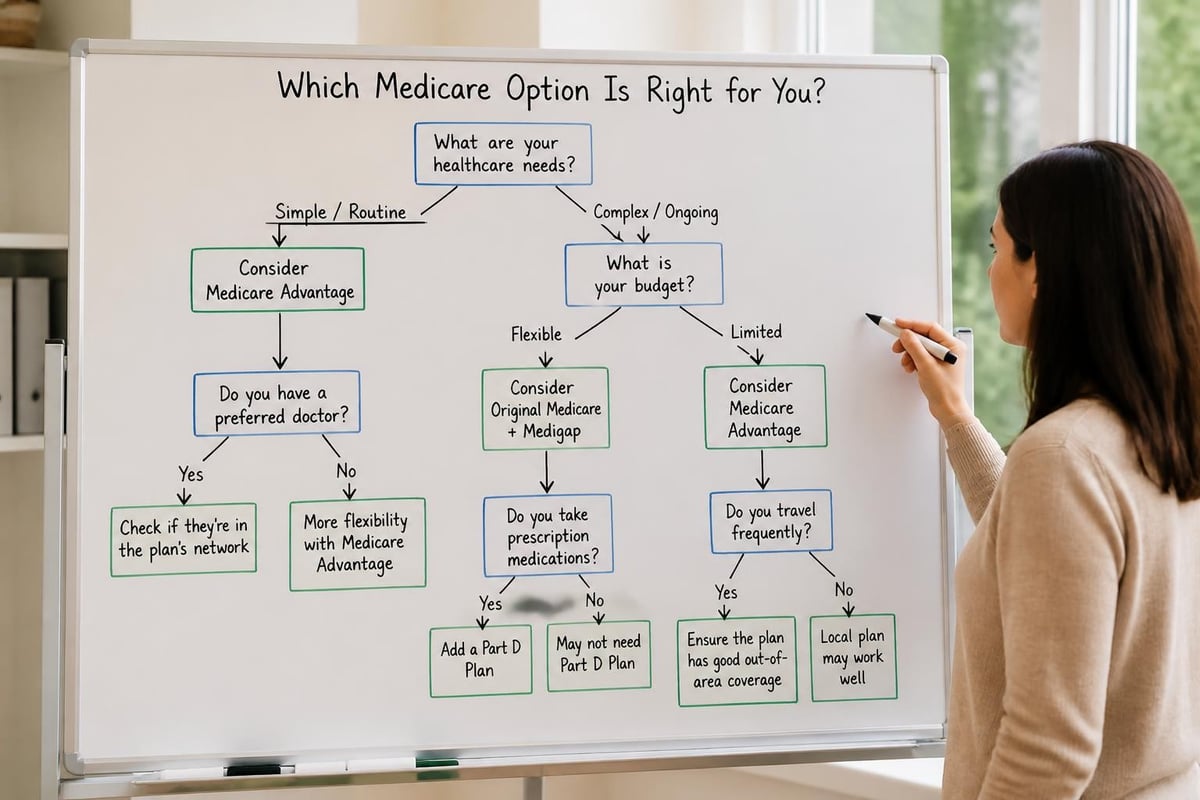
Choosing the right insurance medicare coverage requires careful evaluation of your personal circumstances, health needs, and financial situation. No single approach works best for everyone, and what makes sense today may change as your health or finances evolve.
Start by assessing your current health status and anticipated needs. Do you have chronic conditions requiring frequent specialist visits? Do you take multiple prescription medications? Do you prefer having the freedom to see any doctor, or are you comfortable with network restrictions in exchange for lower costs?
Medicare seminars can provide valuable education about your options in a no-pressure environment. These sessions typically cover the basics of how insurance medicare works, explain the differences between coverage approaches, and address common questions.
Questions to Guide Your Decision
Before selecting coverage, consider these essential questions:
- Which doctors and hospitals do you want to continue seeing?
- What prescription medications do you take regularly?
- How much can you comfortably afford in monthly premiums?
- What's your tolerance for out-of-pocket costs when you need care?
- Do you travel frequently, either domestically or internationally?
- Are dental, vision, and hearing benefits important to you?
- Do you qualify for any assistance programs that could reduce costs?
According to Kiplinger’s Medicare basics guide, the average Medicare beneficiary spends approximately $6,100 annually on healthcare costs, including premiums, deductibles, and out-of-pocket expenses. Planning for these costs helps prevent financial strain during retirement.
Resources and Support for Medicare Beneficiaries
Understanding insurance medicare is an ongoing process, not a one-time decision. Fortunately, numerous resources provide free, unbiased information to help you navigate your options.
The official Medicare.gov website offers comprehensive information about all aspects of the program, including a plan comparison tool that allows you to evaluate Medicare Advantage and Part D options based on your specific medications and doctors. The site also provides information about Medicare health plans available in your area.
State Health Insurance Assistance Programs (SHIPs) offer free, personalized counseling to help Medicare beneficiaries understand their coverage options. These programs provide one-on-one assistance with enrollment, claims issues, and coverage questions without selling any insurance products.
For additional support in the Triad Area, including Greensboro, Kernersville, High Point, and Winston Salem, local insurance professionals can provide personalized guidance tailored to your specific situation. You can reach out for assistance by calling 336-862-1763, emailing moserinsurancegroup@gmail.com, or visiting moserinsurancegroup.com.
Annual Review Best Practices
Your insurance medicare needs will likely change over time, making annual coverage reviews essential. Each fall, during the Annual Enrollment Period, take time to:
- Review your current plan's performance and satisfaction level
- Compare your plan to other available options in your area
- Verify your doctors still participate in your plan's network
- Confirm your medications remain covered at reasonable costs
- Assess any changes in your health status or care needs
- Evaluate whether additional benefits would provide value
The Centers for Medicare & Medicaid Services coverage center provides detailed information about what Medicare covers, helping you understand which services and treatments are included in your benefits.
Common Medicare Mistakes to Avoid
Even well-informed individuals sometimes make costly errors when dealing with insurance medicare. Awareness of common pitfalls helps you sidestep these issues.
Missing enrollment deadlines tops the list of expensive mistakes. Late enrollment penalties for Part B and Part D last a lifetime, adding hundreds or thousands of dollars to your total Medicare costs over the years. Mark your calendar with relevant dates and set reminders well in advance.
Assuming "free" means no cost can lead to surprises. While many Medicare Advantage plans advertise $0 premiums, you still pay copays, coinsurance, and deductibles when you use services. Review the full cost structure, not just the monthly premium.
Failing to compare plans annually leaves money on the table. Plans change their coverage, costs, and networks every year. What was the best option last year may not be competitive this year. Always compare during the Annual Enrollment Period.
Choosing based solely on price often backfires. The cheapest premium doesn't necessarily result in the lowest total cost, especially if you need significant care. Consider the complete financial picture, including potential out-of-pocket expenses.
Not coordinating with other coverage creates confusion and potential gaps. If you have retiree coverage, COBRA, or other insurance, understand how it works with insurance medicare to avoid being underinsured or paying for duplicate coverage.
For personalized guidance on navigating these complexities, exploring health insurance and Medicare options with an experienced professional can clarify your specific situation and prevent costly mistakes.
Looking Ahead: Medicare's Future and Your Planning
Insurance medicare continues to evolve through legislative changes, regulatory updates, and healthcare innovation. Staying informed about these changes ensures your coverage remains optimal for your needs.
Recent legislative developments have focused on reducing prescription drug costs, expanding telehealth access, and addressing health equity issues. The Inflation Reduction Act of 2022 introduced several significant changes that continue to phase in through 2026 and beyond, including a $2,000 annual out-of-pocket cap for Part D prescription drug costs starting in 2025.
Technology integration is transforming how beneficiaries access care and manage their insurance medicare benefits. Telehealth services expanded dramatically during the pandemic, and many of these flexibilities have been extended. Virtual visits now cover a wider range of services, often with the same coverage as in-person appointments.
Planning Strategies for Long-Term Success
Effective insurance medicare planning extends beyond initial enrollment. Consider these long-term strategies:
- Build a healthcare team: Establish relationships with primary care physicians and specialists before you need urgent care
- Maintain good records: Keep documentation of all healthcare expenses, communications with insurers, and coverage decisions
- Review prescription options: Ask doctors about generic alternatives or therapeutic equivalents that may cost less
- Use preventive services: Medicare covers many preventive screenings and vaccines at no cost when you use in-network providers
- Plan for long-term care: Medicare doesn't cover most long-term care services, so consider how you'll address these potential needs
Understanding your insurance medicare options and choosing wisely creates a foundation for better health outcomes and financial security during your retirement years.
Navigating insurance medicare successfully requires understanding the program's structure, knowing your options, and making informed decisions based on your unique circumstances. Whether you choose Original Medicare with supplemental coverage or opt for Medicare Advantage, the right choice is the one that aligns with your healthcare needs, budget, and preferences. Moser Insurance Group Inc helps individuals and families throughout the Triad Area understand Medicare options with clear guidance and personalized support, so you can make confident insurance decisions without pressure. Contact us at 336-862-1763, email moserinsurancegroup@gmail.com, or visit Moser Insurance Group Inc to discuss which insurance medicare options work best for your situation.
Recent Comments