

Your ability to earn an income is one of your most valuable assets. For most families across the Triad Area, including Greensboro, Kernersville, High Point, and Winston Salem, regular paychecks fund everything from mortgage payments to groceries. Yet few people consider what would happen if illness or injury prevented them from working for months at a time. Income protection insurance addresses this vulnerability by replacing a portion of your earnings when you're unable to work, creating a financial buffer during challenging recovery periods.
What Is Income Protection Insurance
Income protection insurance is a policy designed to replace a percentage of your regular earnings if you become unable to work due to illness or injury. Unlike workers' compensation, which only covers job-related incidents, or short-term disability through your employer, income protection insurance can be purchased individually to provide comprehensive coverage regardless of how or where you become unable to work.
The core function is straightforward: you pay a monthly premium, and if you become disabled and cannot perform your occupation, the policy pays a monthly benefit. This benefit typically ranges from 50% to 70% of your gross income, though the exact percentage depends on your policy terms.
Coverage Duration and Waiting Periods
Most policies include an elimination period, also known as a waiting period, before benefits begin. This period typically ranges from 30 to 90 days, though some policies offer longer elimination periods of 180 or 360 days in exchange for lower premiums.
Common elimination periods include:
- 30 days for higher-premium policies
- 60 days as a standard option
- 90 days for moderate premium reduction
- 180 days for significant premium savings
- 365 days for maximum affordability
The benefit period determines how long payments continue if you remain disabled. Short-term policies might pay benefits for two to five years, while long-term policies can extend until age 65 or even for life, depending on the contract terms.

How Income Protection Works in Practice
Understanding the mechanics helps you determine whether income protection fits your financial plan. According to detailed guidance on policy mechanics, the benefit calculation starts with your pre-disability earnings and applies the policy's replacement percentage.
If you earned $5,000 monthly before becoming disabled and your policy replaces 60% of income, you would receive $3,000 monthly during your disability. Most policies pay these benefits directly to you, not to healthcare providers, giving you flexibility to use the funds for mortgage payments, utilities, food, or any other expense.
Own Occupation vs. Any Occupation
The definition of disability significantly impacts when benefits are payable. Own occupation policies pay benefits if you cannot perform the duties of your specific profession, even if you could work in another capacity. Any occupation policies only pay if you cannot perform any job for which you're reasonably qualified by education or experience.
| Policy Type | Definition | Cost | Best For |
|---|---|---|---|
| Own Occupation | Cannot perform your specific job duties | Higher premiums | Specialists, high earners |
| Any Occupation | Cannot perform any reasonable job | Lower premiums | Budget-conscious buyers |
| Modified Own Occupation | Own occupation for 2-5 years, then any occupation | Moderate premiums | Middle-ground option |
Professional guidance from resources like Moser Insurance Group can help you navigate these definitions and select appropriate coverage levels for your situation.
Who Needs Income Protection Coverage
While everyone faces the risk of disabling illness or injury, certain groups benefit most from dedicated income protection coverage. Self-employed professionals and business owners lack employer-sponsored disability benefits, making individual coverage essential. According to comprehensive coverage guides, workers in physically demanding occupations face higher injury risks and should prioritize this protection.
Primary breadwinners whose families depend heavily on their income need robust coverage. Even dual-income households may struggle to maintain their lifestyle on one salary, particularly with children or significant debt obligations.
Employment Status Considerations
Self-employed individuals should recognize that business interruption doesn't pause personal expenses. Mortgage lenders and creditors won't accept "I'm recovering from surgery" as payment. Income protection ensures you can maintain personal financial obligations while focusing on recovery.
Employees with limited sick leave benefit from coverage that extends beyond their employer's paid time off. Many companies offer only a few weeks of paid sick leave, yet serious health conditions can require months of recovery.
Contract workers and freelancers face irregular income patterns that make planning difficult. Income protection based on average earnings provides stability during periods when work is impossible.
Common Exclusions and Limitations
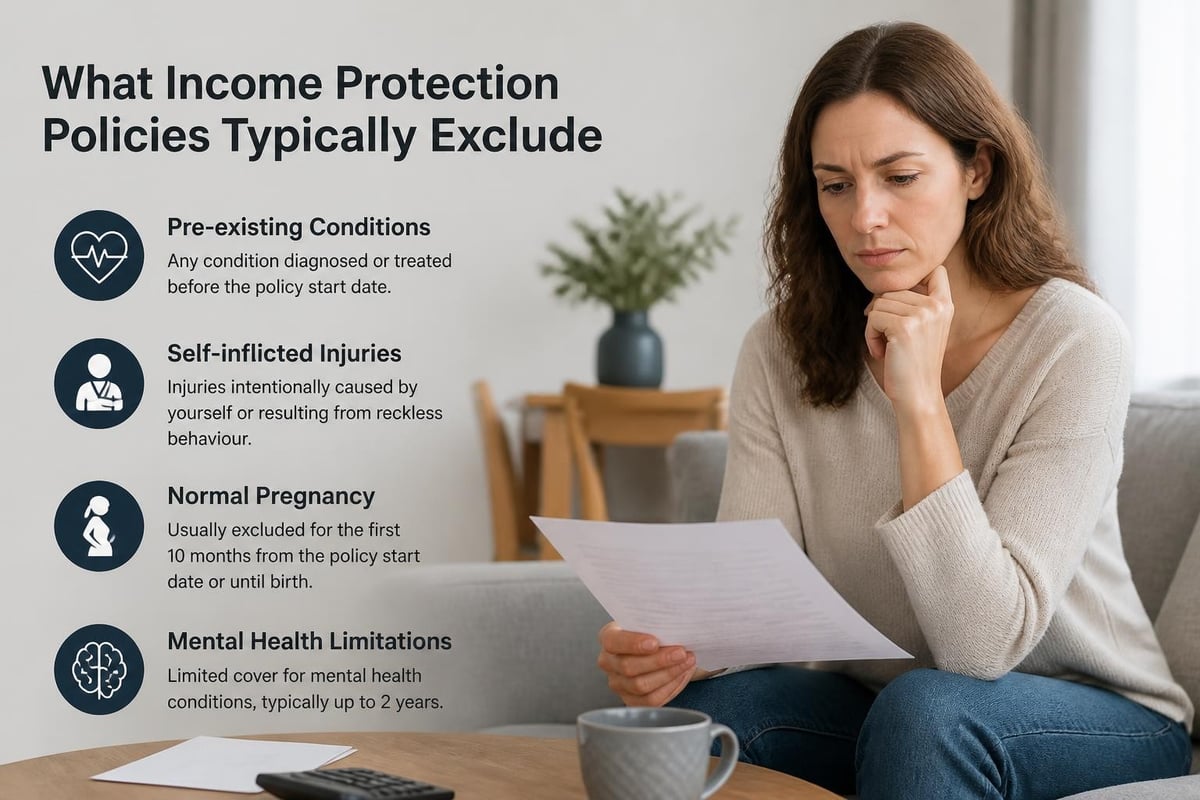
Understanding what income protection doesn't cover is as important as knowing what it does. Pre-existing conditions often face exclusion periods, meaning disabilities related to conditions you had before purchasing the policy may not be covered for the first 12 to 24 months.
Self-inflicted injuries and disabilities resulting from illegal activities are universally excluded. Most policies also exclude normal pregnancy, though complications requiring bed rest or hospitalization may qualify for benefits depending on policy language.
Standard exclusions typically include:
- Pre-existing medical conditions during the waiting period
- Injuries from participation in professional sports
- Disabilities from war or military service
- Self-inflicted injuries or suicide attempts
- Pregnancy-related absences (without complications)
- Incarceration or commission of a crime
Mental health coverage varies significantly among policies. Some exclude psychiatric conditions entirely, while others provide limited benefits with shorter maximum payment periods compared to physical disabilities.
Cost Factors and Premium Determinants
Premium costs for income protection vary based on multiple factors, with insurers assessing risk through underwriting criteria. Age significantly impacts pricing, as older applicants face higher likelihood of disability claims.
Your occupation classification directly affects premiums. Desk workers in low-risk professions pay less than construction workers or others in physically demanding fields. Health status, including weight, blood pressure, and medical history, influences both eligibility and cost.
Premium Calculation Elements
| Factor | Impact on Premium | Example |
|---|---|---|
| Age | Increases with age | 35-year-old pays less than 55-year-old |
| Occupation | Higher risk = higher cost | Accountant pays less than electrician |
| Benefit Amount | Higher benefits = higher premium | 70% replacement costs more than 50% |
| Elimination Period | Longer wait = lower premium | 90-day wait costs less than 30-day |
| Benefit Period | Longer duration = higher cost | To-age-65 costs more than 5-year term |
The coverage amount you select directly correlates with premium costs. Replacing 70% of income costs more than replacing 50%, though the higher percentage provides better financial protection. Similarly, selecting a 30-day elimination period costs more than a 90-day waiting period, but provides faster access to benefits.
Integration With Other Coverage
Income protection works alongside other insurance types but shouldn't be considered redundant. Social Security Disability Insurance (SSDI) provides government benefits but has strict qualification requirements and lengthy approval processes. The Social Security Administration denies approximately 65% of initial applications, and approved benefits often fall short of actual income replacement needs.
Employer-sponsored short-term disability typically covers only 40% to 60% of earnings for 13 to 26 weeks. Long-term disability through employers may provide broader coverage but often caps benefits at a maximum dollar amount that may not adequately replace high earners' income.
Life insurance serves a different purpose, paying benefits upon death rather than during disability. However, some permanent life insurance policies include disability riders that can complement dedicated income protection coverage.
Workers' compensation covers only job-related injuries and illnesses. If you become disabled due to a car accident on the weekend or a health condition unrelated to work, workers' compensation provides no benefits.
Tax Implications of Benefits
The tax treatment of income protection benefits depends on who paid the premiums. If you purchase an individual policy with after-tax dollars, benefits are generally tax-free. This tax-free status makes the benefit amount more valuable since you don't lose a portion to income taxes.
Employer-paid group disability insurance creates taxable benefits. If your employer pays the premiums as a benefit, any disability payments you receive count as taxable income. This distinction matters when calculating adequate coverage levels.
Tax scenarios include:
- Individual policy with personal funds: Benefits tax-free
- Employer-paid group policy: Benefits fully taxable
- Employee-paid group policy: Benefits tax-free
- Shared premium payment: Proportionally taxable
For residents across Greensboro, Kernersville, High Point, and Winston Salem, understanding these tax implications helps in proper financial planning. A 60% replacement rate from a taxable policy may provide significantly less spending power than the same percentage from a tax-free individual policy.

Choosing the Right Coverage Amount
Determining appropriate coverage requires analyzing your monthly expenses and existing resources. Start by calculating essential expenses including mortgage or rent, utilities, food, insurance premiums, minimum debt payments, and transportation costs.
Most financial advisors recommend replacing 60% to 70% of gross income, though your specific needs may differ. Higher earners who save substantial portions of income may adequately protect their lifestyle with 50% replacement, while those with tight budgets may need 70% to cover essential expenses.
Coverage Calculation Approach
- Calculate monthly gross income from all sources
- List all monthly expenses including discretionary spending
- Identify essential vs. optional expenses you could reduce if needed
- Consider existing disability coverage through employers or government programs
- Determine the gap between expenses and other disability income sources
Remember that most policies limit coverage to 60% or 70% of pre-disability earnings to maintain work incentive. Insurers generally won't allow you to purchase coverage that provides more income disabled than you earned while working.
Policy Features Worth Considering
Beyond basic coverage, several policy features enhance income protection value. A residual or partial disability rider pays reduced benefits if you return to work part-time or with reduced capacity. This feature supports gradual return to work without losing all benefits immediately.
Cost-of-living adjustments (COLA) increase benefit amounts annually based on inflation indices, preventing erosion of purchasing power during long-term disabilities. Future increase options let you purchase additional coverage at specific intervals without new medical underwriting, protecting insurability if health declines.
Valuable rider options include:
- Residual disability rider: Pays partial benefits for part-time work
- COLA rider: Adjusts benefits annually for inflation
- Future increase option: Allows coverage increases without new health exams
- Return of premium rider: Refunds portion of premiums if no claims filed
- Non-cancelable guarantee: Prevents insurer from canceling or changing terms
The guaranteed renewable feature ensures the insurer cannot cancel your policy as long as you pay premiums, though they may adjust rates for your entire risk class. Non-cancelable policies lock in both coverage and premium rates, providing maximum stability but higher initial costs.
Application and Underwriting Process
Applying for income protection insurance involves detailed disclosure of your medical history, occupation, income, and lifestyle. Insurers review this information to assess risk and determine appropriate premiums or coverage limitations.
Most applications require proof of income through tax returns, W-2 forms, or profit and loss statements for self-employed applicants. This documentation prevents over-insurance and ensures benefit calculations reflect actual earnings.
Medical underwriting may include a phone interview about your health history, review of medical records, and possibly a paramedical exam with basic health measurements. The insurer uses this information to identify pre-existing conditions and assess overall health status.
Comparing Income Protection to Employer Benefits
While employer-sponsored disability insurance provides valuable baseline protection, individual income protection offers several advantages. Employer coverage typically terminates when you leave the job, while individual policies remain in force regardless of employment changes.
Group policies through employers often define disability as inability to perform any occupation, while individual policies more frequently offer own-occupation definitions. This difference dramatically impacts when benefits are payable, particularly for specialized professionals.
Coverage amounts through employers frequently cap at a maximum monthly benefit, which may inadequately replace high earners' income. Individual policies can be structured to replace the appropriate percentage without arbitrary caps.
When to Purchase Coverage
The ideal time to purchase income protection is while you're healthy, employed, and insurable. Waiting until health issues emerge limits options and increases costs. Young professionals in their 20s and 30s secure the lowest premium rates and establish coverage before medical conditions develop.
Life changes like marriage, home purchase, or having children increase financial responsibilities and make income protection more critical. These milestones signal appropriate times to evaluate coverage needs and establish protection.
Career advancement and income increases also warrant coverage reviews. As earnings grow, existing coverage may no longer adequately replace lost income, necessitating additional protection through future increase options or supplemental policies.
For those exploring comprehensive financial protection, speaking with an experienced agent helps clarify how income protection fits within a broader insurance strategy. If you're in the Triad Area and want personalized guidance, you can reach Moser Insurance Group at 336-862-1763 or moserinsurancegroup@gmail.com, or visit moserinsurancegroup.com to explore your options.
Making an Informed Decision
Evaluating income protection requires honest assessment of your financial vulnerability and risk tolerance. Consider how long you could maintain your current lifestyle if paychecks stopped tomorrow. Most Americans have limited emergency savings, with many unable to cover three months of expenses without income.
Review existing coverage through employers, government programs, and other sources. Calculate the actual gap between total expenses and available disability benefits. This gap represents your unprotected financial exposure.
Compare quotes from multiple insurers, as premiums and policy features vary significantly. Work with independent agents who represent multiple companies rather than captive agents limited to one insurer's products. This approach ensures access to broader options and competitive pricing.
Read policy documents carefully before purchasing, paying particular attention to the disability definition, exclusions, elimination periods, and benefit duration. Understanding these terms prevents surprises when filing claims. Resources available through professional insurance advisors can help clarify complex policy language and identify coverage gaps.
Income protection insurance provides essential financial security by replacing lost earnings when illness or injury prevents you from working, ensuring your family can maintain stability during recovery periods. Understanding coverage options, costs, and policy features empowers you to make informed decisions about protecting your most valuable asset: your ability to earn an income. The team at Moser Insurance Group helps individuals and families across the Triad Area understand their insurance options with clear guidance and personalized support, making it easier to secure the protection you need without pressure. Contact us at 336-862-1763 or moserinsurancegroup@gmail.com to discuss how income protection fits your financial plan.
Recent Comments