

Medicare Advantage plans are rated by the federal government on a one-to-five-star scale, and the best plan for you is the one that scores well and also fits your doctors, prescriptions, and budget. For anyone turning 65 in Greensboro, Winston-Salem, High Point, or Kernersville, medicare advantage plans rated at four or five stars are a sound starting point, but the rating is only one input. This guide explains what the stars measure, what they leave out, and how to build a short list that works for your situation anywhere in the Triad Area.
How Medicare Advantage Plans Are Rated
Medicare Advantage plans are rated using a five-star system, where five is the highest score and one is the lowest. The rating applies to the plan's contract, not to each individual plan option under it, so several plans sold in your county can share one score.
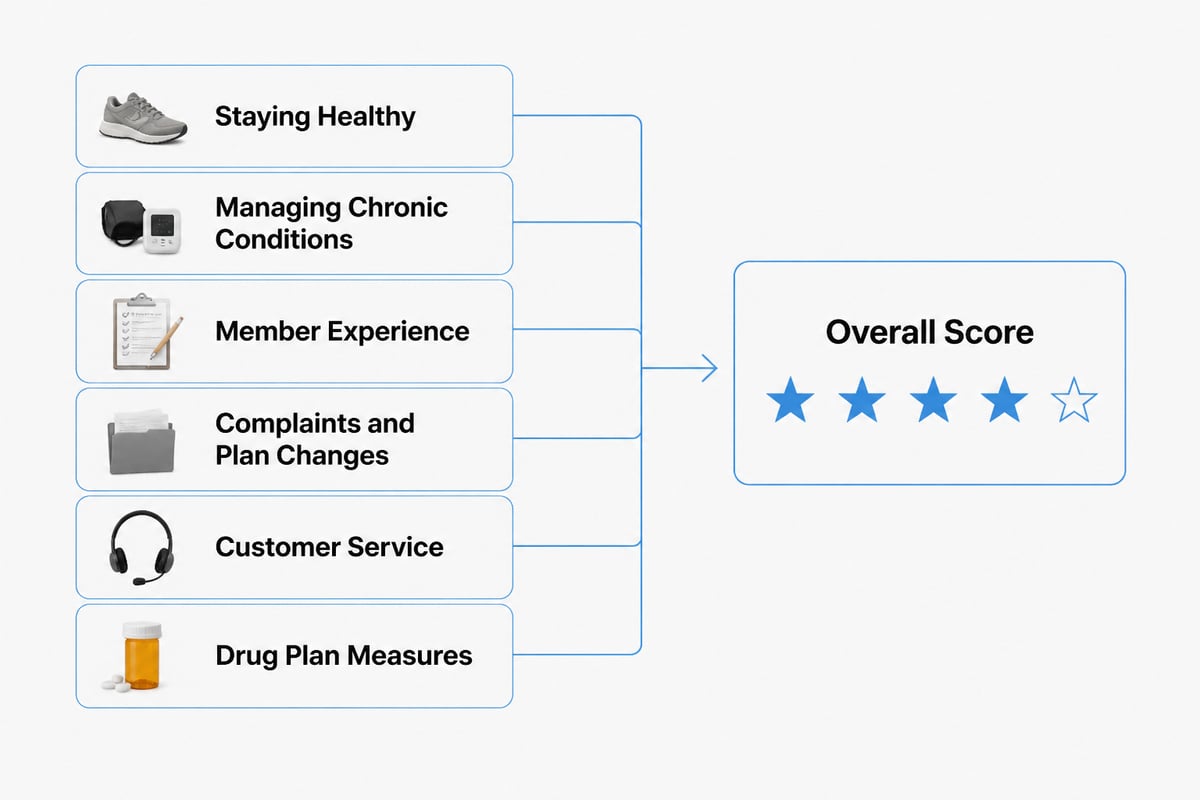
The score blends measures from several categories:
- Staying healthy: screenings, vaccines, and annual wellness visits.
- Managing chronic conditions: how well members with diabetes, high blood pressure, or arthritis are supported.
- Member experience: survey results about getting appointments, seeing specialists, and overall satisfaction.
- Complaints and plan changes: how often members file complaints or leave the plan.
- Customer service: how well the plan handles calls and appeals.
- Drug plan measures: for plans with prescription coverage, pharmacy services and drug safety.
Only a small number of Medicare Advantage contracts earn five stars in a given year, which is why a five-star plan may not be offered in your county at all.
What Star Ratings Do Not Tell You
A star rating describes how a plan performs on average across all of its members, so it cannot tell you whether your cardiologist, your pharmacy, or your medications are covered. Two members of the same five-star plan can have very different experiences.
Several gaps are worth understanding before you let a score drive your decision.
Averages Do Not Reflect Individual Fit
A plan that excels at preventive screenings may still have a narrow network in Forsyth or Guilford County. If the specialists you rely on are outside that network, the star count does not help you.
Ratings Change Every Year
CMS updates ratings annually, and plans also adjust their benefits, networks, and formularies each year. A plan that earned five stars last year may earn four this year, and a plan that was strong on benefits may trim them. Reviewing your plan every fall is the practical safeguard.
Lower-Rated Plans Can Still Be a Good Match
A three-star plan with your doctors in network and your drugs on its formulary can serve you better than a five-star plan that excludes them. Treat the rating as a filter, then confirm fit.
If you want to see how these scores translate to the carriers available locally, our overview of 5-star Medicare Advantage plans walks through the topic in more detail.
Are Medicare Advantage Plans Good or Bad?
Medicare Advantage plans are neither good nor bad in general; they are a trade-off that works well for some people and poorly for others. Whether one suits you depends on how you use health care.
The common advantages include:
- Hospital, medical, and usually prescription drug coverage bundled into one plan.
- A yearly cap on in-network out-of-pocket costs.
- Extras such as dental, vision, and hearing, which Original Medicare does not cover.
- Low or even $0 monthly premiums beyond your Part B premium. Supplemental premiums on many plans are modest, though amounts vary by plan and county.
The common drawbacks include:
- Provider networks that limit your choice of doctors and hospitals.
- Prior authorization requirements that can delay certain services.
- Copayments that add up if you need frequent specialist care or a hospital stay.
- Annual changes to benefits and networks.
People who are generally healthy, comfortable with a network, and value bundled extras often do well. People who travel frequently or want unrestricted access to specialists may prefer pairing Original Medicare with a Medigap policy. Our guide to differences in Medicare plans lays out both paths side by side.
Medicare Advantage Plans Rated by Plan Type: HMO, PPO, and Others
The plan type affects your freedom to choose providers as much as the star rating does. According to Medicare.gov, HMO members generally must use the plan's provider network, except for emergency or urgent care and out-of-area dialysis, while PPO members can generally go out of network but may pay more.
| Plan type | Network rules | Specialist referrals | Typical fit |
|---|---|---|---|
| HMO | Must use plan network, with emergency and urgent care exceptions | Most plans require a referral | Lower costs, comfortable with a defined network |
| PPO | Out-of-network allowed, usually at higher cost | Generally not required | More flexibility, willing to pay somewhat more |
| Special Needs Plan | Network-based, tailored to a specific condition or situation | Varies by plan | Eligible members with defined health needs |
| Medical Savings Account | Different cost structure | Varies | Members who add a separate drug plan |
Medicare.gov also notes that most HMO plans require a referral to see a specialist, while PPO plans generally do not. All Special Needs Plans must include Medicare prescription drug coverage, while Medical Savings Account plans do not, so members who want drug coverage must join a separate Medicare drug plan.
For a closer look at each structure, see our pages on Medicare HMO plans and Medicare Advantage PPO plans.
Prior Authorization and Why It Belongs in Your Comparison
Prior authorization is a plan's requirement that you or your doctor get approval before certain services are covered, and it is one of the most practical differences between plans. Prior-authorization requests to Medicare Advantage insurers have risen in recent years, according to KFF.
Star ratings do not isolate how burdensome these requirements are for a given plan. Before enrolling, ask which services require approval, such as imaging, specialist procedures, or skilled nursing stays, and how long decisions typically take.
If a service you need is denied, you have the right to appeal. Our walkthrough on how to file an appeal if your plan does not cover an item or service explains the process step by step.
Build Your Own Rating: Five Questions to Score Any Plan
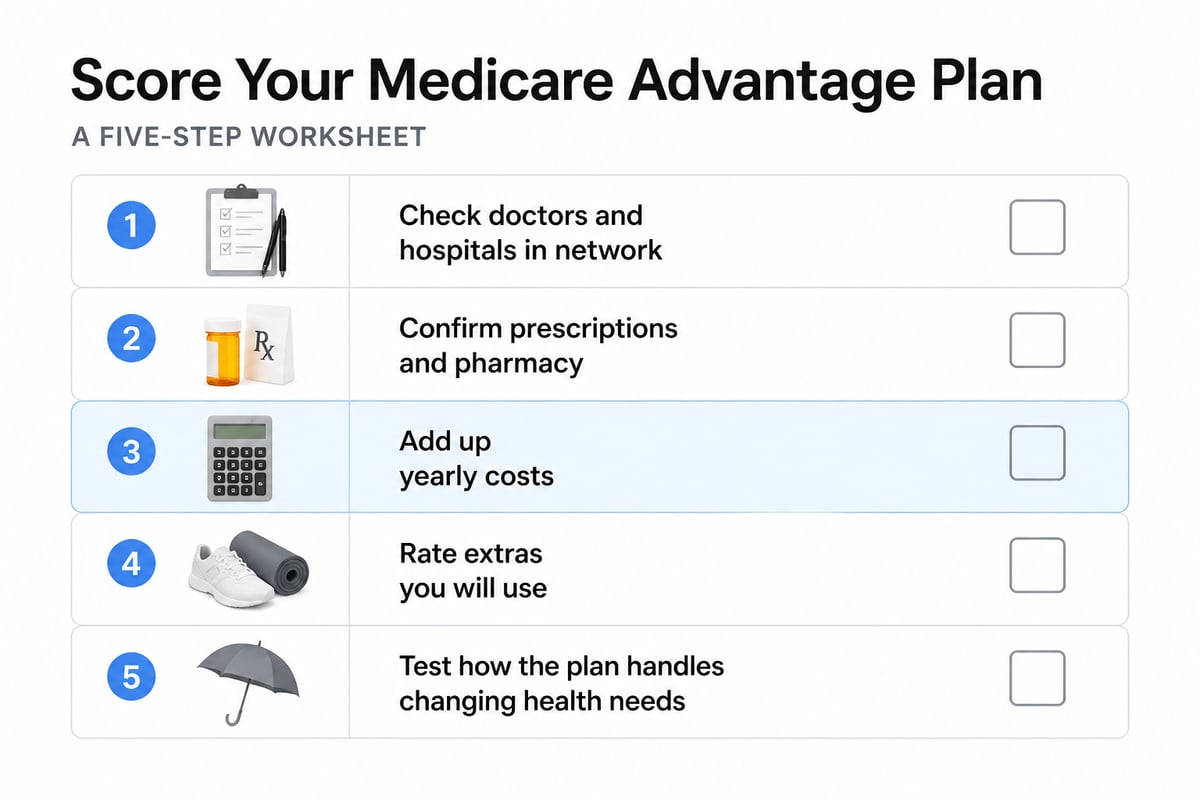
The most reliable way to rate a plan is to score it against your own life. A short worksheet turns a long list of options into a clear choice.
- Are my doctors and hospitals in the network? Check your primary care physician, your specialists, and the hospital you would use. In the Triad, this often means confirming whether systems in Greensboro and Winston-Salem are both covered.
- Are my prescriptions covered, and at what tier? Look up each medication, its tier, and any restrictions. Confirm your preferred pharmacy is in network.
- What is my total yearly exposure? Add the premium, deductible, typical copays for your visits, and the plan's maximum out-of-pocket limit.
- Which extras will I actually use? Dental, vision, hearing, and fitness benefits only matter if you use them and the limits are reasonable.
- What happens if my needs change? Consider how the plan handles hospital stays, referrals, and prior authorization if your health shifts.
You can run many of these checks yourself with Medicare's Plan Compare tool, which lists plans available in your ZIP code. For a practical framework on weighing costs, coverage, drugs, and star ratings together, AARP also publishes a guide to finding the best plan for you.
Local Factors in Greensboro, Winston-Salem, High Point, and Kernersville
Plan availability, networks, and benefits vary by county, so a plan that rates well in one part of the Triad Area may not be sold in another. The top options for a Greensboro resident can differ from those open to someone in Kernersville or a rural corner of Guilford County.
Keep these local points in mind:
- Network overlap: Confirm that the hospitals and specialty groups you use in Greensboro, Winston-Salem, and High Point are all included if you travel between them.
- Pharmacy access: Preferred pharmacies can lower your drug costs, so check that a convenient location is in the plan's preferred network.
- County-specific plans: Contracts are offered by service area, which is why some highly rated plans are simply unavailable to you.

Enrollment Timing for New Medicare Beneficiaries
Your first chance to join a plan is your Initial Enrollment Period, which surrounds your 65th birthday, and the timing you choose affects when coverage begins. Missing it can mean waiting for the next window or, in some cases, paying penalties for Part B or drug coverage.
After your first enrollment, these are the windows to know:
- Annual Enrollment Period: October 15 through December 7, when you can switch plans for the following year.
- Medicare Advantage Open Enrollment: January 1 through March 31, for people already in a Medicare Advantage plan who want to switch to another Advantage plan or return to Original Medicare.
- Special Enrollment Periods: Available after certain events, such as moving out of your plan's service area or losing other coverage. A five-star plan can also offer its own special enrollment opportunity, where one is available in your area.
Because rules and dates matter, our guide to Medicare Advantage open enrollment in North Carolina is a useful companion if you are approaching a deadline.
Common Medicare Mistakes to Avoid
The biggest mistakes people make with Medicare are choosing a plan on premium alone, skipping the doctor and drug check, and failing to review the plan every year. Each one is avoidable with a little preparation.
- Picking the lowest premium without checking total costs. A $0 premium plan can carry higher copays that outweigh the savings.
- Assuming your doctor is in network. Always verify with the plan, not just the provider's office.
- Overlooking drug tiers and pharmacy networks. A covered drug can still be expensive on a high tier.
- Ignoring the annual notice of change. Plans send it each fall, and it lists what will differ next year.
- Enrolling late. Delays can create coverage gaps or lifelong penalties.
- Relying on a rating alone. A high score is a reason to look closer, not a reason to stop looking.
Which Is Better: One Carrier or Another?
There is no single carrier that is better for everyone, because the right choice depends on which plans are offered in your county and how well they match your doctors and prescriptions. Comparing carrier names in the abstract is less useful than comparing the actual plans available at your address.
This is where working with an independent agency helps. Moser Insurance Group Inc works with multiple insurance carriers, so you compare options in one place, and we stay neutral while educating you so you can make an informed decision. Our Medicare Advantage Plans page outlines the plan options we help Triad residents review, including Medicare Supplement, Medicare Advantage, and related coverage. We tell you exactly which Medicare plan to choose, at no cost to you, and we check in during the year to review your plan and Medicare changes.
If you want to read more about what to expect from local plans, our top 10 questions answered for Greensboro is a practical starting point. Moser Insurance Group Inc is one of the fastest growing independent insurance groups in Central North Carolina.
FAQ
Should I choose a five-star plan if one is available in my county?
A five-star plan is worth serious consideration because it signals strong performance on quality and service. Still, confirm that your doctors, hospital, and prescriptions are covered before enrolling, since fit matters more than the score alone.
Can I switch plans if I am unhappy after I enroll?
Yes, but only during certain windows. You can change plans during the Annual Enrollment Period each fall, and if you are already in a Medicare Advantage plan you can use Open Enrollment from January 1 through March 31. Special Enrollment Periods apply after qualifying life events.
Does it cost anything to get help comparing plans?
Working with Moser Insurance Group Inc costs you nothing. You can reach us at (336) 862-1763 or moserinsurancegroup@gmail.com, and we serve the Triad Area, including Greensboro, Kernersville, High Point, and Winston-Salem.
Start by writing down your doctors, your prescriptions, and your preferred pharmacy so you can test any plan against them. When you are ready to compare real options for your ZIP code, Call/Text Now (336) 862-1763 or visit moserinsurancegroup.com to talk with a Moser Insurance Group Inc advisor serving Greensboro, Kernersville, High Point, and Winston-Salem. You can also email moserinsurancegroup@gmail.com, and we will walk through your choices without pressure.
Recent Comments