

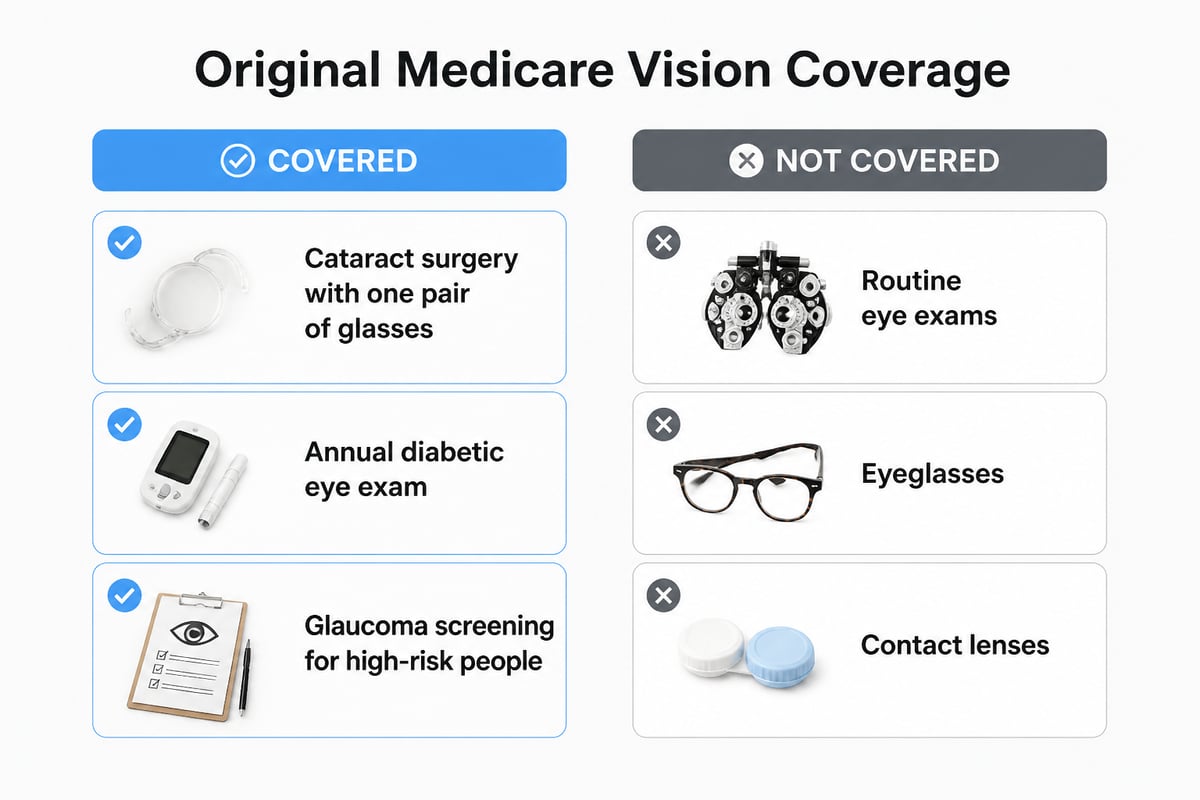
Original Medicare covers medically necessary eye care, such as cataract surgery and certain disease screenings, but it does not cover routine eye exams, eyeglasses or contact lenses. For many people turning 65 in the Triad area, that gap comes as a surprise, and it is a key reason Medicare vision coverage deserves attention before you choose a plan. This guide explains what Original Medicare pays for, what it leaves out, and how Medicare Advantage and standalone vision plans can fill the gaps.
What Does Original Medicare Cover for Your Eyes?
Original Medicare (Part A and Part B) covers eye care only when it is tied to a specific medical condition or procedure, not to everyday vision maintenance. Part B pays for services that diagnose or treat disease, and it applies the same cost sharing it uses for most outpatient care. Part A can apply when a procedure requires an inpatient hospital stay.
In practice, Part B covers a short list of eye-related services:
- Cataract surgery that implants an intraocular lens, plus one pair of eyeglasses or one set of contact lenses afterward
- An annual diabetic retinopathy exam for people with diabetes
- Glaucoma screening once every 12 months for people at high risk
- Macular degeneration testing and certain treatments, when medically necessary
- Treatment for eye conditions such as infections or injuries
You can read more about how outpatient services fall under Part B in our overview of what Medicare Part B covers.
Can I Get a Free Eye Test With Medicare?
Original Medicare does not provide a free routine eye test. A routine exam to check your prescription falls under the "routine vision care" category that Part B excludes.
Some eye tests carry cost sharing when they meet Medicare's medical criteria, and you typically owe the Part B deductible and 20% coinsurance, so "free" is rarely accurate. Two situations come closest:
- A medically necessary exam. If you have symptoms or a diagnosed eye disease, the visit is billed as medical care rather than routine vision care.
- A Medicare Advantage plan with a vision benefit. Some of these plans include a routine exam at little or no copay, though this depends on the plan and its provider network.
Which Screenings and Exams Does Part B Cover?
Part B covers two preventive eye services, and both are limited to people who meet specific risk criteria. Neither replaces a routine exam, but both can catch sight-threatening disease early.
Diabetic Eye Exams
Part B covers a diabetic retinopathy eye exam once a year for people with diabetes. According to Medicare.gov’s diabetes eye exam page, after you meet the Part B deductible you generally pay 20% of the Medicare-approved amount for the doctor's services.
Glaucoma Screenings
Part B covers a glaucoma screening once every 12 months for people at high risk. Medicare.gov’s glaucoma screening page lists the qualifying groups: people with diabetes, those with a family history of glaucoma, African Americans age 50 or older, and Hispanic Americans age 65 or older. You pay 20% of the Medicare-approved amount after the Part B deductible, and a hospital outpatient copayment may also apply.
Does Medicare Pay 100% of Cataract Surgery?
No. Medicare covers cataract surgery when it is medically necessary, but you still share the cost. After you meet the Part B deductible, you generally pay 20% of the Medicare-approved amount for the surgeon's services and the facility, whether the procedure happens in a hospital outpatient department or an ambulatory surgical center.
Cataract surgery is one situation where Original Medicare helps with glasses. Medicare.gov’s cataract surgery page states that after surgery that implants an intraocular lens, Part B covers one pair of eyeglasses with standard frames or one set of contact lenses. If you choose upgraded frames, you pay the extra cost. The supplier must also participate in Medicare, so confirm that before you order.
Premium lens implants can add charges that Medicare does not pay. Ask your surgeon's office for an itemized estimate before scheduling.
What Is Not Covered by Original Medicare?
Original Medicare excludes most everyday vision care, and that exclusion affects nearly everyone who wears corrective lenses. The main items you will pay for yourself are:
- Routine eye exams for glasses or contacts
- Eyeglasses and contact lenses, except the post-cataract pair described above
- Fittings for glasses or contacts
- Most vision correction procedures performed for cosmetic or convenience reasons
Medicare.gov’s eyeglasses and contact lenses page confirms that beneficiaries pay the full cost for these noncovered items. That means routine prescription updates and new lenses or contacts generally come out of your own pocket. The one exception is narrow. Only after cataract surgery that implants an intraocular lens does Part B pay for one pair of eyeglasses with standard frames or one set of contact lenses, and only from a supplier that participates in Medicare. Upgraded frames cost extra. Because cost sharing applies even to the covered pair, you generally pay 20% of the Medicare-approved amount once the Part B deductible is met. If you are weighing the wider list of exclusions, including dental and hearing, our guide to the four parts of Medicare shows where each type of coverage sits.

Medicare Vision Coverage Through Medicare Advantage
Medicare Advantage is one common way beneficiaries add routine vision benefits to their Medicare coverage. These Part C plans must cover everything Original Medicare covers, and most add extras. KFF reports that most individual Medicare Advantage plans offer vision benefits, in its Medicare Advantage 2025 Spotlight, though the scope of those benefits varies by plan.
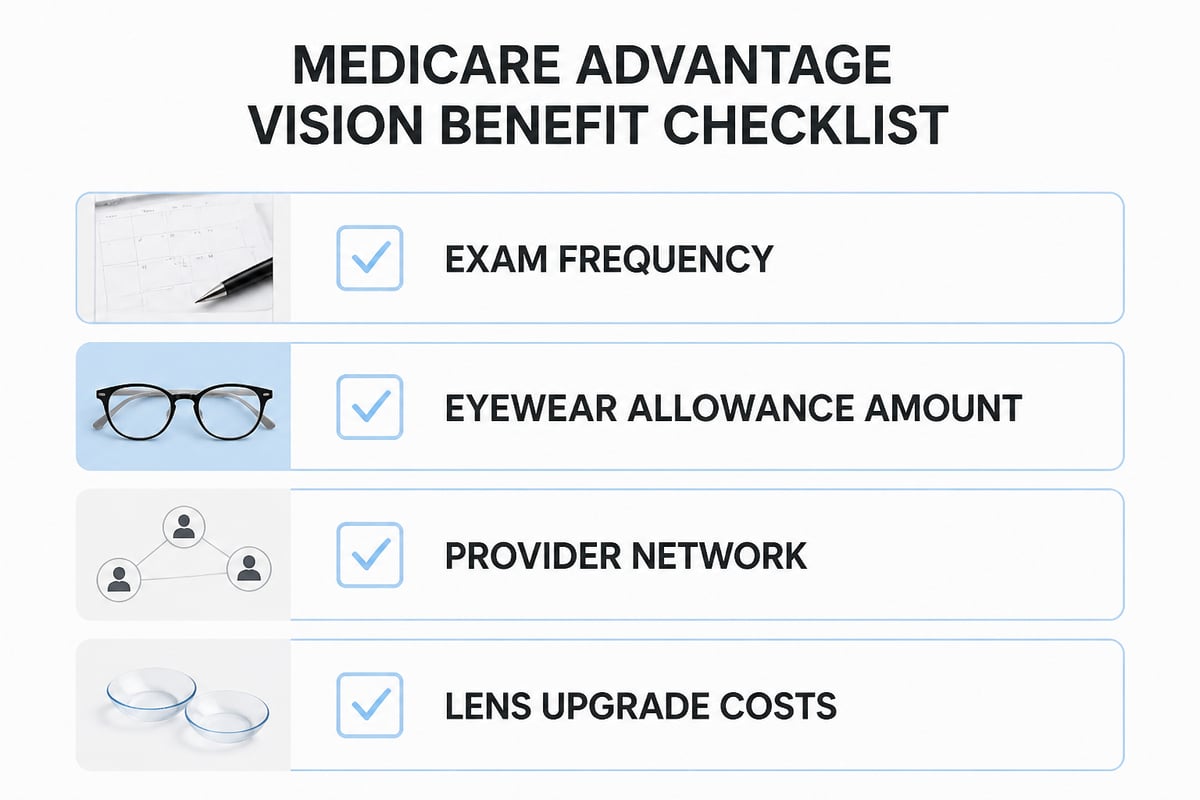
That variation matters. When you compare plans, look closely at these details:
- Exam frequency. Some plans cover one routine exam per year, others every two years.
- Eyewear allowance. Plans often set a dollar amount toward frames, lenses or contacts rather than covering a full pair.
- Network rules. Many plans require you to use participating eye doctors and optical shops.
- Lens extras. Coatings, progressive lenses and transitions may fall outside the allowance.
A plan that looks attractive for its low premium may offer a thin vision benefit, while another may offer a generous allowance but a narrow network. Moser Insurance Group Inc’s Medicare Advantage plans can be reviewed so you can see these differences before you enroll. For a closer look at how vision fits into these plans, see our page on Medicare vision benefits.
Do Medigap Plans Cover Vision?
Medicare Supplement (Medigap) plans do not add routine vision benefits. Their job is to pay part of what Original Medicare leaves behind, such as the 20% Part B coinsurance and deductibles. Because Original Medicare does not cover routine eye exams or eyeglasses, Medigap generally has nothing to pay toward them either. A Medigap policy follows Medicare's approval decisions, so if Medicare does not cover a service, the supplement does not step in to cover it.
Medigap can still help with the covered medical eye care described above. If you need cataract surgery, a Medigap plan may pick up some or all of the 20% coinsurance, depending on the letter plan you hold. The same logic applies to the annual diabetic retinopathy exam and the glaucoma screening for high-risk individuals, where the 20% share of the Medicare-approved amount is the portion a supplement may absorb. It also applies to the 20% you would owe on the one pair of glasses or set of contacts Part B covers after cataract surgery. To see how the two paths differ in daily use, our comparison of Medicare Advantage versus Medicare Supplement lays out the tradeoffs in plain terms.
People who prefer a Medigap plan for its freedom to see any provider often pair it with a separate vision or dental and vision policy. A common setup is Original Medicare, a Medigap plan for medical bills, and a standalone vision plan that covers the yearly exam and an eyewear allowance. If you live in the Triad Area, Greensboro, Kernersville, High Point or Winston-Salem, you can call Moser Insurance Group Inc at 336-862-1763 to talk through that pairing.
Your Options for Routine Eye Care and Glasses
You have four realistic ways to pay for routine eye care, and the right one depends on how often you need new lenses and which doctors you want to see.
| Option | How it works | Best fit |
|---|---|---|
| Medicare Advantage plan with vision | Exam and eyewear allowance built into the plan | People who want one plan for most needs |
| Standalone vision plan | Separate monthly premium for exams and eyewear | People keeping Original Medicare plus Medigap |
| Discount or membership programs | Reduced prices at participating retailers | Occasional wearers with modest needs |
| Paying out of pocket | Full cost at the time of service | People with minimal vision needs |
If you manage a condition such as diabetes or have a family history of glaucoma, you may see an eye doctor more than once a year. In that case a plan with a strong vision benefit and a convenient network can save real money.
How to Choose a Plan in the Triad Area
Start by listing your eye doctor, how often you replace lenses, and any eye conditions you manage, then check each plan against that list. This approach keeps the decision practical, and it matters across the Triad, where networks can differ between Greensboro, Winston-Salem, High Point and Kernersville.
A simple process works well:
- Confirm that your current eye doctor and optical shop accept the plan.
- Compare the eyewear allowance against what you typically spend.
- Check whether the plan also covers hearing and dental, since many bundle them.
- Review the maximum out-of-pocket limit in case you need surgery.
- Note the enrollment window you qualify for, since timing affects when changes take effect.
New to Medicare? Your Initial Enrollment Period surrounds your 65th birthday, and our resource on turning 65 in High Point walks through the timeline. Moser Insurance Group Inc works with multiple insurance carriers, so you compare options in one place. We stay neutral and educate you so you can make an informed decision, and we check in during the year to review your plan and any Medicare changes. Moser Insurance Group is one of the fastest growing independent insurance groups in Central North Carolina and has 119 Google reviews.
FAQ
What are the four things Medicare doesn't cover?
Original Medicare generally does not cover routine vision care, routine dental care, hearing aids and exams, or long-term custodial care. Coverage rules can change, so review the current year's Medicare handbook. Many Medicare Advantage plans add some of these benefits.
Are there other eye services Medicare will not pay for?
Medicare typically will not pay for cosmetic or convenience-based vision procedures, and it will not cover eyewear from suppliers that do not participate in Medicare. Premium lens upgrades after cataract surgery are another common out-of-pocket cost. Ask for an itemized estimate before any procedure.
Can I add vision coverage after I enroll in Medicare?
Yes, in most cases. You can buy a standalone vision plan at any time, and you can switch to a Medicare Advantage plan with vision benefits during an enrollment period you qualify for. Check the deadlines on our page about the Medicare open enrollment deadline.
Your next step is to write down your eye doctor's name, your last prescription date and any eye conditions you manage, then bring that list to a plan review. Moser Insurance Group Inc serves the Triad Area, including Greensboro, Kernersville, High Point and Winston-Salem, and we help you understand which Medicare plan may fit your needs, at no cost to you. You can compare plans through our Medicare Advantage options, email us at moserinsurancegroup@gmail.com, or reach out through Moser Insurance Group Inc by calling or texting us now at 336-862-1763.
Recent Comments