

Whole life insurance costs substantially more than term coverage for the same death benefit, because the premium also funds a lifelong guarantee and a cash value account. The National Association of Insurance Commissioners (NAIC) gives a buyer-guide example of a $100,000 whole life policy at age 35 with an annual premium of $1,800, compared with $250 for renewable term coverage. That $1,550 gap shows what the cash-value feature adds. Your own price will depend on your age, health, coverage amount and the way you choose to pay.
This guide explains each factor in plain terms for readers in the Triad Area, including Greensboro, Kernersville, High Point and Winston-Salem, so you can judge a quote with confidence.
How Much Does a Whole Life Insurance Policy Cost?
A whole life policy's cost depends heavily on age, health, coverage amount and payment structure, and can range widely from one applicant to the next. No single number applies to everyone, and any figure you see online is an illustration, not a quote.
What you can count on is the structure. Whole life premiums are generally level for life, according to the NAIC, meaning the amount you pay at purchase is the amount you keep paying, even if your health changes later. You lock in your rate at the age and health class you hold on the day the policy is issued.
That structure explains the price. Term insurance charges only for the risk of death during a set period. Whole life charges for the risk of death, the guarantee that coverage never expires, and a savings component that builds cash value you can access while you are alive.
For a deeper look at larger coverage amounts, see this breakdown of what a $1 million whole life policy can cost.
The Main Factors That Set Your Premium
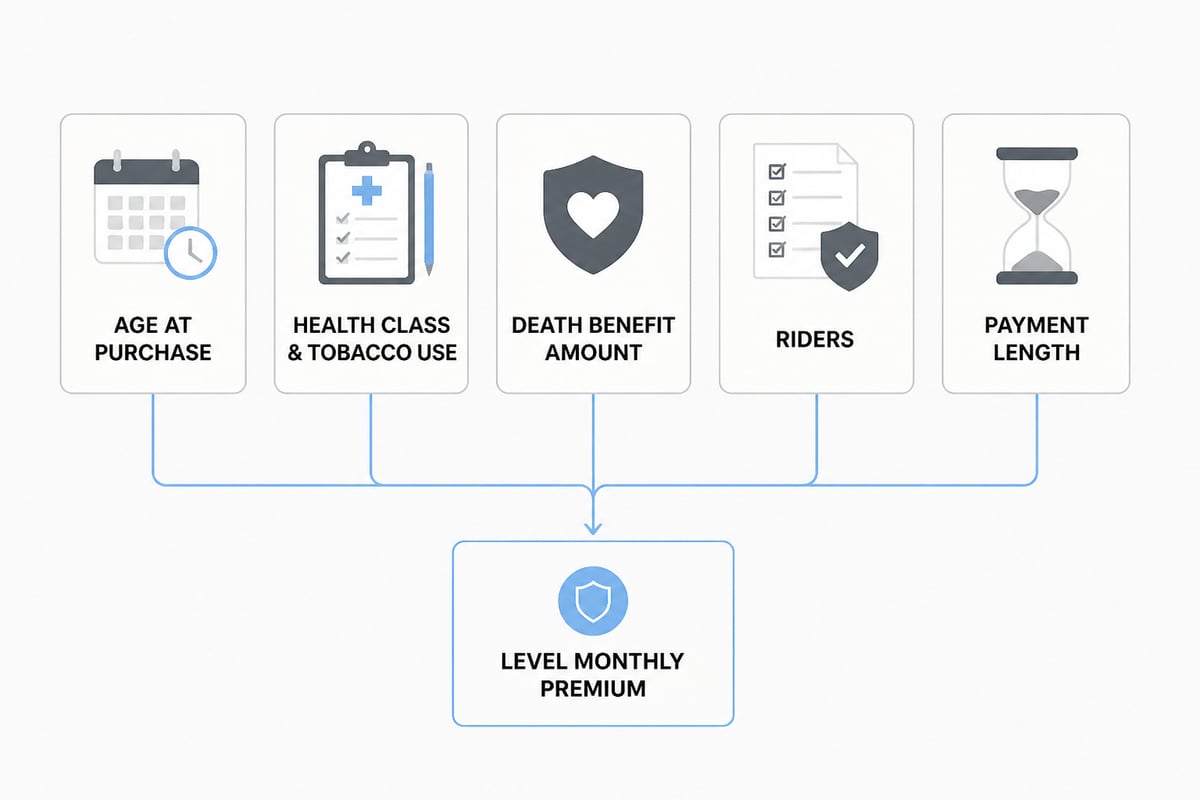
Insurers price a whole life policy using a short list of inputs, and the first three carry the most weight.
- Age at purchase. Waiting longer generally raises the premium, because the insurer expects to collect for fewer years before paying a claim.
- Health and tobacco use. Underwriters assign a health class based on medical history, build, family history and nicotine use. Tobacco users generally pay more than nonsmokers.
- Death benefit amount. A $50,000 policy costs far less than a $500,000 one, though the relationship is not perfectly linear.
- Sex. Rates often differ between men and women because of life expectancy tables.
- Riders. Optional add-ons such as a waiver of premium or a child term rider increase the total. You can read how a child term rider works on a life insurance policy before deciding whether it fits.
- Insurance company. Carriers price differently for the same applicant, which is why comparing more than one is worth the effort.
Whole Life vs. Term: Understanding the Price Gap
Whole life costs more than term because it is built to last and to accumulate value, while term is built to be cheap and temporary. The NAIC's buyer-guide example of $1,800 versus $250 a year, drawn from its life insurance consumer guide, is a useful reference point for the scale of the difference.
The two products serve different jobs:
- Term insurance covers a defined stretch, often 10, 20 or 30 years, such as the years a mortgage or dependent children need protection. It carries no cash value.
- Whole life insurance covers you for your entire life as long as premiums are paid, and a portion of each payment builds cash value.
If your goal is to replace income for a fixed period at the lowest possible price, term usually wins on cost. If your goal is a guaranteed payout whenever death occurs, such as for final expenses or leaving an inheritance, whole life addresses a need term cannot. Some families combine both, and a whole life and term life blend can balance affordability with permanence.
Payment Structure: Level, Limited-Pay and Single-Premium
The way you schedule payments can change the cost of each payment dramatically, even when the death benefit stays the same.
| Payment structure | How you pay | What to expect |
|---|---|---|
| Level-premium whole life | Same premium for life | Lowest payment per period of the three |
| Limited-payment whole life | Premiums for a set period, such as 10 or 20 years, or to a certain age | Higher payment, then no more premiums |
| Single-premium whole life | One lump sum | Largest upfront outlay, immediate cash value |
Limited-payment whole life costs more per payment because premiums are paid over a shorter period, and a single-premium policy uses one lump-sum payment and provides immediate cash value. Both points come from the NAIC's life insurance overview.
Limited-pay can appeal to retirees who want coverage fully paid before income tightens. A lump sum suits someone with a defined pool of assets to place. If that second option interests you, this explanation of single-premium whole life insurance walks through how it works.
Participating vs. Nonparticipating Policies
A participating whole life policy generally costs more than a nonparticipating one, because it carries the possibility of dividends. According to the NAIC, participating policies may pay dividends based on the insurer's financial performance, and those dividends may reduce premiums or purchase additional coverage.
Dividends are not guaranteed. They depend on the company's results, so they should be treated as a possible benefit rather than a promise built into your budget. The higher premium buys the chance of dividends and, in some cases, a stronger long-term position.
To weigh the tradeoff, review how participating whole life insurance is structured and what the dividend options mean for your out-of-pocket cost.

What Whole Life Costs at Different Ages
Starting younger is the most reliable way to lower a whole life insurance policy cost over the long run, since the level premium is set by your age at issue. The same coverage amount generally costs more at an older age, and the gap tends to widen in your 50s and 60s.
Age also changes which products make sense:
- Pre-65 buyers in their 40s and 50s usually qualify for standard underwriting and can choose from the full range of face amounts.
- Retirees and those near Medicare age often shop for smaller policies to cover final expenses and leave a modest legacy. Options such as affordable life insurance for seniors are designed around that need.
- Applicants with health concerns may be steered toward simplified-issue or graded-benefit designs, which carry higher rates because the insurer takes on more uncertainty.
If you are approaching Medicare age and still working through health coverage decisions, it can help to sort those out first, then size the life policy to the budget that remains.
Can You Borrow Against Whole Life Insurance?
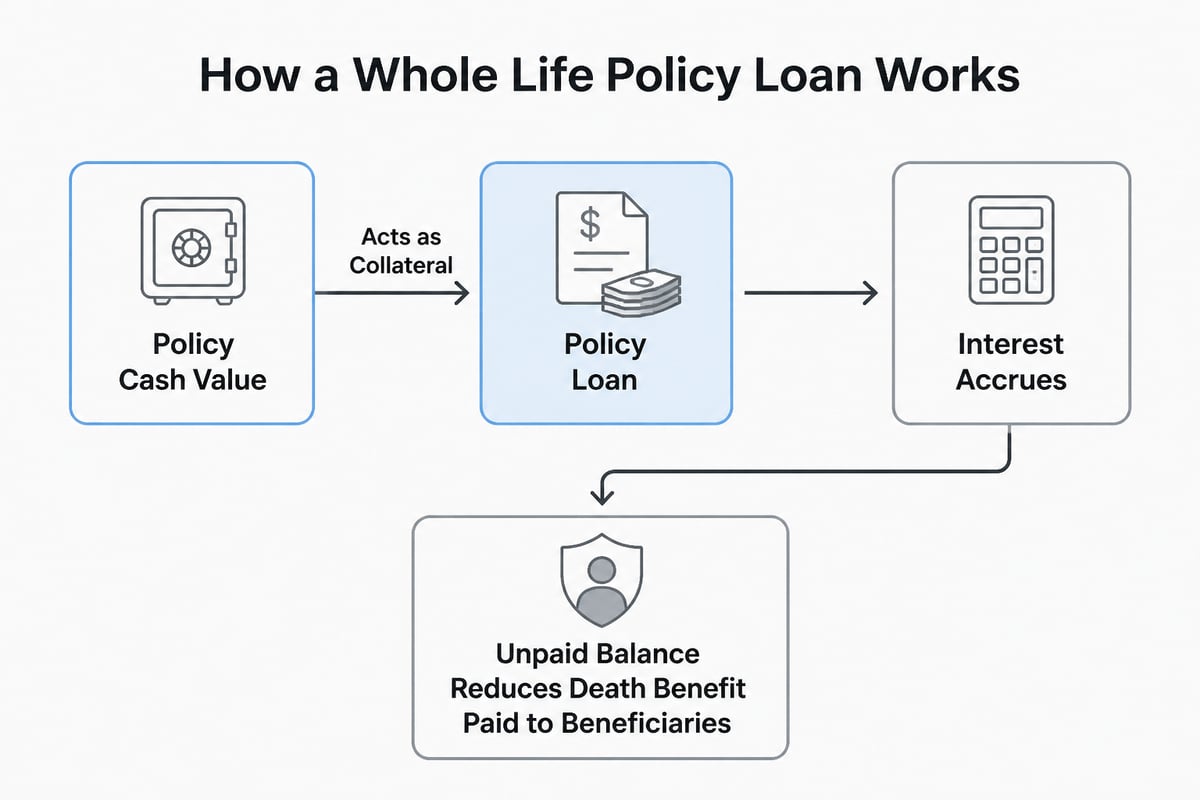
Yes, you can borrow against a whole life policy once it has built enough cash value, and the cash value acts as collateral for the loan. Because you are borrowing from the insurer rather than withdrawing your own money, a loan generally does not require a credit check or a fixed repayment schedule.
There are costs to understand. Loans accrue interest, and any unpaid balance, including interest, is subtracted from the death benefit if you pass away before repaying it. A loan large enough to exhaust the cash value can cause the policy to lapse, which can create a tax bill.
How your dividends are treated while a loan is outstanding depends on whether the insurer uses direct or non-direct recognition. This comparison of direct recognition vs. non-direct recognition loans explains the difference.
The Downsides of Whole Life to Weigh Against the Price
The main drawbacks of whole life are its higher premium, slow early cash value growth and reduced flexibility compared with term. Being direct about these helps you decide whether the cost is worth carrying.
- Higher premiums. The same death benefit costs many times more than term, which can strain a budget and leave you underinsured if you buy too little coverage to keep the payment low.
- Slow cash value in early years. In the first several years, much of what you pay covers insurance and policy costs, so cash value may be modest.
- Surrender charges. Canceling early can mean getting back less than you paid in. Before ending a policy, review the steps for canceling a life insurance policy in North Carolina.
- Lower returns than some alternatives. Cash value growth is steady and guaranteed in part, but it is not designed to match market-based investing. For a balanced view, read whether whole life insurance is a good investment.
If the premium would force you to drop the policy within a few years, a smaller whole life policy or a term policy may serve you better.
Ways to Keep Your Whole Life Premium Manageable
You can lower your whole life insurance policy cost by adjusting the variables you control before you apply. Several practical steps tend to help:
- Apply earlier rather than later. Your age on the issue date locks in the rate.
- Improve what you can. Quitting tobacco and addressing blood pressure or weight before a medical exam can move you into a better health class.
- Right-size the death benefit. Match coverage to a specific purpose, such as final expenses or an inheritance goal, instead of choosing a round number.
- Skip riders you do not need. Each one adds to the premium.
- Compare several carriers. Different companies rate the same health history differently, and shopping across them is where the savings often appear.
An independent agency can run these comparisons side by side. Moser Insurance Group Inc works with multiple insurance carriers, so you see options in one place, and the team stays neutral and focuses on educating you so the decision stays yours. For a permanent policy with guaranteed protection and a cash value component, you can review the Whole Life Insurance options available through Moser Insurance Group Inc.
North Carolina residents can also read about how whole life insurance works in North Carolina for state-specific context.
FAQ
What are the cons of whole life insurance?
The main cons are a premium that is many times higher than term coverage, cash value that grows slowly in the early years, and potential surrender charges if you cancel soon after buying. Dividends on participating policies are also not guaranteed.
Which life insurance companies are considered the best?
The best carrier depends on your age, health and coverage goals, because companies rate applicants differently. Comparing several carriers through an independent agency such as Moser Insurance Group Inc, which serves Greensboro, Kernersville, High Point, Winston-Salem and the wider Triad Area, helps you see which offers the strongest value for your situation. You can also review life insurance options in Greensboro, NC.
Your next step is to gather the basics a quote depends on: your age, a rough health history, the coverage amount you have in mind and whether you prefer lifelong or limited payments. From there, the team at Moser Insurance Group Inc can compare carriers for you and explain each option without pressure, serving the Triad Area including Greensboro, Kernersville, High Point and Winston-Salem. Reach out by email at moserinsurancegroup@gmail.com or visit moserinsurancegroup.com to get started, or call 336-862-1763 and speak with someone who will walk you through the numbers at no cost.
Recent Comments