

Whole life insurance for veterans comes from two places: the VA's VALife program, which offers up to $40,000 in guaranteed-acceptance coverage to eligible veterans with a service-connected disability rating, and private whole life policies sold through the civilian market. Each serves a different need, and many veterans in the Triad end up using both.
If you live in Greensboro, Kernersville, High Point, Winston-Salem or elsewhere in the Triad Area, the choice usually comes down to three questions: Do you have a VA disability rating? How much coverage does your family actually need? Can you qualify for a private policy at standard rates? This article walks through each path so you can compare them with clear facts.
What Whole Life Insurance Means for a Veteran
Whole life insurance is permanent coverage that stays in force for your entire life as long as premiums are paid, and it builds cash value you can borrow against. The premium is level, the death benefit is guaranteed, and the policy does not expire the way a term policy does.
For veterans, this matters at the moment service-provided coverage ends. Servicemembers' Group Life Insurance (SGLI) is temporary, and Veterans' Group Life Insurance (VGLI) is term coverage. According to the VA’s VGLI page, VGLI is term life insurance with coverage available from $10,000 to $500,000, and the monthly premium depends on your age and the amount you choose. Term coverage tends to become expensive as you age, which is why permanent coverage appeals to veterans who want final expenses, a legacy, or a debt payoff plan that cannot lapse after a set number of years.
Whole life is not the right tool for every goal. If you need a large death benefit to cover a mortgage and income replacement while your family is young, term coverage costs far less per dollar of protection. Whole life fits best when the need is lifelong: burial costs, leaving something behind, supporting a spouse who will outlive you, or covering a special-needs dependent.
VALife: Guaranteed Whole Life Coverage for Service-Connected Veterans
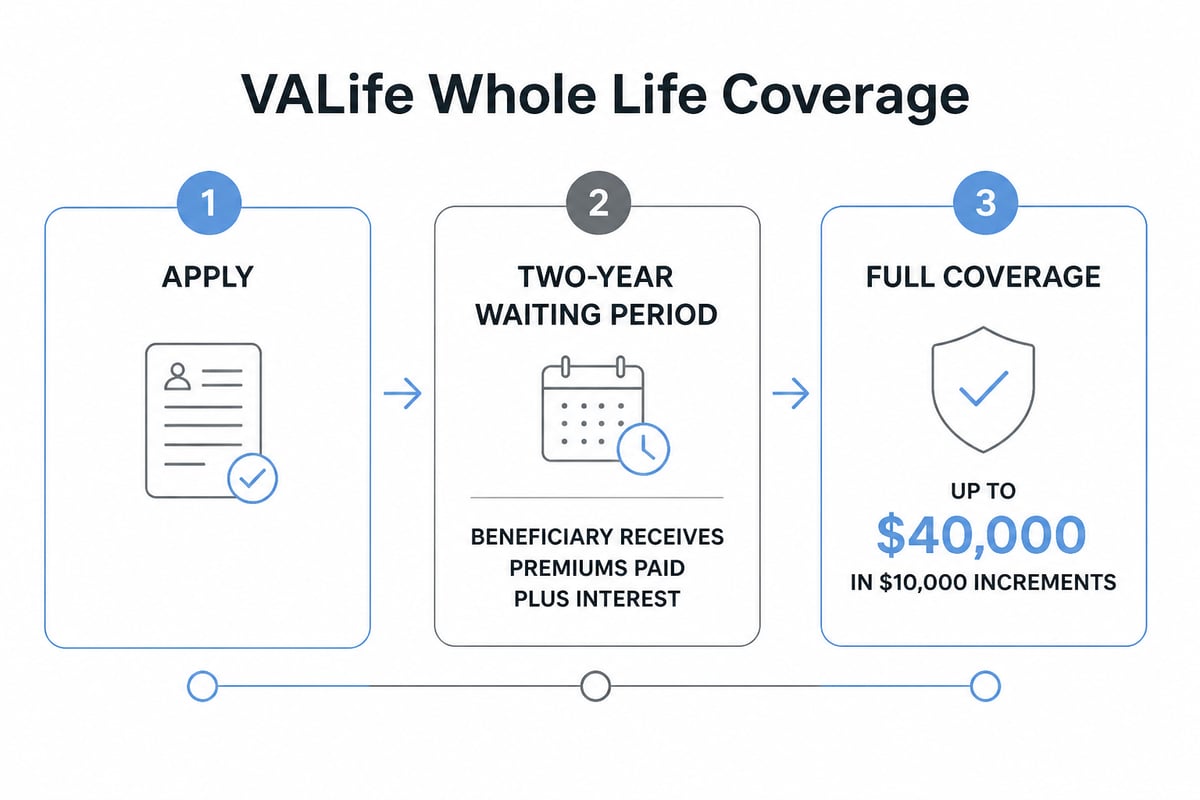
VALife is the VA's guaranteed-acceptance whole life insurance program, and it is the most direct form of whole life insurance for veterans who hold a disability rating. Under the VA’s VALife eligibility rules, veterans with a service-connected disability rating, including a 0% rating, qualify, and those age 80 or younger can apply without a time limit.
Key features of the program:
- No health questions. Acceptance is guaranteed if you meet the eligibility rules.
- Coverage of up to $40,000, available in $10,000 increments.
- Fixed premiums. Rates are based on your age and chosen coverage amount, and the premium rate does not increase while you keep the policy.
- Cash value. Like other whole life policies, VALife builds cash value over time.
The Two-Year Waiting Period
VALife's full coverage amount takes effect two years after you apply, provided you pay premiums during that period. If a policyholder dies during the two-year window, the VA’s VALife FAQs explain that the beneficiary receives the premiums paid plus interest. After the waiting period, the beneficiary receives the full coverage amount as long as premiums remain current.
This graded structure is the trade-off for guaranteed acceptance. It is the same principle behind graded benefit whole life insurance sold in the private market.
Applying After Age 80
Veterans age 81 or older may still qualify, but only under narrow conditions. Per the VA, you must have applied for disability compensation before turning 81, received a rating for that disability after turning 81, and apply for VALife within two years of being notified of the rating.
A Change for S-DVI Holders
For VALife applications made on or after January 1, 2026, existing S-DVI coverage ends when the VA approves the VALife application. If you hold S-DVI today, review the trade-offs before you apply. The VA’s life insurance overview lists each program so you can see what you currently have.
VALife, VGLI and Private Whole Life Compared
The three main options differ in coverage type, maximum amount and underwriting, and comparing them side by side shows where each one fits.
| Feature | VALife | VGLI | Private whole life |
|---|---|---|---|
| Policy type | Whole life | Term life | Whole life |
| Maximum coverage | $40,000 | $500,000 | Varies by age and health |
| Health questions | None (guaranteed) | Based on timing of application | Usually yes, unless guaranteed issue |
| Premium over time | Does not increase | Rises with age band | Level for life |
| Disability rating required | Yes, including 0% | No | No |
| Cash value | Yes | No | Yes |
The pattern is clear. VALife gives permanent protection without medical underwriting but caps at $40,000. VGLI offers much larger amounts but is term coverage. Private whole life can provide larger permanent coverage, though approval and price depend on your health and age.
If you want to read more about private permanent coverage built for service members and their families, our page on life insurance for veterans covers it in more detail.
How Much Coverage Do You Actually Need?
Most veterans need enough permanent coverage to cover final expenses and any debts that would pass to family, and a larger term policy for income needs if dependents still rely on them. A simple way to size it:
- Estimate final expenses, including funeral and burial costs.
- Add outstanding debts a spouse would inherit, such as a mortgage balance or auto loans.
- Add a cushion for your spouse's living expenses during the transition.
- Subtract existing coverage, such as group life from a civilian employer or VGLI.
A veteran in Winston-Salem with a paid-off home may find $20,000 to $40,000 of VALife covers final costs. A veteran in High Point who still carries a mortgage and supports a spouse may need a private policy or a stack of coverage types.
What Does a $100,000 Policy Cost Per Month?
A $100,000 whole life policy typically costs more than a term policy of the same size, and the monthly premium depends on your age, health, tobacco use and the carrier. A healthy 45-year-old will pay far less than a 65-year-old with health conditions. Any quote without your age and health details is only a guess, so request a personalized number rather than relying on a generic figure. Our guide to affordable life insurance for seniors explains the factors that move the price.
Active Duty Coverage and the Conversion Window
Active duty servicemembers are covered by SGLI, and that coverage does not carry into retirement automatically. SGLI coverage ends shortly after separation, so planning has to begin before you leave service.
The transition creates a decision window. VGLI is available to separating servicemembers, and timing affects whether health questions apply. Veterans who skip the window can still buy private coverage, but they will face standard underwriting. A veteran with a service-connected condition may find private approval harder or more expensive, which is where VALife's guaranteed acceptance becomes valuable.

Widows, Survivors and the Disabled Veteran
Surviving spouses of veterans rated 100% disabled may receive Dependency and Indemnity Compensation (DIC) from the VA, which is a separate monthly benefit and not life insurance. Eligibility rules and current payment rates are set by the VA, so confirm the figures with a VA benefits officer before building your plan around them.
What Is the Best Life Insurance for a Disabled Veteran?
The best life insurance for a disabled veteran is usually VALife as a base layer, because acceptance is guaranteed regardless of the condition that produced your rating. From there, a private policy can add coverage if your health allows it. Some applicants may qualify for fully underwritten whole life at standard or modestly rated premiums, and others may do better with simplified-issue or graded products. Comparing these options across several carriers matters, because underwriting guidelines for the same condition vary widely.
Cash Value, Dividends and Policy Loans
Whole life builds cash value that grows at a guaranteed rate, and some policies also pay dividends, which are not guaranteed. You can borrow against the cash value, and the loan reduces the death benefit if it is unpaid at death.
Two points help veterans evaluate this feature honestly. First, cash value grows slowly in the early years, because much of the early premium covers the cost of insurance and expenses. Second, a policy loan carries interest, and how the carrier credits dividends while a loan is outstanding depends on its method. Our explanation of direct recognition vs. non-direct recognition loans breaks down that difference. If you want to understand whether the savings component justifies the cost, read our look at whether whole life insurance is a good investment.
A Layered Strategy Many Veterans Overlook
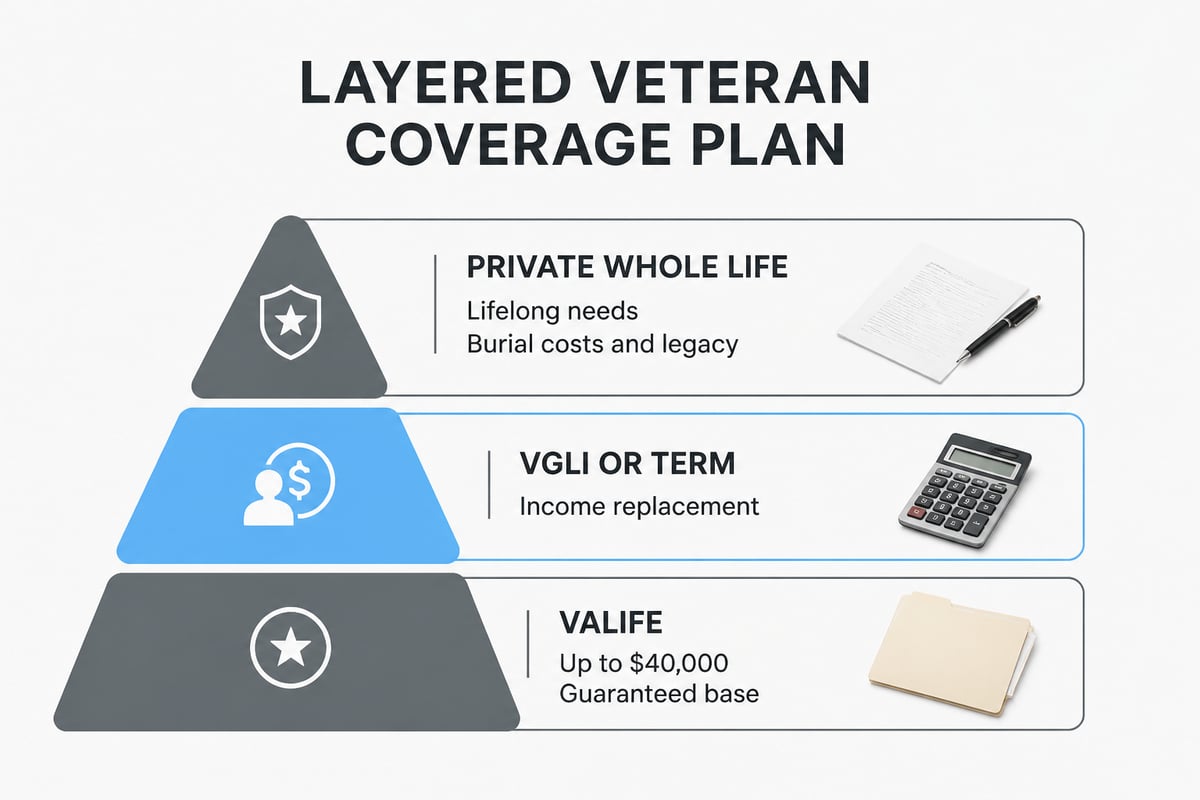
A layered approach works better than choosing a single policy, and it lets each product do the job it is best at. A practical structure looks like this:
- Base layer: VALife for guaranteed permanent coverage, if you hold a rating.
- Income layer: Term coverage, either VGLI or a private term policy, for the years when dependents rely on your paycheck or pension.
- Legacy layer: A private whole life policy for lifelong needs, sized to what your budget supports.
Layering also protects you against a common mistake: dropping VGLI or term coverage before the permanent policy is in force and the VALife waiting period has passed. Keep the term layer until the permanent layer fully covers the need.
Whole life insurance for veterans works best when the pieces are timed together, and the sequencing is where independent guidance helps most.
How Moser Insurance Group Helps Triad Veterans
Moser Insurance Group Inc helps individuals and families understand their insurance options, so veterans in Greensboro, Kernersville, High Point, Winston-Salem and the wider Triad Area can get clear guidance in one place. The agency stays neutral and focuses on education, which means you get an explanation of how VALife, VGLI and private coverage fit together before any decision is made. Moser Insurance Group Inc is one of the fastest growing independent insurance groups in Central North Carolina.
For permanent coverage in the private market, the agency's Whole Life Insurance offering provides guaranteed protection plus a cash value component built for long-term planning. You can also review the agency's page on North Carolina whole life insurance for state-specific considerations, or its Greensboro life insurance page if you prefer a local starting point.
To reach the office directly, call 336-862-1763, email moserinsurancegroup@gmail.com, or visit moserinsurancegroup.com.
FAQ
How much life insurance do active duty military get?
Active duty servicemembers are covered under SGLI, which is temporary coverage that ends after separation. Coverage amounts are elected in increments, so confirm your current election with your unit's personnel office or your SGLI online account.
Can a veteran with a 0% disability rating get VALife?
Yes. The VA states that VALife is open to veterans with a service-connected disability rating, including 0%. Eligible veterans age 80 or younger can apply without a time limit.
Does VALife pay out if I die in the first two years?
It pays a reduced amount. If a policyholder dies during the two-year waiting period, the beneficiary receives the premiums paid plus interest, and after the waiting period the full coverage amount is paid if premiums are current.
Start by pulling your VA disability rating letter and any existing SGLI, VGLI or S-DVI paperwork, because those documents determine which options are open to you. From there, Moser Insurance Group Inc can compare carriers, explain how a private Whole Life Insurance policy would sit alongside your VA coverage, and answer your questions without pressure. Veterans across Greensboro, Kernersville, High Point and Winston-Salem can reach out through Moser Insurance Group Inc, where you can Call/Text Now (336) 862-1763 to talk through your options.
Recent Comments