

Permanent life insurance with a cash value component offers a dual benefit that attracts many individuals and families across Greensboro, High Point, Winston Salem, Kernersville, and the broader Triad Area. Unlike term policies that provide temporary protection, cash value life insurance builds financial value you can access during your lifetime while maintaining death benefit protection for your loved ones. Understanding how these policies work, the different types available, and whether they align with your financial goals requires careful consideration and clear guidance-especially as you approach retirement age and Medicare eligibility.
Understanding Cash Value Life Insurance Fundamentals
Cash value life insurance represents a category of permanent policies that remain in force for your entire life, provided you maintain premium payments. Each premium payment splits between two functions: covering the cost of insurance (the death benefit) and building cash value within the policy. This cash value grows tax-deferred over time, creating a living benefit you can tap into through loans or withdrawals.
The National Association of Insurance Commissioners provides detailed consumer guidance explaining how cash value accumulates differently across policy types. The fundamental principle remains consistent-part of your premium exceeds the actual cost of insurance, and this excess builds as savings within the policy.
How Cash Accumulation Works
When you pay your premium, the insurance company deducts various fees and charges:
- Cost of insurance (mortality charges)
- Administrative expenses
- Rider charges for additional benefits
- Premium loads or sales charges
The remaining amount contributes to your policy's cash value account. This accumulation grows based on the specific type of policy you own-through guaranteed interest rates, market-linked returns, or dividend payments from the insurance company.

Types of Cash Value Life Insurance Policies
The market offers several distinct types of permanent coverage, each with unique characteristics affecting how cash value grows and how much flexibility you have in managing the policy.
Whole Life Insurance
Whole life insurance provides the most predictable and guaranteed form of cash value accumulation. Your premium remains fixed for life, and the policy guarantees both a minimum cash value growth rate and a death benefit amount. Mutual insurance companies often pay dividends that can further increase your cash value, though dividends are never guaranteed.
The cash value in whole life policies grows slowly in early years because initial premiums primarily cover insurance costs and company expenses. After 10 to 15 years, the cash value growth accelerates as the cost of insurance component stabilizes. This makes whole life particularly suitable for long-term planning and individuals who value certainty over flexibility.
Universal Life Insurance
Universal life insurance introduces flexibility that whole life lacks. You can adjust both your premium payments and death benefit amount within certain limits, making it adaptable to changing financial circumstances. The Washington State Insurance Commissioner’s guide outlines how universal life policies credit interest to your cash value based on current market rates, subject to a guaranteed minimum.
Key features of universal life include:
- Flexible premium payments (within minimum requirements)
- Adjustable death benefit options
- Transparent fee structures
- Interest-sensitive cash value growth
- Potential for policy lapses if cash value depletes
The flexibility comes with responsibility. If you underfund the policy or if interest rates fall below projections, your cash value may not sustain the policy, requiring additional premium payments to prevent lapse.
Variable Universal Life Insurance
Variable universal life (VUL) combines universal life's flexibility with investment options similar to mutual funds. Your cash value invests in sub-accounts you select-stock funds, bond funds, or money market options. This creates potential for higher returns but also exposes you to market risk and the possibility of cash value decline.
The Texas Department of Insurance consumer bulletin emphasizes that variable policies require careful monitoring because poor investment performance can erode cash value and threaten policy sustainability. VUL policies suit financially sophisticated individuals comfortable managing investment risk within their life insurance.
Indexed Universal Life Insurance
Indexed universal life (IUL) represents a middle ground between fixed universal life and variable policies. Your cash value earns interest linked to a stock market index like the S&P 500, but with both a floor (typically 0% to 2%) protecting against losses and a cap limiting maximum gains. This structure provides market participation with downside protection, though caps can significantly limit growth in strong market years.
| Policy Type | Premium Flexibility | Growth Method | Risk Level | Guarantees |
|---|---|---|---|---|
| Whole Life | Fixed | Guaranteed + dividends | Low | Strong |
| Universal Life | High | Current interest rates | Low-Medium | Moderate |
| Variable Universal | High | Investment sub-accounts | High | Minimal |
| Indexed Universal | High | Index-linked with caps | Medium | Moderate |
Accessing Your Cash Value
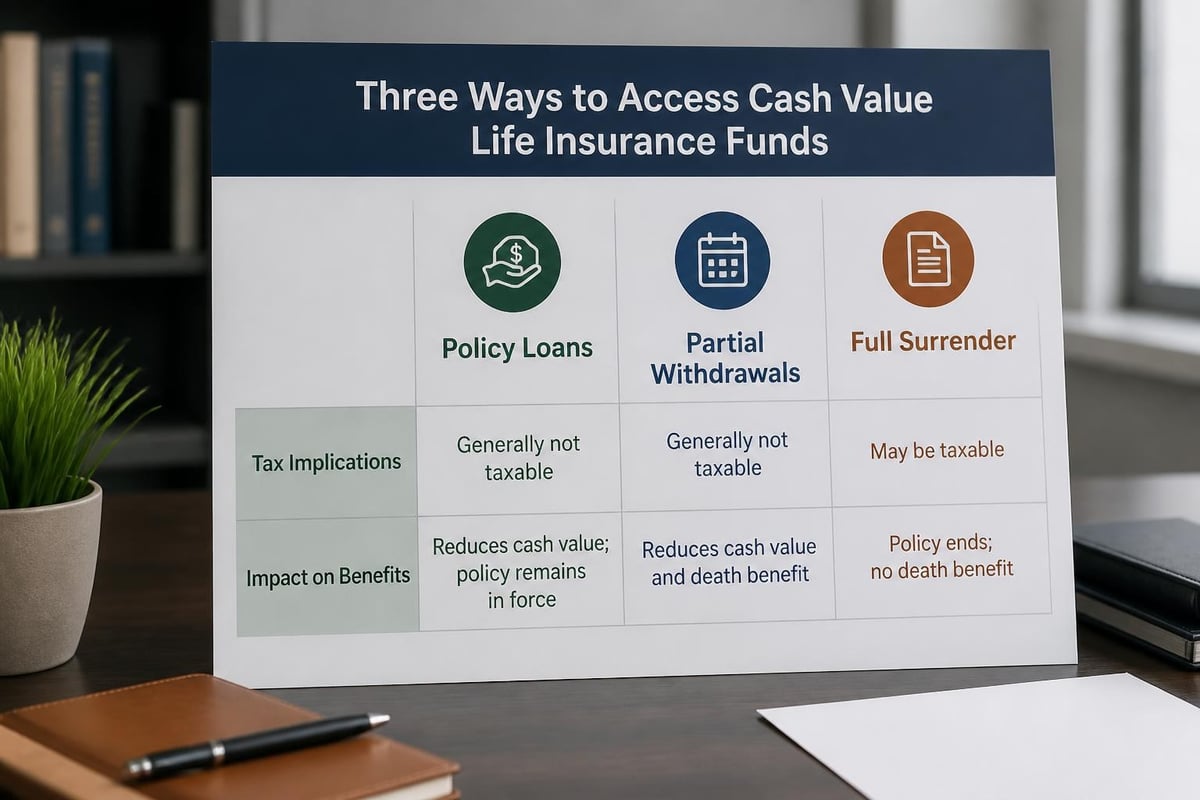
The accumulated cash value in your policy creates several options for accessing funds during your lifetime. Understanding these methods and their implications helps you make informed decisions about when and how to use this resource.
Policy Loans
Most cash value policies allow you to borrow against your accumulated value without triggering taxes or underwriting. The insurance company charges interest on the loan, but you're essentially borrowing your own money. You're not required to repay the loan, though unpaid loans with accumulated interest reduce your death benefit.
Policy loan considerations include:
- Loan interest rates (often fixed or tied to indexes)
- Impact on death benefit if unpaid
- No credit checks or approval process required
- Tax-free access to funds
- Potential for policy lapse if loans exceed cash value
The IRS Publication 575 provides comprehensive guidance on the tax treatment of policy loans, confirming that loans themselves aren't taxable events as long as the policy remains in force.
Withdrawals
You can withdraw cash value directly from most policies, though this permanently reduces both your cash value and death benefit. Withdrawals up to your basis (the total premiums you've paid) come out tax-free. Amounts exceeding your basis are taxable as ordinary income.
Withdrawals differ from loans because you're removing money from the policy rather than borrowing against it. This makes them appropriate for situations where you don't intend to replenish the funds and accept a reduced death benefit.
Surrender for Cash
Surrendering your policy means canceling it entirely and receiving the cash surrender value-your accumulated cash value minus any surrender charges the insurance company assesses. Surrender charges typically decline over time and disappear after 10 to 20 years, depending on the policy.
For Greensboro and Triad Area residents balancing Medicare costs, retirement income, and legacy planning, understanding these access methods helps integrate life insurance into broader financial strategies. Some families use cash value to supplement retirement income or cover unexpected medical expenses not addressed by Medicare coverage.
Tax Advantages of Cash Value Life Insurance
The tax treatment of cash value policies creates significant advantages compared to many other savings vehicles. These benefits make permanent life insurance an attractive component of comprehensive financial planning, particularly for individuals in higher tax brackets or those maximizing other tax-advantaged accounts.
Tax-Deferred Growth
Cash value grows tax-deferred, meaning you don't pay income tax on interest, dividends, or investment gains as they accumulate within the policy. This allows the full amount to compound over decades without the drag of annual taxation. The benefit compounds over long holding periods, making these policies particularly valuable when purchased in your 40s, 50s, or early 60s.
Tax-Free Death Benefit
Your beneficiaries receive the death benefit income-tax-free under federal law. This creates certainty in estate planning-the stated death benefit amount passes to your heirs without reduction for income taxes, regardless of how much the cash value has grown beyond your premium payments.
Tax-Free Loan Access
As outlined in IRS guidance on life insurance products, policy loans don't create taxable events as long as the policy remains in force until your death. This allows you to access accumulated value during retirement without increasing your taxable income, potentially helping you manage Medicare premium surcharges tied to income thresholds.
Modified Endowment Contract Considerations
Policies funded too heavily in early years may be classified as modified endowment contracts (MECs), which lose some tax advantages. MEC loans and withdrawals become taxable to the extent of policy gains, and withdrawals before age 59½ face a 10% penalty. Working with a knowledgeable professional helps you structure premium payments to maintain favorable tax treatment.
Evaluating Whether Cash Value Life Insurance Fits Your Needs
Cash value life insurance serves specific financial objectives effectively while being less suitable for others. Honest assessment of your situation helps determine whether permanent coverage makes sense or whether term life insurance better meets your protection needs.
Ideal Candidates for Cash Value Policies
You may benefit from cash value life insurance if you:
- Need lifelong coverage for final expenses or estate planning
- Have maximized other tax-advantaged savings options (401(k), IRA, HSA)
- Want forced savings with the discipline of premium payments
- Seek tax-diversification in retirement income sources
- Plan to leave a legacy regardless of when you pass away
- Need permanent coverage for business succession or buy-sell agreements
Families in High Point, Winston Salem, and the Triad Area often consider permanent life insurance as they transition into retirement and evaluate how to cover final expenses while preserving assets for heirs. Medicare covers many healthcare costs, but final expenses, estate taxes, and legacy goals remain separate planning considerations.
When Term Life Makes More Sense
Conversely, term life insurance offers higher coverage amounts at significantly lower premiums for temporary protection needs. NerdWallet’s comparison of cash value products highlights that most working families need substantial coverage to replace income if a breadwinner dies-coverage levels that permanent insurance makes prohibitively expensive.
Term life often works better when you:
- Need maximum coverage during working years
- Have 20-30 years of income replacement needs
- Prioritize lower premiums to free up cash for other investments
- Want simple coverage without cash value complexity
- Already have sufficient retirement savings vehicles
Many financial advisors recommend "buy term and invest the difference"-purchasing affordable term coverage and investing premium savings in diversified portfolios. This strategy works well for disciplined savers who don't need life insurance's forced-savings component.
Common Misconceptions About Cash Value Life Insurance
Several persistent myths about permanent life insurance lead to confusion when evaluating coverage options. Clearing up these misconceptions helps you make decisions based on accurate information rather than outdated or incomplete understanding.
"It's Always a Bad Investment"
Cash value life insurance isn't an investment in the traditional sense-it's insurance with a savings component. Comparing policy returns to stock market returns misses the point. The death benefit protection, tax advantages, and guaranteed elements create value that pure investments don't provide. For the right person with the right policy, cash value insurance complements rather than replaces investment accounts.
"The Cash Value Is My Money to Keep"
Your beneficiaries typically receive only the death benefit, not the death benefit plus accumulated cash value. The cash value funds the death benefit, meaning it doesn't represent additional money your heirs receive. Some policies offer "return of premium" riders or increasing death benefit options that preserve cash value for heirs, but these features increase premiums.
"I Can't Afford Permanent Coverage"
While permanent insurance costs more than term coverage, the cost calculation must account for your entire lifetime. Term premiums rise dramatically or become unavailable entirely as you age. Permanent coverage locks in premiums for life, and the cash value creates financial resources you can access. For some individuals, this makes permanent coverage more affordable than repeatedly purchasing term policies throughout life.
"All Cash Value Policies Are the Same"
The dramatic differences between whole life, universal life, variable, and indexed products mean "cash value life insurance" encompasses vastly different policies. Regulatory guidance on life insurance illustrations emphasizes the importance of understanding whether policy values are guaranteed or based on non-guaranteed projections that may not materialize.
Working With Insurance Professionals in the Triad Area
Selecting the right cash value policy requires understanding your complete financial picture-current expenses, Medicare planning, retirement income sources, estate planning goals, and family protection needs. This complexity makes professional guidance valuable, particularly when comparing illustrations from multiple carriers.
Questions to Ask Your Agent
When exploring permanent life insurance options in Greensboro, Kernersville, or surrounding areas, prepare specific questions:
- What portions of the illustration are guaranteed versus projected?
- How do premium payment schedules affect long-term cash value?
- What happens if I need to reduce or stop premiums temporarily?
- How do surrender charges decline over the policy duration?
- What riders should I consider for my specific situation?
- How does this policy integrate with my Medicare and retirement planning?
The Louisiana Department of Insurance consumer guide provides a helpful framework for evaluating policy features and asking informed questions during the shopping process.

Understanding Policy Illustrations
Life insurance illustrations project how your policy may perform over decades based on current assumptions. These projections aren't guarantees-they reflect hypothetical scenarios using today's interest rates, dividend scales, or index performance assumptions. Always request both guaranteed and current assumption columns to understand best-case and worst-case scenarios.
Pay particular attention to years 10, 20, and 30, examining:
| Year | Cash Surrender Value | Death Benefit | Total Premiums Paid | Net Position |
|---|---|---|---|---|
| 10 | Projected amount | Projected benefit | Total invested | Comparison |
| 20 | Projected amount | Projected benefit | Total invested | Comparison |
| 30 | Projected amount | Projected benefit | Total invested | Comparison |
This analysis reveals how long you must maintain the policy before cash value exceeds premiums paid and how the death benefit changes over time.
Integrating Cash Value Insurance into Comprehensive Planning
Cash value life insurance works best as one component of a broader financial strategy rather than a standalone solution. For Triad Area residents approaching or entering retirement, coordination with Medicare planning, Social Security optimization, and estate planning creates the most effective outcomes.
Coordination with Medicare Coverage
While Medicare addresses healthcare costs in retirement, life insurance serves different purposes-income replacement, final expense coverage, estate liquidity, and legacy creation. Some families use cash value to bridge coverage gaps before Medicare eligibility at 65, accessing cash value to pay for health insurance premiums or out-of-pocket costs.
The combination of Medicare Supplement coverage and permanent life insurance can provide comprehensive protection-Medicare Supplements handle healthcare costs while life insurance addresses final expenses and legacy goals. Understanding how these pieces fit together helps optimize your overall protection strategy.
Estate Planning Applications
Cash value policies create instant estate liquidity, providing funds to pay estate taxes, settle debts, or equalize inheritances among heirs. The death benefit's income-tax-free status makes it efficient for wealth transfer. Irrevocable life insurance trusts (ILITs) can further enhance estate planning benefits by removing death benefits from your taxable estate.
For business owners in High Point or Winston Salem, permanent insurance often funds buy-sell agreements, key person coverage, or executive benefit plans. The cash value serves business purposes during your lifetime while ensuring business continuity if you pass away.
Retirement Income Supplement
Some financial plans incorporate cash value as a supplemental retirement income source. After building substantial cash value over decades, you can take systematic loans against the policy to supplement other income sources. This strategy works particularly well in years when you want to avoid tapping retirement accounts that would trigger taxable income and potentially increase Medicare premiums.
Policy Maintenance and Long-Term Management
Purchasing a cash value policy represents the beginning of a long-term relationship requiring periodic attention. Unlike term insurance that simply renews annually, permanent policies need monitoring to ensure they perform as intended and continue meeting your needs.
Annual Review Components
Schedule annual reviews examining:
- In-force illustration comparing actual performance to original projections
- Premium payment status and any flexibility you might want to exercise
- Death benefit adequacy given family changes or inflation
- Cash value accessibility for planned or emergency needs
- Beneficiary designation accuracy after life changes
- Loan balance and its impact on death benefit
- Rider utilization and potential additions
Preventing Unintended Lapses
Policy lapse occurs when cash value depletes to the point where it can no longer cover insurance costs and fees. This typically happens when policyholders stop paying premiums without understanding the cash value can't sustain the policy indefinitely, or when loan interest accumulates excessively. Preventing lapse requires monitoring cash value levels and understanding how long current cash value will support the policy without additional premiums.
Updating for Life Changes
Major life events trigger policy reviews-marriage, divorce, births, deaths, retirement, business changes, or relocation. Your coverage amount, beneficiaries, and cash value access strategy may need adjustment to reflect your new circumstances. The flexibility built into universal life products proves particularly valuable during these transitions.
Making Your Decision on Cash Value Life Insurance
Deciding whether cash value life insurance belongs in your financial plan requires weighing costs, benefits, alternatives, and your specific goals. No single answer fits everyone-the right choice depends on your unique situation, risk tolerance, time horizon, and priorities.
Start by clarifying your primary objective. If you need maximum protection during working years, term life likely serves you best. If you want guaranteed lifelong coverage with predictable costs and access to accumulated cash, permanent insurance deserves serious consideration. For those seeking long-term tax-advantaged savings with death benefit protection, cash value policies offer unique advantages not available through other financial products.
Request quotes for both term and permanent coverage at amounts matching your protection needs. Compare the cost difference over 10, 20, and 30 years, considering what you'd accomplish by investing premium savings if choosing term coverage. Factor in your saving discipline-would you actually invest the difference or would life insurance premiums force better savings behavior?
Consider your health and insurability. If you have conditions that might make future coverage difficult or expensive to obtain, locking in permanent coverage now provides security. Conversely, excellent health might make term coverage remarkably affordable, allowing you to reassess as you age.
For Greensboro and Triad Area residents, local guidance matters. Working with professionals who understand both national insurance products and local financial planning considerations helps ensure recommendations align with your complete picture-from Medicare coordination to North Carolina estate planning nuances.
Cash value life insurance offers permanent protection combined with tax-advantaged savings for individuals whose goals extend beyond temporary coverage needs. Whether whole life's guarantees, universal life's flexibility, or indexed products' market participation fits your situation depends on careful analysis of your financial objectives and long-term plans. If you're exploring life insurance options for your family in Greensboro, High Point, Winston Salem, Kernersville, or anywhere in the Triad Area, Moser Insurance Group Inc provides clear, pressure-free guidance to help you understand your choices and make confident decisions. Contact us at 336-862-1763, email moserinsurancegroup@gmail.com, or visit Moser Insurance Group Inc to discuss how life insurance fits into your complete protection and planning strategy.
Recent Comments