

Turning 65 marks a significant milestone in healthcare coverage as you become eligible for Medicare. Understanding the enrollment process and timing requirements is essential to ensure continuous coverage and avoid costly penalties. Whether you're still working, already receiving Social Security benefits, or planning retirement, applying for Medicare at 65 requires careful planning and knowledge of your specific situation. The decisions you make during your Initial Enrollment Period can affect your healthcare costs for years to come.
Understanding Your Medicare Eligibility at 65
Most Americans become eligible for Medicare when they turn 65, regardless of their employment status. The program provides health insurance coverage through different parts that work together to cover hospital care, medical services, and prescription drugs.
Your eligibility begins the first day of the month you turn 65. If your birthday falls on the first day of the month, coverage starts the first day of the preceding month. This timing detail matters when coordinating with employer coverage or planning medical procedures.
Automatic Enrollment vs. Manual Application
Whether you need to actively apply depends on your current benefits status. If you're already receiving Social Security or Railroad Retirement Board benefits, you'll be automatically enrolled in Medicare Parts A and B. Your Medicare card arrives in the mail approximately three months before your 65th birthday.
Automatic enrollment applies when you:
- Receive Social Security retirement benefits
- Receive Social Security disability benefits for 24 months
- Get Railroad Retirement Board benefits
- Have been diagnosed with ALS (Lou Gehrig's disease)
For everyone else, applying for Medicare at 65 requires taking action during your Initial Enrollment Period. Many people in the Triad Area, including those in Greensboro, Kernersville, High Point, and Winston Salem, delay Social Security benefits beyond 65 to maximize retirement income, making manual Medicare enrollment necessary.
The Initial Enrollment Period Explained
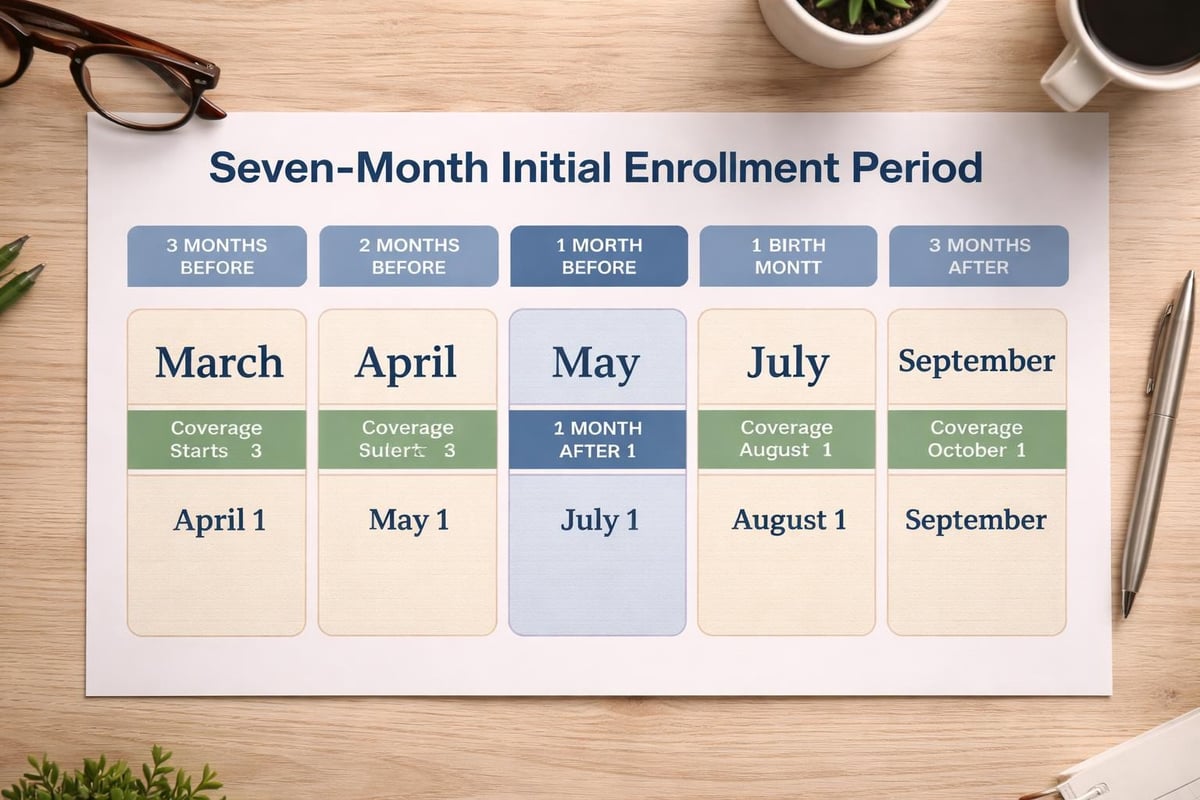
Your Initial Enrollment Period (IEP) is a seven-month window surrounding your 65th birthday. This timeframe includes the three months before your birthday month, your birthday month itself, and the three months following.
When you enroll during this period affects when your coverage begins. Signing up during the three months before your birthday month means coverage starts the month you turn 65. Enrolling during your birthday month typically results in coverage beginning the following month.
| Enrollment Month | Coverage Start Date |
|---|---|
| 3 months before birthday | Month you turn 65 |
| 2 months before birthday | Month you turn 65 |
| 1 month before birthday | Month you turn 65 |
| Birthday month | Following month |
| 1 month after birthday | Two months later |
| 2 months after birthday | Three months later |
| 3 months after birthday | Three months later |
The Initial Enrollment Period timing becomes especially important when coordinating the transition from employer coverage to Medicare. Gaps in coverage can result in unexpected medical bills and potential late enrollment penalties.
Special Considerations for Working Seniors
If you're still working at 65 with employer-sponsored health insurance, you might delay Medicare enrollment without penalties. However, this exception only applies when your employer has 20 or more employees or you're covered under a spouse's employer plan of that size.
Smaller employer plans typically require Medicare to become primary coverage at 65. Understanding these nuances prevents coverage gaps and ensures proper claim processing. For personalized guidance on your specific employment situation, contact Moser Insurance Group Inc at 336-862-1763 or moserinsurancegroup@gmail.com.
How to Apply for Medicare at Age 65
The application process offers multiple convenient options depending on your preference and situation. Each method connects you to the Social Security Administration, which processes Medicare applications.
Online Application Process
Applying online at ssa.gov provides the fastest, most convenient method for most people. The digital application takes approximately 10-15 minutes to complete and doesn't require creating an account or logging in.
Steps for online application:
- Visit the Social Security Administration website
- Select "Apply for Medicare Only"
- Complete personal information sections
- Provide work history details
- Review and submit your application
- Print confirmation for your records
The system guides you through each section with clear instructions. You can save your progress and return later if you need to gather additional information.
Phone and In-Person Options
Calling Social Security at 1-800-772-1213 connects you with representatives who can complete your application over the phone. Wait times vary, but calling early in the morning or later in the week typically reduces hold times.
In-person applications at your local Social Security office provide face-to-face assistance. Schedule an appointment online to minimize wait time. Bring your Social Security card, birth certificate, and proof of citizenship if you weren't born in the United States.

Choosing Your Medicare Coverage Options
Applying for Medicare at 65 involves more than just enrolling in Parts A and B. You'll need to decide on prescription drug coverage and whether to add supplemental insurance to cover costs that Original Medicare doesn't pay.
Medicare Part A covers hospital stays, skilled nursing facility care, hospice care, and some home health services. Most people qualify for premium-free Part A based on their work history or their spouse's employment record.
Part B covers doctor visits, outpatient care, medical equipment, and preventive services. This coverage requires a monthly premium that varies based on your income from two years prior. In 2026, the standard Part B premium is subject to annual adjustment.
Prescription Drug Coverage Decisions
Medicare Part D provides prescription drug coverage through private insurance companies. While optional, choosing to skip Part D during your Initial Enrollment Period can result in a permanent late enrollment penalty if you decide to add it later without creditable coverage.
The penalty equals 1% of the national base beneficiary premium multiplied by the number of months you went without creditable coverage. This penalty continues for as long as you have Medicare drug coverage. Research available Part D plans to find the best match for your medications.
Medicare Advantage vs. Original Medicare with Supplements
After enrolling in Parts A and B, you can choose to receive your benefits through Original Medicare or switch to a Medicare Advantage plan. Original Medicare allows you to see any provider that accepts Medicare nationwide, while Medicare Advantage plans typically use networks.
Many people in Winston Salem and surrounding areas add Medicare Supplement plans to Original Medicare. These Medigap policies help cover deductibles, copayments, and coinsurance that Medicare doesn't pay. Alternatively, Medicare Advantage plans often include prescription drug coverage and extra benefits like dental and vision.
| Coverage Type | Provider Choice | Out-of-Pocket Costs | Prescription Drugs | Extra Benefits |
|---|---|---|---|---|
| Original Medicare + Supplement | Any Medicare provider | Predictable, mostly covered | Separate Part D needed | Limited |
| Medicare Advantage | Network providers | Variable copays | Often included | Often included |
Avoiding Common Enrollment Mistakes
Many individuals approaching 65 make preventable errors during the Medicare enrollment process. Understanding these pitfalls helps ensure smooth, penalty-free coverage.
Missing your Initial Enrollment Period represents the most costly mistake. If you don't have qualifying employer coverage and fail to enroll when first eligible, you'll face a late enrollment penalty for Part B. This penalty equals 10% of the standard premium for each 12-month period you could have had Part B but didn't enroll.
Coordination with Employer Coverage
Assuming you must enroll in Medicare at 65 while working causes unnecessary confusion. The decision depends entirely on your employer size and coverage type. Health Savings Accounts (HSAs) add another layer of complexity since you cannot contribute to an HSA while enrolled in any part of Medicare.
Workers with HSAs must stop contributions six months before applying for Medicare at 65 if they want to avoid tax penalties. Medicare Part A enrollment is retroactive up to six months from your application date, potentially causing HSA contribution issues.
Key coordination questions to answer:
- Does your employer have 20 or more employees?
- Is your coverage through COBRA (requires Medicare enrollment)?
- Do you contribute to an HSA?
- Will you receive Social Security benefits before 65?
Understanding the enrollment process and timing prevents these common coordination problems. Professional guidance helps navigate complex situations involving multiple coverage sources.
What Happens After You Apply
Once you submit your Medicare application, processing typically takes several weeks. The Social Security Administration reviews your information and determines your eligibility and premium amounts based on your work history and income.
Your red, white, and blue Medicare card arrives by mail before your coverage starts. This card shows your Medicare number (different from your Social Security number for security), your name, and whether you have Part A, Part B, or both. Keep this card in a safe place and never share the number except with trusted healthcare providers and insurance professionals.
Setting Up Premium Payments
Part B premiums can be paid several ways depending on your situation. If you receive Social Security benefits, the premium is automatically deducted from your monthly payment. Otherwise, you'll receive a bill from Medicare every three months.
Setting up automatic payments from your bank account ensures you never miss a premium payment. Late payments can result in coverage termination, requiring you to wait until the General Enrollment Period to re-enroll with potential penalties.
Selecting Supplemental Coverage
After receiving your Medicare card, you have a six-month Medigap Open Enrollment Period starting the month you're both 65 and enrolled in Part B. During this window, insurance companies cannot deny coverage or charge higher premiums based on health conditions.
This guaranteed-issue period represents the best time to purchase supplemental coverage. Waiting until later might result in medical underwriting, higher premiums, or coverage denial. Residents throughout the Triad Area can explore supplemental options by visiting moserinsurancegroup.com or calling 336-862-1763.

Special Enrollment Situations
Not everyone fits the standard applying for Medicare at 65 scenario. Several situations create different rules and timelines that require understanding to maintain continuous coverage.
Delayed Enrollment with Employer Coverage
When you delay Medicare because you have qualifying employer coverage, you get a Special Enrollment Period. This eight-month window begins the month after your employment ends or your group health coverage ends, whichever comes first.
The Medicare enrollment guide explains how this Special Enrollment Period works and what documentation you need. You'll typically need Form CMS-L564 completed by your employer to prove you had creditable coverage, allowing penalty-free delayed enrollment.
COBRA and Medicare Coordination
COBRA coverage doesn't count as employer coverage for Medicare purposes. If you're on COBRA when you turn 65, you should enroll in Medicare during your Initial Enrollment Period to avoid penalties. Medicare becomes your primary insurance, and COBRA can supplement what Medicare doesn't cover.
However, once you enroll in Medicare, paying for COBRA rarely makes financial sense. Medicare combined with a supplement or Advantage plan typically provides better coverage at a lower cost.
Veterans Benefits and TRICARE
Veterans Affairs (VA) benefits provide excellent healthcare for service-connected conditions, but they don't replace Medicare. VA benefits and Medicare don't coordinate like traditional insurance, meaning VA doesn't pay Medicare deductibles or copayments.
Most veterans still enroll in Medicare Part A since it's premium-free. Part B enrollment depends on individual circumstances and whether you want access to non-VA providers. TRICARE for Life requires Medicare Parts A and B as primary insurance, with TRICARE covering most remaining costs.
State-Specific Considerations
While Medicare operates as a federal program with consistent basic rules nationwide, certain state variations affect your coverage decisions. North Carolina residents have specific options and protections that influence their Medicare planning.
State regulations govern Medicare Supplement insurance, affecting which plans insurers can sell and how they price policies. Understanding these state-specific rules helps you make informed decisions about supplemental coverage.
North Carolina Medigap Regulations
North Carolina allows insurers to use different pricing methods for Medigap policies. Some companies use community rating (everyone pays the same regardless of age), while others use attained-age rating (premiums increase as you age) or issue-age rating (premiums based on your age when you first buy).
The state guarantees your right to purchase certain Medigap plans during your six-month open enrollment window. After this period, medical underwriting typically applies unless you qualify for a guaranteed issue right due to specific circumstances.
Financial Assistance Programs
Many people don't realize that programs exist to help pay Medicare premiums, deductibles, and other costs. These assistance programs can significantly reduce healthcare expenses for those who qualify based on income and resources.
Medicare Savings Programs
Four Medicare Savings Programs help pay Medicare costs for beneficiaries with limited income and resources. These state-administered programs can cover Part A premiums, Part B premiums, and Medicare deductibles and copayments depending on which program you qualify for.
The Qualified Medicare Beneficiary (QMB) program provides the most comprehensive help, covering Part A and B premiums plus cost-sharing. Other programs cover different combinations of costs based on income thresholds that adjust annually.
Extra Help with Part D
The Extra Help program, also called the Low-Income Subsidy, assists with prescription drug costs under Medicare Part D. Qualifying beneficiaries pay reduced or zero premiums, lower deductibles, and minimal copayments for medications.
Automatic qualification occurs if you receive Medicaid or Supplemental Security Income. Others must apply through Social Security to determine eligibility based on income and asset limits.
Documents You'll Need
Gathering necessary documentation before applying for Medicare at 65 streamlines the enrollment process and prevents delays. While you won't need all documents in every situation, having them ready ensures you can complete your application efficiently.
Your Social Security number forms the foundation of your Medicare application. If you're not a U.S. citizen by birth, you'll need proof of lawful residence in the United States. A birth certificate or other proof of age documents when your coverage should begin.
Commonly required documentation:
- Social Security number or proof of application
- Birth certificate or proof of age
- Proof of U.S. citizenship or lawful residency
- W-2 forms or tax returns if you worked recently
- Military discharge papers if applying for veterans benefits
- Current health insurance information
Employment information helps determine if you qualify for premium-free Part A. If you're applying based on a spouse's work record, you'll need their Social Security number and employment details as well.
Planning Your Healthcare Transition
Successfully applying for Medicare at 65 involves more than just paperwork. Strategic planning ensures your healthcare needs remain covered during the transition from employer insurance, individual coverage, or uninsured status to Medicare.
Review your current medications and healthcare providers before making coverage decisions. Confirm whether your doctors accept Medicare assignment, which affects your out-of-pocket costs. If you take multiple prescriptions, compare Part D plans to find the most cost-effective option for your specific medications.
Creating Your Medicare Timeline
Start planning at least four months before turning 65. This timeline provides enough cushion to research options, compare plans, and complete applications without rushing. Early planning proves especially valuable when coordinating the end of employer coverage with Medicare start dates.
The step-by-step Medicare enrollment process helps you understand what to expect each month leading up to your 65th birthday. Breaking the process into manageable monthly tasks reduces stress and ensures nothing falls through the cracks.
Scheduling Preventive Care
Medicare covers numerous preventive services at no cost when provided by participating providers. Once your coverage begins, schedule your "Welcome to Medicare" preventive visit within the first 12 months. This comprehensive review of your health helps establish baselines and creates a prevention plan.
Annual wellness visits continue each year after your Welcome to Medicare visit, providing ongoing preventive care and health assessments. Taking advantage of these covered services helps maintain your health and catch potential issues early.
Getting Professional Guidance
The complexity of Medicare enrollment and plan selection often benefits from professional assistance. Licensed insurance agents who specialize in Medicare can explain options, compare plans, and help you avoid costly mistakes without charging fees for their services.
Working with a local expert provides the advantage of understanding area-specific plan availability and provider networks. Professionals stay current on annual changes to Medicare rules, premiums, and plan offerings that affect your coverage decisions.
Quality guidance focuses on education rather than pressure. You should feel informed and confident about your choices, understanding both the benefits and limitations of different coverage options. For those in High Point, Greensboro, Kernersville, Winston Salem, and throughout the Triad Area, local expertise ensures recommendations match regional healthcare resources and plan availability.
Independent agents represent multiple insurance carriers, allowing them to compare options across different companies. This unbiased approach helps you find the best fit for your healthcare needs and budget rather than being limited to a single company's offerings.
Applying for Medicare at 65 requires understanding enrollment periods, choosing appropriate coverage, and coordinating with existing insurance to avoid penalties and gaps. Taking action during your Initial Enrollment Period and making informed decisions about Parts A, B, D, and supplemental coverage protects both your health and finances. Moser Insurance Group Inc provides clear, personalized guidance to help you navigate Medicare decisions with confidence. Contact us at 336-862-1763, email moserinsurancegroup@gmail.com, or visit Moser Insurance Group Inc to get the support you need for a smooth transition to Medicare.
Recent Comments