

Key man life insurance is a policy a business buys on the life of an owner, executive or other critical employee, with the company named as owner and beneficiary, so it receives a cash payment if that person dies. The money helps the business cover lost revenue, recruit a replacement, repay debt and keep operating while it recovers. For owners in Greensboro, Winston-Salem, High Point and Kernersville, it is one of the most direct ways to protect a company that depends heavily on one or two people.
The sections below explain who qualifies as a key person, how coverage amounts are set, what premiums look like, how the tax rules work, and how to put a policy in place.
What Key Man Life Insurance Covers
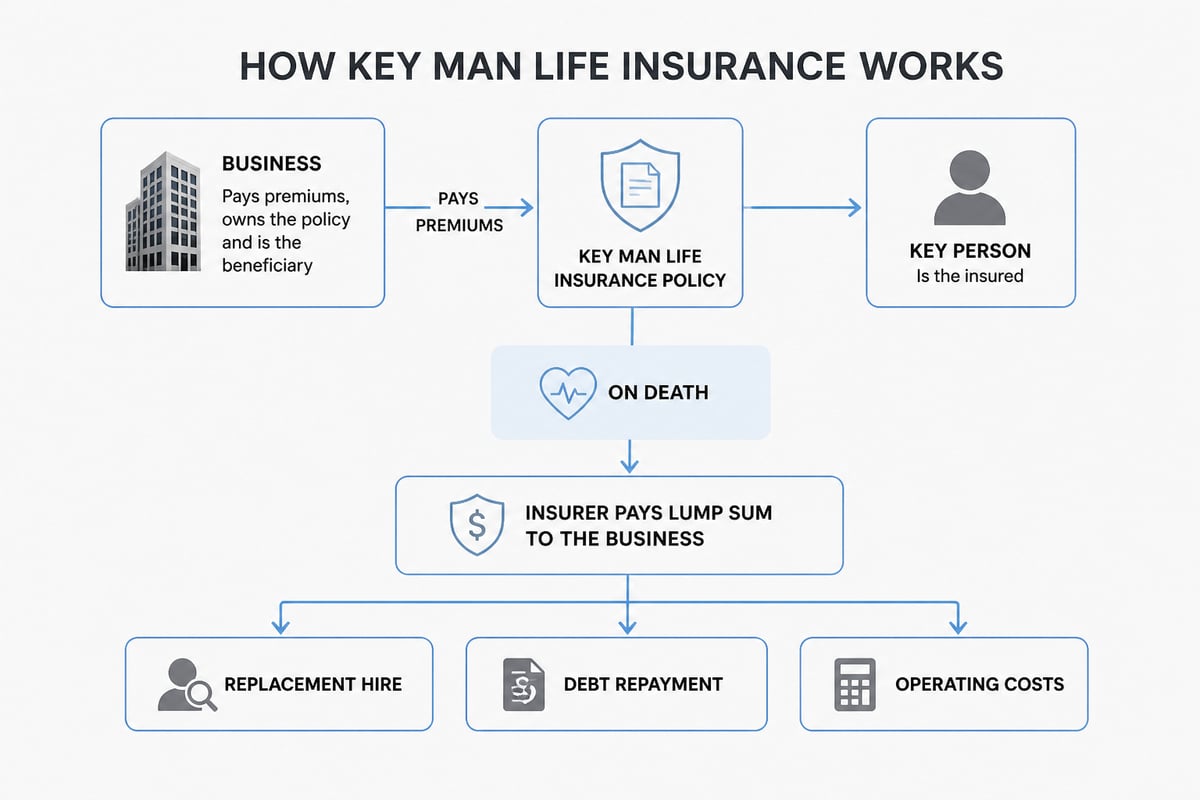
A key man policy pays the company, not the family, when the insured person dies. The business pays the premiums, owns the policy and receives the death benefit. Many carriers and advisors now call it key person insurance, since the person insured may be any gender and any role.
The benefit is typically paid as a lump sum. The business can spend it on whatever the loss demands:
- Replacing lost sales or contracts the person was responsible for
- Covering salaries and overhead during a transition period
- Recruiting, hiring and training a successor
- Repaying a loan or line of credit that was personally guaranteed
- Reassuring lenders, vendors and customers that the company is stable
Personal life insurance protects a household from the loss of income. A key man policy protects the company from the loss of a person whose skills, relationships or reputation produce a large share of its revenue. The two serve different beneficiaries and should not be treated as substitutes for each other. For a deeper look at the business case, Moser Insurance Group has published an overview of why your business needs key man life insurance.
Who Counts as a Key Person
A key person is anyone whose loss would cause a measurable financial setback to the company within the first year or two. Titles matter less than impact. Underwriters will ask you to show that the person genuinely drives revenue, holds irreplaceable knowledge, or is tied to the company's borrowing.
Common examples include:
- Founders and majority owners whose names and relationships anchor the brand
- Top salespeople who personally hold the largest accounts
- Technical or professional specialists, such as a lead engineer, physician or licensed contractor
- Executives whose departure would trigger loan covenants or investor concerns
- Co-owners in a closely held firm, where a death could leave the survivor facing the heirs of the deceased
A manufacturing firm in High Point, a professional practice in Winston-Salem or a family-owned service company in the Triad often fits this profile, because a handful of people carry most of the institutional knowledge. If you can name someone whose absence would hurt payroll, lending or customer retention within months, that person is a candidate.
How Much Coverage a Business Needs
Coverage should reflect the financial damage the loss would cause, not a round number. Insurers will want a rationale, and a well-supported figure is easier to approve and easier to defend in a tax review.
Three approaches are common in practice:
- Multiple of compensation. A common starting point is a multiple of the person's annual salary and bonus, adjusted for how much of the company's success depends on them.
- Contribution to profit. Estimate the profit the person generates directly, then multiply by the number of years it would take to find and train a replacement.
- Debt and obligations. Add any loans, leases or lines of credit that are personally guaranteed or that lenders would call in after a death.
A practical worksheet adds three numbers together: lost profit during recovery, replacement and training costs, and debt that comes due. The total becomes your target coverage amount. Reviewing this figure every year or two keeps it aligned with growth, since a policy that fit a five-person company may fall short for a twenty-person one.
How Much Key Man Insurance Costs
Premiums depend on the insured person's age, health, tobacco use, the amount of coverage and the type of policy, so there is no single price. A healthy younger applicant will generally pay far less per thousand dollars of coverage than an older applicant with health conditions, and a larger policy costs more than a smaller one.
Several factors move the price:
- Age and health of the insured. These are the biggest drivers, followed closely by tobacco use.
- Coverage amount. Larger benefits cost more, though the rate per thousand often drops at higher amounts.
- Policy length. A 10-year term costs less than a 20-year term, and both cost far less than permanent coverage.
- Medical exam. Fully underwritten policies usually offer the lowest rates for healthy applicants.
Because rates differ between carriers for the same person, comparing several is the most reliable way to avoid overpaying. Moser Insurance Group works with multiple carriers, so a Triad business owner can see options side by side in one conversation instead of repeating the process with each company.
Term or Permanent Coverage for a Key Person Policy
Term insurance is the usual choice because the business's dependence on a person is temporary, while permanent insurance suits owners who want a longer-lasting asset. Each has a clear role.
| Feature | Term life | Permanent life |
|---|---|---|
| Coverage length | Fixed period, such as 10, 15 or 20 years | Lifetime, as long as premiums are paid |
| Premium | Lowest at the start | Higher, but level |
| Cash value | None | Builds over time and may be borrowed against |
| Best match | A defined period of dependence, such as a loan term | Succession planning or a long-held owner relationship |
Term fits a company that expects to outgrow its reliance on one person within a known window, such as the life of a loan or the years before a successor is ready. Permanent coverage, including whole life or indexed universal life, can double as a balance-sheet asset because the cash value may be accessed later. Moser Insurance Group explains the tradeoffs in its term vs. permanent life insurance overview, which is a useful starting point before you request quotes.
Is Key Man Life Insurance Tax Deductible?
Premiums are generally not tax deductible, because the business is the beneficiary of the policy. Under IRC §264(a)(1), a company generally cannot deduct life insurance premiums when it is directly or indirectly the beneficiary, as KeyPersonInsurance.com summarizes the rule.
The tradeoff is on the other end. Death benefits are typically received income-tax free, which is the general treatment of life insurance proceeds described in IRS Publication 525. That favorable treatment depends on following the employer-owned life insurance rules, which apply to contracts issued after August 17, 2006, according to KeyPersonInsurance.com.
Those rules carry specific requirements:
- Notice and consent. The insured employee must generally be told in writing about the coverage and consent to it before the policy is issued.
- Qualifying exceptions. The tax-free treatment is protected when the insured was a director, a highly compensated employee, or an employee within the prior 12 months. For the highly compensated exception, Hotaling Insurance cites a 2024 compensation threshold of more than $150,000, and the threshold is indexed for inflation.
- Annual reporting. Employers must file Form 8925 each year to report employer-owned life insurance contracts, as Hotaling Insurance notes.
Policy loans on a permanent policy add another wrinkle. Interest on policy debt is generally disallowed, though IRC §264(e) may allow an exception for a limited amount of policy-related debt per key person, subject to a rate cap, according to Octans Insurance. Tax treatment varies by situation, so review the details with your CPA before you buy.
Who Should Be the Beneficiary
The business should be the owner and beneficiary of a key man policy, because the purpose is to replace the company's loss. If a family member is named instead, the payout does not reach the company when it needs the cash, and the arrangement stops functioning as business protection.
A few practical points apply:
- Name the company exactly as it appears on its formation documents, including entity type.
- Add a contingent beneficiary, such as a successor entity, in case the company no longer exists when the claim is filed.
- Keep personal coverage separate. The key person should still hold their own policy for their family, with their spouse or children as beneficiaries.
If you are a co-owner who also wants a buy-sell arrangement, that is a different structure, usually funded by separate policies. Keeping the two purposes distinct avoids confusion at claim time and keeps the tax treatment clean.
Funding a Buy-Sell Agreement With the Same Policy
A key man policy and a buy-sell agreement address different problems, but they work well together. Key man coverage keeps the company running after a death. A buy-sell agreement determines what happens to the deceased owner's shares and who has the right and the cash to purchase them.
Without a funded plan, a surviving owner in a Triad family business can end up co-owning the company with a deceased partner's heirs, who may have no interest in or experience with the industry. Life insurance on each owner provides the liquidity to complete the buyout at a price set in advance. Many closely held companies review both arrangements together, so the amounts, ownership of each policy and beneficiary designations are consistent. An attorney should draft the agreement, and an insurance advisor can match the funding to it.
How to Put a Policy in Place
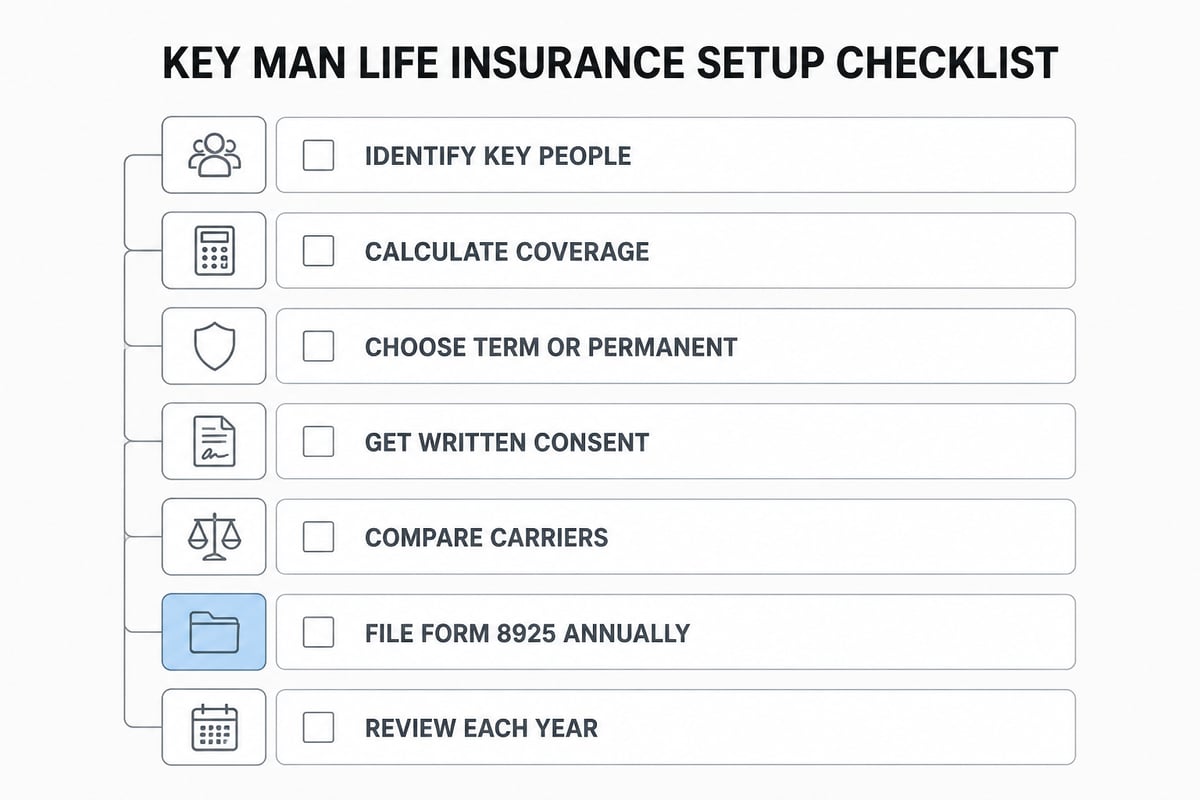
Setting up a key man policy takes a handful of steps, and most can be completed in a few weeks depending on underwriting.
- Identify the key people and rank them by how much revenue or debt depends on each.
- Calculate the coverage amount using lost profit, replacement costs and obligations.
- Choose a policy type based on how long the dependence is expected to last.
- Obtain written consent from the insured person before the policy is issued.
- Compare carriers and complete the application and any medical exam.
- File the required reporting each year and keep consent documents on record.
- Review annually, especially after a major hire, a loan or a change in ownership.
Business owners often benefit from a neutral guide through this sequence. Moser Insurance Group tells you which option fits, at no cost to you, while staying neutral and explaining the reasoning so you can make an informed decision. It also checks in during the year to review your coverage as circumstances change. For businesses and families across the Triad, including Greensboro, Kernersville, High Point and Winston-Salem, Life Insurance is the product that powers a key man arrangement, and a conversation is the quickest way to match it to your company.
Common Mistakes to Avoid
Most problems with key man coverage come from skipped paperwork or outdated amounts, not from the insurance itself. A short checklist catches nearly all of them:
- Skipping the written consent. Without it, the death benefit may lose its tax-free treatment.
- Forgetting Form 8925. The annual filing is easy to miss and should be tracked every year.
- Underinsuring. A figure chosen years ago may no longer match revenue or debt.
- Insuring the wrong person. Cover those whose absence would hurt, not just those with senior titles.
- Naming the wrong beneficiary. A policy payable to a family member does not protect the company.
- Never reviewing. Growth, new loans and staff changes all shift the right coverage amount.
A policy that is reviewed once a year and documented properly will almost always perform as intended.

FAQ
How much is key man insurance?
The cost depends on the insured person's age, health, tobacco use, the coverage amount and whether the policy is term or permanent. A younger, healthy person on a term policy will pay a small fraction of what an older person on permanent coverage pays. The most reliable way to get a real number is to request quotes from several carriers for the specific person and amount.
Can you write off key man life insurance?
In most cases no. When the business is the direct or indirect beneficiary, premiums are generally not deductible under IRC §264(a)(1). The offsetting benefit is that the death benefit is usually received income-tax free when the employer-owned life insurance requirements are met.
Who should you put as a beneficiary on a key man policy?
The business itself should be both the owner and the beneficiary, since the policy exists to cover the company's loss. Personal coverage for the key person's family should be a separate policy naming the spouse or children.
Start by listing the two or three people your business could not replace within a year, then estimate the revenue and debt tied to each. Moser Insurance Group serves business owners across the Triad, including Greensboro, Kernersville, High Point and Winston-Salem, and can walk you through Life Insurance options and tax questions with neutral guidance. You can reach the team by email at moserinsurancegroup@gmail.com or at moserinsurancegroup.com, and Call/Text Now (336) 862-1763 to talk through a plan for your company.
Recent Comments