

Term plans are life insurance policies that pay a tax-free death benefit to your beneficiaries if you die within a set number of years, and they are usually the most affordable way to protect a family's income. You choose a coverage amount and a term length, pay a fixed premium, and the policy ends when the term does. For families and business owners across the Triad, including Greensboro, Kernersville, High Point, and Winston-Salem, the right plan comes down to matching the term to the years your family would be most financially exposed.
This guide explains how term coverage works, the types available, how to size a policy, and what to check before you buy.
How Term Plans Work
A term plan is a contract with three moving parts: the face amount, the term length, and the premium. If the insured person dies during the term, the insurer pays the face amount to the named beneficiaries. If the term ends first, coverage stops and no benefit is paid.
The National Association of Insurance Commissioners notes that term policies commonly cover set periods such as 1, 5, 10, or 20 years, or run until a specified age. The South Carolina Department of Insurance adds that term insurance generally carries lower premiums in the early years than permanent insurance, but it does not build cash value.
That trade-off defines the product. You are paying only for protection, so the cost per dollar of coverage is low. There is no savings component, no loan feature, and nothing to cash out.
Consumer guidance from the NAIC's life insurance resource is also useful for reviewing how beneficiaries receive benefits and what to confirm about renewal and premiums before you sign.
Types of Term Plans
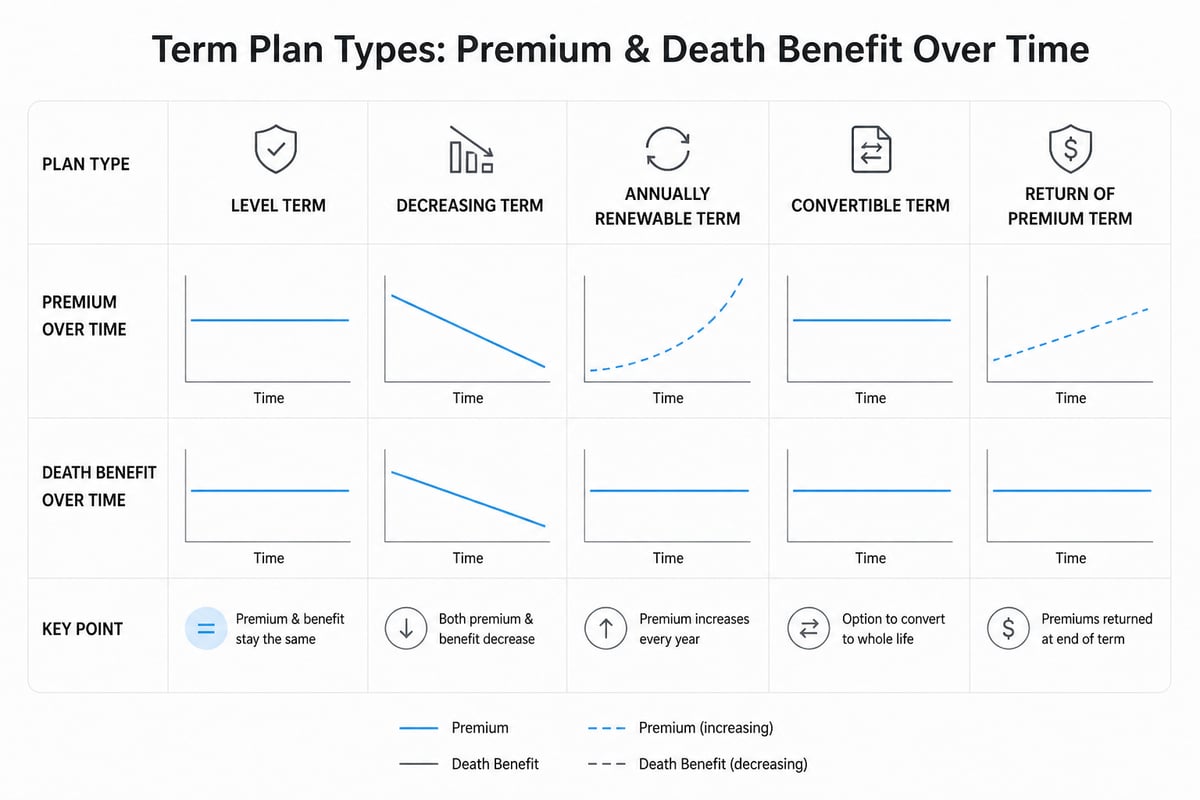
The main types differ in how the premium and the death benefit behave over time. Knowing the differences prevents you from buying a structure that does not fit your plans.
- Level term: The premium and the death benefit stay the same for the whole term. This is the most common choice because it is predictable.
- Decreasing term: The death benefit shrinks over time, often to mirror a declining mortgage balance. Premiums typically stay level.
- Annually renewable term: Coverage renews each year without a new medical exam, but the premium rises as you age.
- Convertible term: The policy can be exchanged for permanent coverage without new medical underwriting, usually within a stated window.
- Return of premium term: You pay a higher premium, and if you outlive the term, the insurer refunds the premiums paid. A closer look at term insurance plans with return of premium shows when the higher cost is worth it.
Convertibility deserves particular attention. If your health changes during the term, a conversion option lets you keep coverage you might not otherwise qualify for. The convertible term life insurance FAQ covers how conversion windows and deadlines typically work.
Term Plans vs. Whole and Universal Life
Term coverage is temporary and low cost, while whole and universal life are permanent and carry a cash value component at a much higher premium. The right choice depends on whether your need has an end date.
| Feature | Term | Whole Life | Universal Life |
|---|---|---|---|
| Coverage period | Fixed years | Lifetime | Lifetime (if funded) |
| Premium | Lowest | Highest, fixed | Flexible, mid to high |
| Cash value | None | Yes | Yes |
| Best fit | Temporary needs like income replacement | Lifelong needs | Flexible long-term planning |
Most households with a mortgage and children have a need that peaks and then fades. Term coverage fits that pattern well. Permanent coverage tends to make sense when the need never ends, such as leaving an inheritance or covering final expenses at any age.
For a deeper side-by-side, the overview of term vs. permanent life insurance and the comparison of term life insurance vs. universal life walk through the cost and flexibility differences in detail.
How Much Coverage Do You Need?
The amount of coverage you need is the total financial gap your family would face without your income, which you can estimate by adding up obligations and subtracting existing resources. Many people stop at a rule of thumb. A short worksheet gives a more reliable figure.
- Income replacement: Multiply your annual income by the number of years your family would need support, such as until your youngest child finishes school.
- Debts: Add the mortgage balance, car loans, credit cards, and any business debt you personally guaranteed.
- Future costs: Add anticipated expenses such as college tuition or care for a dependent family member.
- Final expenses: Include funeral and estate settlement costs.
- Subtract assets: Deduct savings, existing life insurance, and any employer-provided group coverage.
The result is a defensible target. Round up modestly, because premiums for a larger face amount are often only slightly higher per dollar of coverage.
Business owners have a few extra items to weigh, including a buyout funded by a policy on a partner and key-person protection. Retirees should also ask whether a lump sum is still needed at all, since children are grown and mortgages may be paid off.
Choosing the Right Term Length
Pick the term length that outlasts your longest major obligation, not the one with the lowest premium. A 30-year term for a 35-year-old with a new mortgage can cover the loan and the child-raising years in a single policy.
Use this as a quick guide:
- 10 years: Covers a shorter window, such as the last years of a mortgage or a bridge until retirement savings are on track.
- 20 years: Fits families with young children and a mortgage of similar length. The article on 20-year term life insurance explains this choice in more detail.
- 30 years: Suits younger buyers who want coverage locked in at a low rate through their prime earning years.
A common mistake is buying a term that ends just before the need does. If your mortgage runs 28 more years, a 20-year policy leaves eight years uncovered, and buying new coverage later means higher rates and fresh medical underwriting.
What Term Plans Cost
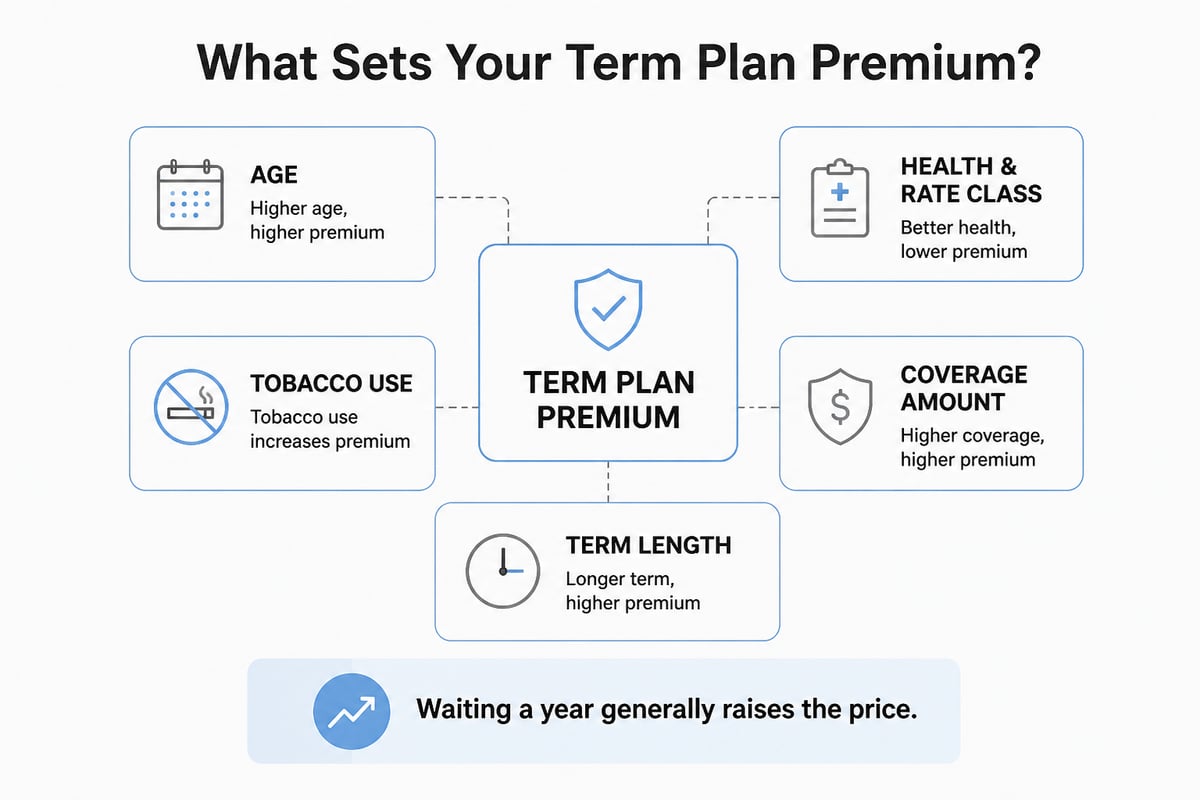
Premiums depend mainly on your age, health, tobacco use, the face amount, and the term length. Younger and healthier applicants pay the least, and each year of waiting generally raises the price.
Insurers sort applicants into rate classes, from preferred to standard and below, based on medical history, build, family history, and lifestyle. Moving up one class can lower the premium noticeably, so it helps to know where you stand before you apply. A short rate class health quiz gives a rough sense of which class you may land in.
The market itself is healthy and growing. LIMRA reported that in 2025, U.S. term life new premium rose year over year, and the number of policies sold grew as well. Term life remained a major part of total U.S. individual life insurance sales that year. Steady demand reflects how many households rely on term coverage as their core protection.
Riders and Add-Ons Worth Considering
Riders are optional features that adjust a policy to your situation, usually for an additional premium. A few are worth evaluating for families and business owners.
- Child term rider: Provides a small amount of coverage on your children under one policy. The explainer on the child term rider details what it pays and when it ends.
- Waiver of premium: Keeps the policy in force if you become disabled and cannot pay.
- Accelerated death benefit: Allows access to part of the death benefit if you are diagnosed with a terminal illness.
- Conversion privilege: Often built in, and valuable if your health changes.
Add only what solves a specific problem. Each rider adds cost, and a plain level term policy with a conversion option meets the needs of many households.
What Happens When the Term Ends
When a term plan expires, the coverage ends, and you generally have three options: let it lapse, convert it to permanent coverage if the policy allows, or buy a new policy at your current age and health.
Some policies offer renewal at the end of the term, but premiums typically jump sharply because they are based on your attained age. This is why it is better to plan the term length up front. If you reach the end of a policy and still have dependents or debts, convert while the option is open or apply for new coverage while you are still in good health.
For retirees, the question often reverses. Once the mortgage is paid and children are independent, letting a term plan expire can be a reasonable decision, with the premium savings redirected to retirement income or health coverage needs.
How to Compare and Buy a Term Plan
The best way to buy a term plan is to define your need first, then compare offers from several insurers on the same face amount and term length so the quotes are directly comparable. Shopping a single carrier shows you only one price.
Follow these steps:
- Calculate your coverage amount using the worksheet above.
- Choose a term length that outlasts your longest obligation.
- Gather health details, including medications, recent diagnoses, and family history.
- Request quotes at the same face amount and term from multiple carriers.
- Compare rate class, convertibility, riders, and the insurer's financial strength.
- Read the application carefully. Inaccurate answers can lead to a denied claim.
Avoid the quoting errors that lead to surprises later, such as understating tobacco use or guessing at medical history.
Moser Insurance Group Inc works with multiple insurance carriers, so you can compare options in one place instead of applying with each company separately. The team stays neutral and educates you so you can make an informed decision, with no pressure. If you want to see a number, you can request a term life insurance quote directly on the site.
Term Coverage in North Carolina
Term coverage in North Carolina follows the same principles as anywhere else, but local households often weigh it alongside health and retirement decisions. Many families in the Greensboro, High Point, Kernersville, and Winston-Salem area balance a mortgage, children, and a plan to retire in their 60s.
Pre-65 buyers sometimes overlook how life coverage and health coverage interact. Employer-provided group life insurance typically ends when you leave the job, so an individual term plan stays with you regardless of employment. Retirees approaching Medicare eligibility can also review North Carolina health insurance options for the years before 65.
Moser Insurance Group Inc offers term life insurance with a range of coverage amounts and term lengths. A fixed premium and a tax-free payout to beneficiaries make it a straightforward way to protect a family during the years it matters most.
Common Questions About Term Plans
Do I get my money back if I outlive the term?
With a standard term plan, no. The premium pays for protection only. A return of premium policy refunds what you paid, but at a higher price, so weigh the extra cost against what you could earn by investing the difference.
Can I cancel a term plan?
Yes. You can stop paying premiums at any time, and the policy will lapse. There is no cash surrender value, so you receive nothing back on a standard term plan.
Is a medical exam always required?
Not always. Some policies use accelerated underwriting based on application answers and database checks, while larger face amounts or older applicants often still require an exam. Underwriting choices affect speed and price.
Does the death benefit get taxed?
In general, life insurance death benefits paid to a named beneficiary are not subject to federal income tax. Estate and other tax situations can vary, so it is sensible to confirm details with a tax professional for larger estates.
How does term life fit with Medicare planning?
They solve different problems. Medicare covers medical costs after 65, while term coverage replaces income and pays debts if you die. Households approaching 65 often review both at the same time, and the Medicare Advantage plans in Greensboro page is a good starting point for the health side.

Start by writing down your mortgage balance, your annual income, and the number of years your family would need support, since those three numbers shape every other decision. From there, Moser Insurance Group Inc can compare carriers for you, explain how term life insurance fits your budget, and answer questions at moserinsurancegroup@gmail.com or moserinsurancegroup.com. Clients across the Triad, including Greensboro, Kernersville, High Point, and Winston-Salem, can Call/Text Now (336) 862-1763 to talk through coverage options with a licensed agent who will tell you plainly what fits.
Recent Comments